Ring Side Report-Board Game Review of Rome-City of Marble

Originally posted at www.throatpunchgames.com, a new idea everyday!

Product-Rome

Producer– R & R games

Price– $31 here https://www.amazon.com/Rome-City-Marble-Board-Game/dp/B015QGG7PO

Set-up/Play/Clean-up– 30-60 minutes (2-4 players)

Type- Euro

Depth-Light

TL; DR-An excellent intro eurogame with no randomness. 94%
pic2586529_md.jpg

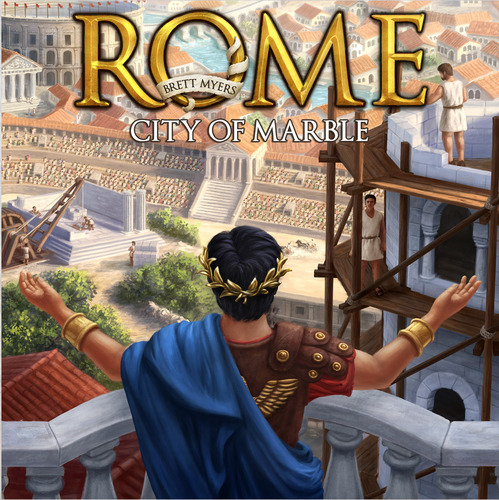
Basics-   Rome WAS built in a day!  In Rome-City of Marble, each player takes the role of different Patrician family in Rome.  Through public works you demonstrate your power and influence in the city.  Who ever ends the game with the most victory points is the most power family.

This game is pretty simple.  Each turn a player can the following actions twice: draw tiles, play tiles, recall a magistrate, and expand an aqueduct.  When you select your action, you place a marker on your board over that action, and you can take the same action twice.  

Drawing and playing tiles is the lifeblood of the game.  The most simple action is drawing tiles.  When you draw a tile, you draw two of the four types of tiles: temple (green), baths (blue), theaters (yellow), and arenas (red).  You can not draw the same tile type twice in one action.  But, if you use your second action to get tiles, you can draw more of the types you drew the first time.  You can not use the tiles you gain this turn on this turn.  

IMG_20170408_143134563

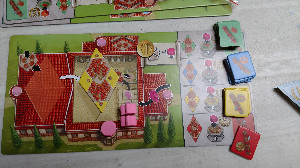
Playing tiles is where the game gets interesting.  The game board is divided into a number of triangles.  Player must set tiles next to other tiles or one of the three random starting locations in these triangles, and they may play one of their three magistrates down when they play a tile. The goal of setting down the tiles is to complete a hexagon between the tiles.  Each tile has two triangle colored sides and two colored rhombus sides.  When the colored sides form a hexagon, game pauses as the players see if they formed the correct color and who has the most influence.  Temples can only be made from three tiles,so only the colored rhombuses can form the hexagon.  Arenas can only be formed from six tiles, so they can only be formed from the colored triangles.  Baths require four tiles, and theaters require five tiles.  If you build a temple with six temples, then you don’t score for that building.  If the correct types of buildings are in the hexagon, then the players may score for that site.  Here is where magistrates come into play.  Magistrates are placed on a tile when you place the tile.  If the proper number of tiles is in the section, then the players count who has magistrates on the right type of tiles.  If someone builds an arena, but doesn’t have any magistrates on red tiles, then they have no influence.  Whoever has the most influence on the right types of tiles for the construction then builds that type of building by placing a marker on the tile to claim it as his or her own, the also earn victory points depending on the structure with arenas worth the most, and temples worth the least.  If there is a tie or no one has influence from magistrates, then a fountain is built and no one gets points.  Once the construction is done, every player who helped build the construction, with the right influence or not, may remove a magistrate and put it on the imperium space of the building just constructed.  If you built a fountain, you can still recall your magistrate, but he goes to the treasury instead.   At the end of your turn, you recall all magistrates from the imperium or treasury space and take one imperium or coin from the space they came from.  Imperium can be spend during your turn to take an extra action on your turn, or saved till the end of the game.  The player with the most of imperium of each type earns extra victory points.  Each coin is worth one point at the end of the game.

The next two actions are not as complex as building, but are equally as important.  If a player builds a tile next to a aquaduct, then they get to place three aqueduct pieces without spending an action.  As an action you can extend the aqueduct as well.  When you extend an aqueduct to a fountain, you score a point.  At the end of the game, each building that has an aqueduct to it scores two points.  Recalling a magistrate is simply moving a magistrate from the board to your player board that can be used this turn.  This way you can recall magistrates from tiles you know will never score.

After three of the four stacks of tiles are empty in a round, the next round each player gets only one action where they can’t use imperium to take more actions.  Then players score for coins and aqueducts.  The player with the most points is the most influential family in Rome!

Mechanics-I love the way this game plays!  After five minutes of explaining, you will master the game and can deep dive into the strategy.  It a euro, but not one that will destroy you mentally or takes five hours.  Honestly, a hour might be the longest you will play this game.  It’s deep for its simplicity, and it doesn’t overstay its welcome.  My one weird complaint is there isn’t resource management, but adding a subgame where you have to earn tiles might make this one a bit too complicated.  4.75/5

Theme-This game feels like I’m building in ancient time.  Each player gets to build Rome, and I do feel like I’m trying to out maneuver other players as the best moves reveal themselves through play.  If you see a small opening where you can drop two tiles  and earn an arena while your opponents never saw this coming, it feels awesome.  Other games have ruined me though as I wonder why I can’t hurt my opponents than peacefully coexist and build with them.  4.75/5

Instructions-The instructions are deceptively long, but that’s because they are four different versions of the rules in one book.  The book is short when you read the language you need.  And it does well by showing lots of pictures.  As you can see above, it’s hard to describe polygons and shapes with words!  I like how this book is written and how it teaches the players.  5/5
IMG_20170408_143145633 (1)

Execution– I love what’s here, but I do have one semi-small complaint.  The parts all look nice and pretty.  It’s chunky cardboard so I get nice tiles to play with and feel.  What I hate is the player board that don’t have spaces for all your stuff.  I hate having to set stuff to the side like with your tokens.  That’s my own small level of crazy, but if you can put my neuroses aside, it’s a fantastically made game.   You can see all the pieces in our unboxing at https://youtu.be/eCUn3hVJzg0 4.5/5

Summary-Rome-City of Marble is an amazing intro game.  It teaches itself well.  It’s parts are nice,and the rules are slick.  If you want five hours of math on Saturday night, then this is not the game for you.  It’s a great game, but not that game.  If you want a tight hour of fun or want go get new players into the hobby, then this is the game for you. 94%


Ring Side Report-Freeway Fighter #1

Book-Freeway Fighter #1

Author and Illustrators– Ewington, Coleby, O’Grady, Campbell

Book- ~$3.99 here https://www.amazon.com/Freeway-Fighter-1-Andi-Ewington-ebook/dp/B06WWGCJGV

TL; DR-I wanna play the old games now!  91%

FREEWAY-FIGHTER-ISSUE-1_COVER_A (1)

Basics-The world has ended and those left fight to survive.  That’s a standard intro to everybody’s favorite post-apocalyptic freeway franchise, but this one is based on the Fighting Fantasy game called Freeway Fighter!  In this comic we meet Rose, a former not-NASCAR driver who survived a massive plague and now fights in a world where only the fast survive.

Characters-You can’t really say characters for this one as you really only get to meet Rose, the main character of this series so far.  She’s described more in actions than in words as she speaks in a few monologues to the audience but mostly is alone in the issue.  She spends lots of time behind the wheel, and does a bit of outside the car actions.  I’m intrigued by her, and do want to know more about her.  So good job here.  4.5/5

Setting-I’d say this is a ripoff of Mad Max, but both Mad Max and Fighting Fantasy date back a long time.  This is a good reimagining of the Freeway Fighter books from FF.  The world looks and feels dirty and harsh.  What’s here shows a good contrast between the world of today and the world of Freeway Fighter.  5/5

Story-This isn’t a story heavy book, but that doesn’t make it bad.  When I first read the book, I felt the writers tipped their hands too quickly by telling the reader how the world went to hell, but then I realized, this is not that kind of book.  This is straight up action.  And it’s good at that.  The book’s main goal is get the word out about the world and introduce Rose.  It does that well.  I know a bit about who she is, and what is going on.  The book sets the stage for a race that happened long ago, and now I want to know what happens in that race and what’s going to happen to Rose.  Well done!  4.75/5

Execution-Oh comics…I love comic books.  This one is well written, and the art is great.  What does hurt this a bit is the price.  It’s $3.99, and the book isn’t an extended issue.  I love what’s here, but it feels a bit too much for it’s current price.  4/5

Summary-I grew up in a pretty rural area in Wisconsin, so geek culture didn’t really make its way out to my home town.  This books makes me want to find and play the old Fighting Fantasy Freeway Fighter books.  The comic looks awesome, is well written, and makes me want to know what happens to Rose in issue 2.  All those are great things, but the major problem I have is price.  $3.99 is a bit much for this book.  That hurts a bit.  But, get this one through your pull program, so you get a bit of a price break and it’s well worth you time.  91%.

Daily Punch 5-10-17 Shattering Revelations spells for Call of Cthulhu 7th ed.

How about some quick ways to gain power.  Nothing bad ever happened from that!  Here’s another spell for Call of Cthulhu, 7th ed.


Shattering Revelation

Cost: 10 magic points; 2D10 Sanity points
Casting time: 1 hour
This spell opens the gate in your mind wide to the cosmos.  You begin to see all in front of you.  That which you ask for, and that which man was not to know.  For every 2 whole points of sanity lost in this spell, you increase your Cthulhu Mythos skill by 1.  May the gods have mercy on your soul.

Alternative names:  The Dark Tutor, Peering Through the Keyhole, The Madman’s Path

Daily Punch 5-9-17 Ululation to the High Priest spell for Call of Cthulhu 7ed

Finally got to play some more Cthulhu, so let’s build on what went down!

Ululation to The High Priest

Cost: 10 magic points; 1D6 Sanity points.
Casting time: 30 minutes
As you finish screaming the words of this spell, you open a small gate to the high priest of the dark gods himself where he offers you the gift  of his own knowledge. Spending 10 magic points give you a bonus die on one Cthulhu mythos roll.
Alternative names: Dark Blessing of Cthulhu,  The Expensive Tutor, The Harsh Mastery

Daily Punch 4-11-17 Spell Simpleton negative quality for Shadowrun 5e

We have a spell savants, let’s have the opposite..


Spell Simpleton

Bonus: 5 karma

REQUIREMENT: You must be mage or aspected mage

Not everybody get’s to be a doctor.  And other people can’t figure out the self-check out lane.  You’re kind of in the latter with magic.  When you want to learn a new spell, you must spend 8 karma to do so.


Thoughts?

Ring Side Report- RPG Review of Homeward Bound- Simple rules for player-owned base

Originally posted at www.throatpunchgames.com, a new idea everyday!

Product–  Homeward Bound- Simple rules for player-owned base

System-Dungeons and Dragons 5e

ProducerJan Sielicki

Price– $3 here http://www.dmsguild.com/product/201016/Homeward-Bound–simple-rules-for-playerowned-base?affiliate_id=239993

TL; DR-Finally a use for money! 94%

Basics– You’ve killed the dragon, gotten it’s hoard, and now you just want to go back to the inn to drink?  Savages!  Time to get and build up your own house!  Homeward Bound is a supplement focusing on maintaining a home in the adventure.  Instead of just drinking in a bar, you can own land, quest to keep that piece of land safe, and drink in your own home!  This book has options for the players and ideas for the DM.

Mechanics or Crunch-This book isn’t built to be a player option book, and that’s very important going forward.  This book does have benefits to the player in the form of different things you can build which are nice and some of these even have levels of benefits depending on how much you build up.  Those are all good additions to the players’ options in game.  However, the major problems I had were the lack of player specific character options and the build your own manner option.  Players can build things that give them a better start to the adventure, but there are not feats, spells, or player options that deal with their own manor.  Also, players don’t have options to build their own manor out right.  The typical ways to get a manor are find one or be gifted one.  I’d like to forge my own.  These don’t break the book by any means, but I’d like a bit more as a player.  Something that might help is a character sheet for your house showing what you’ve added, the rooms that are there, and what bonuses you get from each.  As a DM, I have enough from this book to do well with it in my game.   4.25/5

Theme or Fluff–  This is a book of how to get and build a manor.  Overall it doesn’t tell a story per se, but it gives you the theme of owning and building a house in DnD.  The book does include a possible campaign for a DM to throw at the players, which is a nice touch.  However, all the things in here have a good theme and description to them.  It’s an entertaining  read.  5/5

Execution-This book has got pictures, color, columns, art, tables, backgrounds, and story.  Then why the 4.9?  Size.  This book has tiny font. On a tablet, it’s ok because I can zoom in.  As a print out, it’s hell on the eyes.  That said this is some of the best execution I’ve seen for a DnD 5e book yet.  It’s organized well and even hyperlinked!  Compared to some of the other stuff with just black text/white background/5 pages/5 bucks, this does raise the bar for the competition.  Just be prepared to squint a bit. 4.9/5

Summary– I like what’s here.  Here is the biggest part-this book picks up where the core DM’s Guild doesn’t go.  You get a house/castle/tent anywhere, what do you do with it?  This book gives you options.  And the best thing this book does is give you options for what to do with money.  Players are drowning in cash with not option for magic weapons as standard int he rules.  Here, players get an awesome way to spend cash while building up a place to call home.  Is this book perfect?  No-I want larger text as I’m going blind, and I want player options.  But here is the thing.  This is a solo book done by one guy that’s as long as a Paizo player product, with pictures, and a mini-campaign, that  costs less than the black and white standard adventures from the Adventure League.  This book is not perfect, but book is what most of the DMs Guild need to aspire to be. 94%

Daily Punch 4-5-17 Condemn spell for Pathfinder

I like disadvantage.  Let’s make this happen in Pathfinder

Healing Burst

DESCRIPTION

School necromancy [emotion, fear, mind-affecting]; Level cleric/oracle 1, inquisitor 1, paladin 1, shaman 1, witch 1

CASTING

Casting Time 1 standard action
Components V, S, DF

EFFECT

Range Touch
Duration 1 round/level
Saving Throw Will negates; Spell Resistance yes

Touching the target with your holy symbol, you ask your god to curse the subject before you.  The target must roll two dice on the first attack roll (weapon or spell) it does each round while under the curse.  At the end of each of the creature’s turns while affected by this spell, it may attempt a new saving throw to end the effect.  This save is a free action.   If this save is successful, the effect ends. If not, the curse continues on the creature continues laughing for the entire duration.