Ring Side Report-Review of Lords of Waterdeep and Scoundrels of Skullport

I think it’s time for a three-fer on game reviews.  This week I go through Lords of Waterdeep and its expansion which is really two different expansions

First the base game.

Ring Side Report-Lords of Waterdeep

Price-$50

Set-up/Play/Clean-up-2 Hours

Publisher-Wizards of the Coast

TL;DR-An OK intro eurogame with a bit of Forgotten Realms feel. 70%

Basics-Lords of Waterdeep is a eurostyle worker placement game set in the Forgotten Realms campaign setting for Dungeons and Dragons.  Players take the roles of different lords and vie for control of the city.  Players win by having the most number of victory points at the end of the game.  Players typically win victory points by completing quests that require a number of fighters, wizards, clerics, or rogues to complete.  Each turn, players place a character on spaces that build more action spaces (buildings), give different cubes(fighters etc), give more quests, let you play intrigue/attack cards, grants the first player token, or give money.  Players may on their turn cash in cubes indicated on a quest to get the victory points for that quest.  Play continues like this until all units are played and then anyone who played intrigue cards gets to replay their tokens for more actions.  Once all the turns are done, players reveal their lords and get victory points based on who they were and what quests they completed.

Theme-The game isn’t bad, but I didn’t feel very lordly.  I liked the amount of back story that went into this game.  The back of the book give in-depth histories on all the lords that are in Waterdeep and the buildings.  But, I never felt like I was sending minions off to do my work.  I never really felt like I was vying for power.  I felt like I was a guy playing a game in my house moving cubes around.  It’s not “bad”, but it’s not great. 3/5

Mechanics-Again, nothing is “bad,” but it’s not amazing.  The mechanics felt like an easier to play version of way to many other eurogames out there.  I enjoyed myself, but there really isn’t anything new.  In fact, this game might be somewhat limited when compared to the other games out there.  In other games, you get to try to make more tokens to make more actions.  In this game, you automatically get one on turn five.  It feels a bit simplistic.  Also, some of the mechanics kind of conflict with the theme.  In Lords of Waterdeep, when you spend your fighters, wizards, clerics, and rogues, they go away forever when you complete a quest, and you then must get new ones to complete new quests.  Why?  Do all my characters go on suicide missions when I send them out?  In DnD, why would I never work with a quest giver again, but not kill they guy if he screwed me over?  It’s small things that kind of separate me from the theme.  3.5/5

Art/Construction– Here I have some real issues.  The art is good.  Good, old Forgotten Realms art.  There are nice touches like having the in-game money be Waterdeep coinage.  But the box is pretty flimsy.  My copy is beat to hell.  And, I don’t think I’ve done anything to specifically damage it, but it does get hurt pretty fast.  Also, I hate the plastic inlay that holds the game pieces and how it works with the box.  I have more than once had to pick up every piece of this game from my car.  When I spend as much time cleaning up the game from my car as I do playing it, something has gone horribly wrong. 2.5/5

Instructions– Honestly, these instructions are awesome.  Wizards of the Coast knows how to write manuals, and I felt like this one taught me how to play quickly with no real trouble. 5/5

Final Thoughts– This isn’t a bad game.  I’ve had my fun, but for two hours of my time, I typically vote for other games.  It’s easy to play, but any veteran eurostyle gamer out there; they will be a bit board.  If you want an ok intro game, this is it. If you want something with a lot of meat on its bones, you will end up looking elsewhere.  70%

Now there are two expansions that come in one box.  Let’s do them together

Game– Lords of Waterdeep-Scoundrels of Skullport

Producer– Wizards of the Coast

Price-$40

Set-up/play/take-down-2 1/2 hours (with base game)

TL;DR– This makes an ok game into a good game. 80%

Basics– The first expansion to Lords of Waterdeep is a two part expansion.  One part is Undermountain, the largest dungeon in the Forgotten Realms. The second is Skullport, a town within Undermountain and under Waterdeep.  Both expansions come with new buildings, lords, intrigue cards, quests, and a separate board with new actions.  The Skullport expansion also comes with a corruption board.  Corruption is a new mechanic that only is part of the Skullport expansion.  On the Skullport board, buildings, and intrigue cards, players have the options of getting much higher rewards, but at the coast of losing points at the end of the game.  The more corruption that is used, the more each corruption point costs later.

Mechanics-Now we’ve gotten somewhere.  The Undermountain board and game is ok.  Again, nothing really stands out.  It’s got three new actions spots and some new cards.  Ok for an expansion, but not enough for the price of the set.  However, the Skullport side of the box really makes this stand out!  The corruption mechanic is pure awesome.  Now you have to make some intelligent choices on what you think you can get away with.  In addition, both expansions now allow you to really build engines to make your game truly move.  Instead of only choosing the highest point quests for your faction, you might choice lower point ones that give you constant rewards.  The game isn’t perfect.  The religions quests tend to get rid of corruption, so it’s easier to win that route if that’s one of your lords extra victory point conditions is religion.  Also, some of the newer lords are not as useful as the standard set.  The beholder stands out as its power is corruption points are worth +4 victory points in addition to their normal value.  So you don’t really get extra points like all the other players, but you can still get hurt by corruption. 4.5/5

Theme– This game is better than the normal, but it’s not a completely new game.  It does have the same theme breaking problems of the original (disappearing minions etc) that I mentioned before.  Skullport really helps with adding corruption by making me dread getting those little blue skulls, ramping up the tension along the way.  4/5

Instruction– Just like before, Wizards knows how to teach people to pay a game.  Well done 5/5

Art-Didn’t really fix much here.  It’s still a problem and now it almost gets a bit worse.  You put cubes/corruption on spaces.  The cubes get moved, stuff gets shuffled, and it gets to be a problem.  Also, I hate the inlay design! 2.5/5

Final Thoughts-I honestly won’t play this game without the expansion.  The expansion really makes this game a real euro game.  You get engine building and choice; both of which were sorely lacking before.  Lords of Waterdeep wasn’t bad, but now it’s good.  Mind you, good not great.  I’ve played better but nothing at the intro eurogame level. 80%
Ring Side Report- CritCon 2013 Review

Last week Saturday was CritCon.  Let’s give this thing the rundown!

CritCon is a new con started by the Critical Glitch podcast(http://criticalglitch.com/ ).  Critical Glitch is a Shadowrun Podcast, and honestly, it’s a pretty good one.  The podcast loves Shadowrun.  But, the guys on the podcast do say when things are not up to snuff, so it’s a quality analysis of what Catalyst is up to.  CritCon started out as a pure Shadowrun convention, but over time new game groups moved in and at the con was a fair bit of Pathfinder and even a two full tables of World of Darkness.

Location:  CritCon was at the Northwest Masonic Temple in Columbus Ohio.  The location was great.  I had a four hour drive from Jackson, MI, but the con’s room was big enough for the crowd without being overlarge.  Based on this year, the con is sure to grow, and it might need a bigger location next year.

Time: CritCon was a one day thing.  It started~9AM and went till 7PM on November 2nd.  We had to be out the door at seven.  I wish we had more time, because I had a lot of fun and didn’t get to do all thing things I wanted.  The slots were well planned out as we got a good game slot then had a lunch break and finished with a second game slot.  Sadly this was the same day as “Extra Life” but the con ended early.  I’d play/run 25 hours of SR if given the chance.  Kind of a missed opportunity.

Atmosphere:  This thing was incredibly laid back.  At any given time, four or five MVP’s from the Catalyst demo team were sitting around and talking.  I always enjoy meeting with my betters, and it was good to learn from the best and to just shoot the breeze.  In addition, there was a bunch of different pick-up games going on.  It’s always good to see random gaming going on at a con.  To me, unscheduled gaming means new friendships.

Games: Since Critical Glitch is a Shadowrun Podcast and the two hosts are very important members of the Catalyst demo team, Shadowrun was the main commodity.  However, it was great to see some Pathfinder and World of Darkness going on during the con.  There was even a games library with two demo copies of Shadowrun: Crossfire.  I wished I had a chance to play, but there just wasn’t time!

Admission: FREE*  *=five+ non-perishable food items for the Mid-Ohio Food Bank.  With each can you gave away, you got tickets that you could use for bonus dice for your dice pool.  AND the creators of the Podcast and the con HANDMADE dice bags!  I wastched one guy walk in with a full box of Top Ramen, get a crap ton of free dice for the game and a free dicebag.  This is the best con deal I’ve seen in a while.

Final Thoughts: I had a blast.  I ran my first con game of Shadowrun, and as per usual, the runners did some completely crazy stuff that was nowhere near the standard, planed format.  I also got to meet some major players in the Shadowrun world.  Catalyst put some money into this, and when I see major companies putting money into a small con, it makes me want to give them more money (like I don’t already….).  I met some great players and saw some new ways to play Shadowrun.  I wish the con was longer.  I wanted to play some more games and get a chance to try Crossfire, but oh well.  As the con hit 50 people, I’m looking forward to the con, just not the four hours in the car, next year.

Blurbs from the Booth- On randomness: how random is random?

Today’s post will be a bit math heavy, but I promise to make it fun along the way!


Let’s say you and I decide to make an awesome new game.  We’ve decided to make “Fall of the 11th Age”, because 13 is too many ages for you.  A major part of the game is number 11.  We’re going to base the main dice mechanic on its so important.  You’ve had an awesome idea to make a cool new die called a d11 that will go from number 2 to 12, and you excitedly start making the game.  I say that we don’t have the kickstarter money to custom make d11s, so I start working on my version that uses 2 regular six-sided dice (2d6).  Since we both cover basically the same numbers (2 to 12), out systems look close enough to one another. So, we merge my and your ideas and start to really make some headway in the play testing.  But, some strange things begin to happen.  When we use my 2d6 system, things are pretty predictable.  The fighter almost always hits the goblins.   But, when we use the d11, the fighter misses the goblins ~50% of the time, and the wizard pulls of some hits that we didn’t think were possible.  What’s going on?

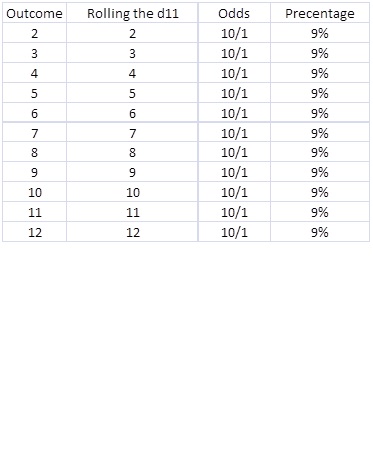
The answer lies in the math behind the game or, more specifically, the statistics of the dice.  Below I have two graphs.  The first is a graph showing how random each result is on the d11.  Statisticians love them some dice problems, so lots of work has gone into the dice.  On a fair die, every side has equal probability of occurring.  For our die d11, that means every side has a ~9% chance of being rolled.  This makes the behind-the-scenes math of “Fall of the 11th Age” pretty easy to figure out.  Here’s a quick example:  to hit the goblin, a fighter needs to roll a seven or better.  So the fighter can roll a 7, 8, 9, 10, 11, or 12.  That’s 6 numbers.  To find that probability of that occurring you multiply 6 by the probability of each event (6 x 1/11).  So the end result is 6/11 or ~55% chance of success on any roll.  I’ve put in a handy chart to show what I mean.


Untitled

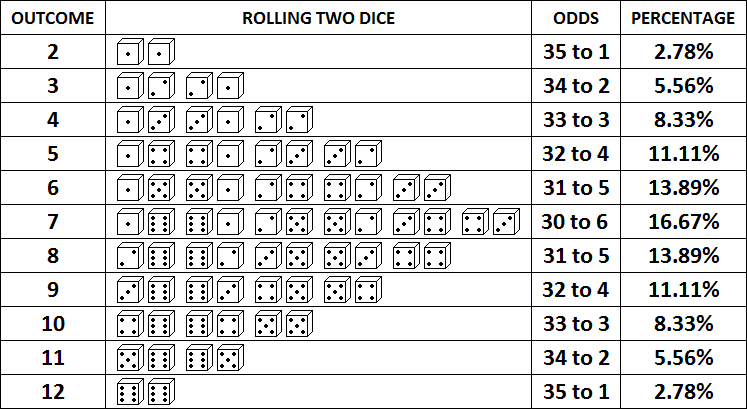
But things are not that simple when it comes to the 2d6 system.  Above, I mentioned how statisticians love them the dice, well a major part of that is how fair dice are and independent.  When you roll a d6, every die face has an equal probability of occurring.  When you roll two, each side has an equal probability of occurring AND what occurs on one die face does not affect the result of another.  There are a few assumptions that go with this and I don’t want to get crazy with physics of rolling dice together, so we’re going to keep this simple.  PLEASE!  It gets weird from here if we go deeper!  So dice are random and separate.  So when we want a result, to figure out the probability of that result we have to count the number of ways to make that result.  I’ve included a table to help with this.  A really important thing to note on this chart is how multiple dice roles make the same number.  For a simple example, look at the 3.  A 1 on the first die and a 2 on the second makes a 3 while a 2 on the first die and a 1 on the second also makes a three.  This is part of the independent results thing above.   So if we use the same “Fall of the 11th Age” math we used above with the d11 to hit the goblin, we need at least a 7 on 2d6.  There are multiple ways to make a seven.  For this, the best way to find the likely hood of this event is to ADD the percentage likelihood of each individual event.  So for a 7 to occur we add 16.67+13.89+11.11+8.33+5.56+2.78 which equals 58.34%.  This may not be a massive change from the d11 system, but it’s also not the whole story.


V4N2WgahS8BojSANeNB38Of0uw7oJbUNAhHAjPGIrP_SQkuC7oc8Vz-9zdARvX0HVEISqSOIljmOetW_1B-dL47H3dl3AuzAzmENXe8T4ccnqXgIoJs

from http://www.wikihow.com/Sample/Dice-Probabilities


Besides just finding the likelihood of hitting the goblin, there is a few more statistics “things” at play.  These are the mean, median, mode, and standard deviation.  Let’s look at the first three.  A mean is the average that we all know and love.  For “Fall of the 11th Age,” we just add up the dice results of 2 to 12 and divide by the total number of events (11) which is 7.  The median is the middle value; think of the median as a balance on a teeter-totter on a play ground.  If we moved the middle of the wooden beam around a bit, where would both sides balance one another.  Again this is 7.  2 3 4 5 6-7-8 9 10 11 12  There are five numbers to 7’s left and five numbers to 7’s right.  Where things really get interesting is with the mode.  The mode is the most likely to occur event in our group of events, or another way to think about it is, the event with the most number of ways it can happen.  For “Fall of the 11th Age,” in the 2d6 approach 7 can occur the most often since six different dice rolls can make a seven.  But, in the d11 approach, there is NO MODE!  Every number can occur equally.  (Again, we can get all math argue-y with if there is no mode you take an average bla bla bla, but this is my article and I want to make a point, so NO MODE!).

Standard Deviation is a bit more complicated, and I won’t go into it all.  For a great summary, go to http://www.mathsisfun.com/data/standard-deviation.html.  But, a real simple definition of standard deviation is a measurement of how much things very.  You use standard deviation to find out how random your stuff really is.  Let’s look at the 2d6.  The average result is 7, but over 60% of the time, you will role between a 5 to a 9.  When you roll a d11, the results get a little more varied.  Using standard deviation, 60% of the time you will roll between 4 and 11.  (If you check my math, I’ve simplified down the actual results.  It makes life a bit easier).  What this really means is you are more likely to be closer to the average in 2d6 then with d11.

Why does this matter?  Well it matters for how random you want your random to be.  For 2d6 vs d11, the difference between 55% and 58% doesn’t matter much, but what if we only needed a 6 instead of a 7?  Using what we went through above, the d11 likelihood is now a 64% while the 2d6 likelihood is now a 71%.  The difference is getting pretty substantial at this point.  Also, how random you want extreme events to be?  For the 2d6 system, 12 or crit will only be 2.78% which is pretty low.  But, for the d11 system, it’s 9%.  The d11 dice don’t really care what side comes up (dice, they are a cruel mistress….).  And since the math works the same in reverse, critical fumbles work exactly the same way (2.78% cs. 9%).  If we graphed the d11 results we would see a flat curve of probabilities.  When multiple ways to achieve the same value occur, interesting new things occur in the data and your game.

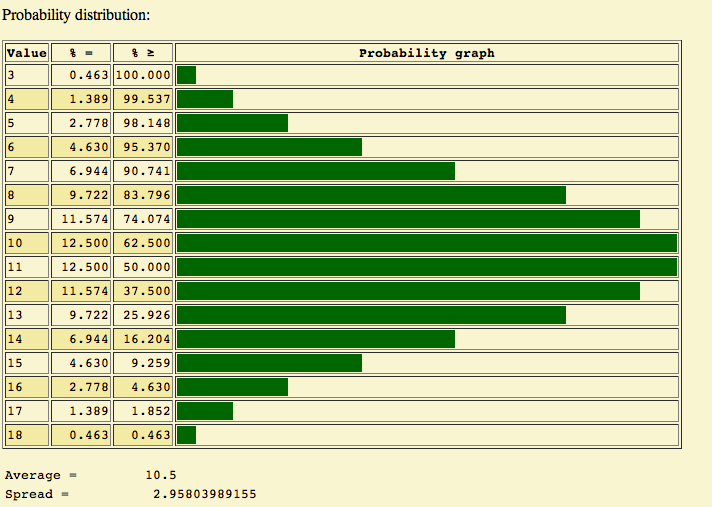
The example above is a pretty simple.  Let’s look at something a bit more extreme.  Let’s use Dungeons and Dragons d20 vs. Hero System’s 3d6.  (Yes, I know 3-18 is a smaller range then 1-20, but I want to use some real world example for the gamers).  A d20 is a single die, every side is equally likely, so every side has a 5% likelihood.  For Hero System, I’ve put another chart below to show all the results and likelihoods to make life easier.  For this one the “%=” column give the probability of a dice roll, and “%>” is the likelihood of this and all higher number dice rolls.  Let’s say you have to roll a 9 to hit a monster.  For a d20, you have a 60% chance to get that event.  But, for the Hero System, its 74%.  Again, this major difference has to deal with the mode and likelihood difference between each number in the two dice pools.  A d20 doesn’t really have a mode (See rant on mode averaging above), while a 3d6 pool has a mode at 10 or 11 and each number has a different probability of being rolled.  What if we need to crit to hit?  In DnD with a d20, its only a 5% chance, but in Hero System’s 3d6 dice pool, I’m looking at a 10-fold lower difference with a meager 0.463%.  When you look at the standard deviation, you are most likely to get between 8 to 13 on 3d6, while on a d20, for the same probability, you will most likely get between a 5 and 15.


Screen shot 2010-12-31 at 20.59.17


from seanswgcorner.blogspot.com

            What the crux of this argument boils down to is likelihood differences in getting different dice values.  How much random do you want in your games?  When I do something in the real world, is my life a full of extremes or is it pretty average?  How often do things get crazy vs. stay normal.  How often do the normal expected results occur when I do something?  On a d20, if a10 hits and a 14 hits, since each are equally likely, does a 14 really represent more skill or just another hit since both are equally likely?  For 3d6, I feel there is a palpable difference in likelihood and it affects the stories I tell.

What do you think?  Now, no system is “wrong”, but what does the math “say” to you?  What do you feel when you play these different games?  Do you feel a difference when a modes and different outcome likelihoods enter the game vs. when it’s just one die?  One of my favorite systems Arcanis uses 2d10 plus an attribute die for its d20 + attribute rolls.  I love that system because you get all the fun of a d20 game, but you also get the predictability of a smaller standard deviation.  While I enjoy the randomness, I feel that helps help keep the game from being overly swingy or random.  What do you want in a game?  How random do you want your random?

Daily Punch 10-30-13 Signature Move in Shadowrun 5e

I think its time for some more Shadowrun 5e fun.  How about another quality?

Signature Move

Cost: 7 Karma

Whether a German Suplex, a cutting a Z into your opponents with your sword, or hitting all the five point of the exploding heart technique, you know how to get things done up close and personal.

You may take a minus -1 to the dice pool of a melee attack and declare you are using your signature move.  You must describe your move to the GM. If you succeed on the attack, you deal an additional +5 net hits when the opponent makes the soak roll.

Thoughts?

Ring Side Report- Review of Shadowrun-The Assassin’s Primer

Module-The Assassin’s Primer


Game System-Shadowrun


Producer-Catalyst Game Labs


Cost-~$5


Page Count-17


TL;DR- Good story with a few rules.  A little pricey for the page count. 87%


Basics-The first player centered addition to the Shadowrun 5e RPG.  This focuses on a webpost by an assassin who is about to die.  He wants to help future assassins and give tips and tricks through this post.  Along the way, various other Shadowrun characters pop in to give their two nuyen.  At the end of the story, the book also gives stats for a new gun as well as few new qualities for your character.


Art– The book does have some art, but don’t expect much.  There are a few black and white pictures as well as a picture of the new gun with its stats and background story.  It’s all ok, but this is not an art heavy book.  I liked what I saw, but there isn’t much. 3/5

Story or “Fluff”– This is really a well done story.  The whole story and they way you read it really put you in the world.  I loved every minute of it.  I felt like I was sitting drinking a soyacaff in a crappy rundown house reading this in AR. 2.5/2.5


Mechanics or “Crunch”– Don’t go into this looking for crunch.  The book does have some mechanics, but if you are a living game person like me, most of the new qualities are parts of codes of honor which you can’t have in the living game. So, that is kind of a bummer.  The story does give some good hints on how to play an assassin.  All and all, it’s an ok book for crunch, but I wanted more. 1.5/2.5


Execution– The way this ways laid out initially left me a little put off, but once I got into it I liked it.  It’s worth a read, as it does get you into the head space of Shadowrun and some of the major players in the universe.  The rules part at the end was a bit short, but well executed.  However, I was a little disappointed with the price.  For a PDF that is mostly story, I felt the $5 price was a bit much as its pretty short and rules light.  I would have liked this a bit more at the $3 price point.  I’m quibbling over dollars, but this is Shadowrun!  What good would a run be if we didn’t negotiate the price? 4/5

 
Final Thoughts– All said and done, I’m pretty happy with this book.  It’s not up to the quality of the core book, but I’m glad I read this small part of the Shadowrun lore.  I really enjoyed what I read.  And think that for anyone out there who likes the Shadowrun world, it’s worth it.  Don’t go into this thinking it’s going to give you the metagame advantage you were hoping for as there are only two pages of real rules though! 87%

Daily Punch 10-29-13 Quick-Step Ring Stats in DnD Next

Been working my way threw “The Companions”, and I think its time for Regis’ ring.

Quick-Step Ring

Legendary ring

A round golden ring set with a clear diamond.

Property [Attuned]:
You gain immunity to all fire damage.  Also the ring has three charges.  You can use a charge as a move action to move 50 feet without provoking any attacks.  If you remain engaged with an enemy that you were initially engaged with, you count as an ally for any effects that require another ally engaged with the enemy.

Thoughts?

Ring Side Report-Game Review-The Manhattan Project

Game– The Manhattan Project


Publisher-Minion Games


Price-~$50


Set-up/play/clean-up– 2 hours


Basics-It’s time to build bombs!  Each player takes the role of a different nation building nuclear weapons.  On your turn you do one of two things: place workers on the main board and your board or recall your workers.  Yes, this is a worker placement game, but the main twist is your building and how you use them.  On the main board, players can buy buildings, repair, declare war, get money, get yellow cake, get bomb designs, get more workers, get more planes to attack, steal other player’s spaces, or refine your yellow cake to plutonium or uranium.  You also get buildings that do much of the same but these are on your board.  When you place workers, you get to place only ONE worker to the main board, but you can place as many workers as you want on your board.  This leads the start of the game to go slow as everyone builds their home boards or only place on worker on a turn, but later in the game, you will see people place well over 10 workers to several different places.  So, like some other euro style games, this is an engine building game.  The way you win is building different bombs.  Each bomb functions like a single use building that requires different types of workers to use as well as an amount of plutonium or uranium.  When you build a bomb, you score its points.  You can also load a bomb for five more points.  With plutonium bombs, you can actually test fire a bomb.  When you do this, you lose all that bombs points, BUT plutonium bombs are not worth that much more.


Theme-You play a nation trying to build bombs, and it’s fantastic.  The different worker types make the game fun and make you really think you are sending your scientists to develop better reactors while engineers are building buildings and the base workers are out there in the mines.  Espionage as an action is amazing.  It really does feel like the cold war where your agents are out there sneaking into different facilities and stealing for your country.  The fact you can declare war and attack really adds the feel of warring nations, and it’s a welcome addition to the euro game genre.  Honestly, I played this game at Gencon, and bought this the next day. 5/5


Mechanics– Again, this is a great game through and through.  It’s a euro, worker placement game; that’s a pretty crowded genre, but this game’s different spin on that really make the game.  The different actions and workers really enhance the theme.  And, the different actions complement one another.  As an example, when you take some actions, money goes to a bribe pile.  When you buy the cheapest building, you get the bribe pile.  This means that you don’t have building build-up that you see in other games where no one wants to take a specific group of locations.  This game might not be for everyone as there is direct player vs. player combat, but it was definitely for me!  My only real complaint was the location deck.  The game starts with a standard set of buildings, but after that, anything thing goes.  So the next five buildings could be the most powerful combination in the game.  The randomness in the building pile could hurt the game play and does take a bit from the game play.  Check below for my suggestion on how to fix that.  4.5/5


Art/Construction– The art of this game is great.  It’s got a retro, 50’s fib to it, so the art really enhances the theme.  The board looks like pieces from a 1950’s office hammering home the feel of the cold war.  The pieces are thick cardboard.  Since I’m crazy, I would have liked different colored meeples for the workers, but the cardboard works.  The boards use iconography instead of words, and that works well.  All and all, a well put together game. The tracks for fighters/bombers could use a bit of work, but I’m happy. 4.5/5


Instructions– The instructions are online at http://www.boardgamegeek.com.  They are written in well-written, readable English with different translations available.  It’s a beefy book (10+ pages), but it does explain how to play quite well.  5/5


Final Thoughts– I love this game.  I love the combat, the engine building, the theme, the mechanics, and almost every aspect of this game.  It’s one of my favorites.  I bring this game with me to every game day I go to.  If you want a great game, the easy to play, but has levels and levels, this is the game for you. 95%


Quick Fixes– The main problem at hand is too much randomness in the building deck.  To fix it, I look to Suburbia.  In that game, when the players set-up the game, they make three piles of tiles to play based on the tile backs.  These tiles are marked with an A, a B, or a C, and they tiles get more powerful as the letters go up.  If Minion games released a revamped set of building cards where the buildings were marked A, B, C so I could shuffle them appropriately, I would buy it in a heartbeat.  Heck, maybe this week, I’ll sit down and make a list of cards for each group!

Why I love Living Games

It’s the first Blurbs from the Booth and today I talk about why I love Living games!


I’ve stood at the invasion of Elturguard as the companion went dark.  I’m immortalized in a statue commemorating the defeat and sealing of an elemental in Mil Takarn.  I’ve thrown waves after waves of demons against intrepid heroes as they stood valiantly in Jappa.  I’ve hacked computers owned by Renraku and stolen a wizard only to sell him to a different corporation in Seattle.  I’ve single handedly destroyed skyships as during the invasion of the floating fortress.  And you may have too.

I love living games.  Living games are long running campaigns where a series of modules are put out by a company or group in a particular game system.  The living game will place rules on what can and can’t happen in character generation and each module so the story that every character experiences is somewhat standardized.  Games like the Living Forgotten Realms, Living Arcanis, Shadowrun missions, Living Divine, Pathfinder Society, Legends of the 13th Age, and others all fill me with only happiness.  Now I know many others out there poo-poo the idea of a “regulated” game, but I don’t mind slight changes to the rules.  Where they only see “limitations” because they can’t do everything they want, I see only opportunities and awesomeness.  Here are some of the high points I see to living games:

  • Unity-Every week, I go to church.  I’m a Roman Catholic and at just past midway through, we all say the Our Father.  I get a feeling of unity with the larger group out there.  I’m not just one guy, I part of a larger whole.  I get that same feeling during a battle interactive (a large multi table game where parties can often interact with one another to help each other out).  I’m filled with a feeling that few can experience when I know several other people are all out there at the same time all fighting for a common goal.
  • Shared Experience- I talked above about all the crazy things I’ve done in game as a GM and a player.  You may have done something similar, and that is AWESOME!  We might not have ever met, or ever will meet, but we have shared something that only a few other people can.  We can sit down at a bar or a con and talk about the crazy stuff that happened when I tried to steal the gem and what happened when you did it.  No two tables are the same, but the basics will be there and now we have some comradery that would never have existed if it weren’t for our shared passion for an RPG.
  • Family/Friends-I’ve met friends at living games who I would have never, ever know existed.  These people came to my wedding, go with me to other cons, play other random games, and have become an important part of my life.  I look forward to hearing from them on a regular basis.  Living games give you an impressive opportunity to meet people you would otherwise not know existed.
  • Personal Opportunities-Everybody has to start somewhere.  Monte Cook did not start writing 1000 page source books.  Neither will you.  But a great place to learn about the industry is to do the grunt work of it.  Cons and living games get your name out there.  I’ve ran games for Wizards of the Coast and got to have sit down chats with heavy hitters in the industry, and it was amazing!  Also, since living games are constantly looking for people to write, it’s a great place to make some in roads.  Now, I’m not saying this will the minor leagues compared to major league baseball, but it’s at least like playing in high school.  It will get your feet wet and get your name out there.  Have a favorite game and want to make a name for yourself?  Check their website.  Most have a proper procedure for you to try being a writer.
  • Groups-Have a game you love, but can’t find a home group to do your crazy My Little Pony/Cthulhu version of it?  Go check out the living games.  Any company worth their salt will have an awesome website to support their living game.  These websites will help you find games or even give you Google groups to start playing in.  Then you find some friends, and eventually crazy Cthulhu Shuterfly with some equally crazy people.
  • Achievement (Real)-Paizo does this amazingly well.  The more you GM for them, the higher your rank.  I was at the table where the first five star female Pathfinder GM earned her rank.  In addition to being with an awesome group of people, I got to witness something phenomenal.  Or, think of it this way, YOU GET TO LEVEL UP IN REAL LIFE!
  • Achievement (Not as Real)- Every Living Forgotten Realms adventure ends with a reward sheet.  Every Pathfinder Society event ends with a chronicle.  You get a tangible reward for playing.  Now, I know it’s just paper, but you “earned” that.  There is a reason why so many companies are popping up selling game aids that represent in game achievement like gold and weapons.  It’s not much, but these represent some hard work by your character.  And, while not as great a say winning a football game, getting your sheet for winning the day does feel pretty good.
  • Effects on the Game World- I’ve been part of a vote to turn the Companion of in Elturguard.  I’ve changed the world of the Forgotten Realms forever.  Can you say that? Often times in each living game, the people who run the campaign ask for feedback based on what the characters did.  This affects future mods and ultimately changes the world.  I want my character to be part of the world and to make a difference.  Do you?  While I know you’re home group now destroyed Cormyr, but did you change the larger world outside your home group?  This is an awesome aspect of Living game: real, tangible effects on the game you love.
  • Company Opportunities-I honestly play more “living” games then I do home games.  I play a lot, but I prefer the play games where anybody can drop in and play and everybody gets a shot to have some fun.  These games give companies who might not otherwise get their game out there a shot to make some noise.  As a player, if I can’t find a group to play a game, then I won’t spend the $90+ to play Dungeons and Dragons (Players Handbook, Monster Manual, and Dungeon Masters Guide).  But if I know that I can easily just jump into a random group and play for free a bunch of times, I am much more likely to buy those three books and as many source books as I can get my hands on.
  • Portability-Some people are locked in an area and can only play RPGs with one group of people.  In some of these groups, sometimes you have to deal with people you otherwise would not like, since it’s your only shot at playing a game.  Living games don’t have that problem.  Don’t like how I GM your game?  You can most likely find someone either online or close by who will run the game system you love for you.  Or you could start your own group and get other who loves your game to join you!  Its win-win!
  • Spreading the Good Word- You have a system you love.  Whatever it is, you absolutely love it.  And I’m happy for you.  So you go to a con or two and run your intro game with pregens you personally created and a mod you wrote with love.  Your players all adore the game and say they will get every book then can!  And they don’t.  They look around, see no one else playing, and forget about that greatest game they ever played.  Living Games give you a bit of help with spreading your word.  Now, that group that loved your came know how to find others.  They know that others are playing.  They will (hopefully) join up with those others and now play your game.  And your game will spread.
  • Adventures- We all love RPGs.  It’s why you’re reading a blog on a RPG website.  What’s harder is having that game ready when your friends show up.  Every week they’re going to show up and you have to spend the prep time to get the game ready, and they don’t care that game prep takes away from your spin class because in this example your friends are mean.  Any Living game worth its salt will have a giant back log of adventures and whole quests for you to work through.  And they are cheap, well put together, and right there!
  • GAMES!-WHY ELSE ARE YOU PLAYING A RPG!  Here are some games that you don’t have to (usually) pay for!  Great living games give you a good taste of a game that a demo can’t.  You get to play a few sessions and maybe even gain a few levels.  Honestly, if you’re at a con and you see a new living game you’ve never heard of, give it a shot.  You’ll get your new pregen character and some fancy new adventure logs.  You have some tangible rewards and you got to play an awesome new game that you can show your friends back home with a ton of adventures for them to play and other new friends to show it too.

This is what I see when I see a living game.  Give them a try if you can.  You just might get more out of them then a simple game.  See if you feel what I feel when I step into a room with a couple hundred of my comrades at arms.

Daily Punch 10-28-13 Contingency Spell in Arcanis


How about a trait to make contingency spells in Arcanis?


Spell Stitched Body [Arcanum, Limited]

Through your faith, dealings, or abilities, you have placed spells into your very body.

Benefit: Your body is stitched with a spell.  The abilities granted by this spell vary by the spell. This spell will go off when conditions imposed by the spell are met or if you lose all wounds.


Thoughts?


Daily Punch 10-25-13

How about something I read about while reading the Sundering?  Its another feat for DnD Next


Charge and Throw

You’ve trained long and hard for this.  You use an opening with one attack to make another happen

Prerequisite: Charge

  • You gain +10′ movement bonus
  • When you charge you may make an additional attack along the way.  This attack must be a thrown weapon attack.
  • If you charge the target of your thrown weapon attack and you hit with the thrown weapon, you gain a +2 bonus to the charge attack.


What do you guys think?