
Ring Side Report- RPG Review of PFS Scenario #6-08: the Segang Expedition

Product– Pathfinder Society Scenario #6–08: The Segang Expedition

System– Pathfinder

Producer– Paizo

Price– ~$ 4 here http://paizo.com/products/btpy9a1w?Pathfinder-Society-Scenario-6-08-The-Segang-Expedition

TL; DR– A good mix of combat and roleplay. 90%


Basics-Time to hitch a ride!  Funds for the Pathfinder Society are low after the adventures in the Worldwound.  Now Pathfinders are working with new allies to find old archeological sites.  Can you find and explore a new site while working with and befriending some new patrons?


Theme or Fluff-This is an interesting one.  It’s two separate missions.  Befriending one of two patrons while still finding what you want in an island Jungle.  As a dungeon crawl alone, it’s not that best one I’ve played.  As a pure roleplaying experience, it’s not complete either.  But this one combines the two well and really does have something for the combat monkey and the thespian in your groups.  It’s not perfect in either, but it does a good job balancing the fun. 4.5/5


Mechanics or Crunch– The adventure provides a new mechanic for how to befriend one of two wealthy backers.  My players constantly tried to keep finding ways to secretly befriend both.  You will have to think on your feet with this one.  The combats are quick, and the adventure does give some extra mechanics fun for allowing players to go hunting from a hunting lodge.  For its fights and non-combat encounters, it’s reasonably well done experience. 4.5/5


Execution– My main problem with this PFS scenario is the same problems I have with all of them.  Paizo only publishes PDF adventures for the society.  Paizo try to keep all the adventures a set length, but honestly, the PDFs could be infinite length providing all the rules I need to run the adventure from how the spells work to basic random dice rolls.  This adventure lists a bunch of different creatures, and I have to have the books to look them up.  Why not just give me the full stats?  It won’t hurt to expand a few extra pages and give me those stats, since I know more and more people are now running adventures as PDFs off tablets.  It’s just a pain to have to dig up all my books to get one stat for from one book and another stat from another book.  Otherwise, the text if sized fine, the art is good, and generally, I have what I need to run this adventure. 4.5/5


Summary– I liked this one.  A father and a son-in-law are off hunting and the players act as guards while still trying to be Pathfinders.  I can see repercussions from last year’s Pathfinder’s affecting the future, and I like it.  The adventure itself is fun, has roleplaying and combat well done, and fits neatly within the time frame for a PFS game.  I had a blast and so did my players.  Well worth running at your tables.  90%


Ring Side Report- RPG Review of Urban Steampunk

Product-Urban Steampunk

System– Uber RPG

Producer– Uber Goober Games

Price– ~$ 13 here http://rpg.drivethrustuff.com/product/100785/Urban-Steampunk-ber-RPG-Steampunk-sourcebook

TL; DR– Ankmir is a fun playground, but this book isn’t full of player options. 85%


100785


Basics-You can’t have steampunk if you don’t have a Victorian city full of machines!  This book provides a perfect city of steam Ankmir to play in/destroy while giving GM’s the options to build their own world.


Theme or Fluff-Much like the other setting books by Uber Goober, this book does a great job of building three different worlds in the same city.  Uber Goober sets up a world of steam tech, a world full of rebels, and a world for magic all in the same city.  Whatever game you want to play, Uber’s sets up the world and gives good background for a great setting to start your own game. 5/5


Mechanics or Crunch– And here is where the book suffers.  Just like Steampunk Uncharted, this book isn’t a splat book for characters.  There are few mechanics discussed here, but don’t get this book if you just want more player options.  There is a great deal of information regarding all the different important population information a player could want if you want to get super crunchy in your story.  It’s a story book, but that aspect is done well. 3.5/5


Execution-This book could use some more pictures to distract from the walls of text.  But the book does have lots of maps, so that helps.  There is textbook problem here as many pages are just two columns of black text on a white background.  That doesn’t draw the reader, but what is here is set up as best as it could be giving the amount of art that is in this one.  Each area gets a description, how to play in the three types of steampunk, story seeds, and persons of interest in the area.  4.25/5


Summary– As with Steampunk Uncharted, if this book and the core Uber RPG: Steampunk book were put together, they would add up to one amazing book.  Uber RPG: Steampunk introduced the city of Ankmir, but this book expands on the main city presented there.  Ankmir is a fun playground to run around in, but if you only want new stuff for your characters, you might want to look at the other books by Uber Goober. 85%


Ring Side Report-Board Game Review of Sushi Go!

Product– Sushi Go!

Producer– Gamewright

Price– ~$13 here http://www.amazon.com/Sushi-Go-Pick-Pass-Card/dp/B00J57VU44/ref=sr_1_1?ie=UTF8&qid=1419311517&sr=8-1&keywords=sushi+go

Set-up/Play/Clean-up– 30 minutes (2 to 5 players)

TL; DR– Quick family fun. 90%


Basics-Hungry for some more quick sushi games?  Sushi Go! is a simple family card game that follows many of the same drafting mechanics popular in 7 Wonders and Among the Stars.  Players start with a hand of cards and choose a card.  All players reveal their chosen cards simultaneously.  Some cards are instant point cards like nigiri cards.  Other cards are worth more as you gain more of the same card like dumplings.  Yet others need a specific number of cards of one type to get any points like tempura where every two score points.  And some are worth more depending who has the most of them at the end of the game.  There are also wasabi that multiply other cards, and the chopsticks card.  If players have a chopstick card, they can shout “Sushi Go!” and take a second card from the same hand of cards.  After selecting your card for the round, you pass the cards to the left.  When you only have two cards, you choose one card, and then throw the other into the center.  After three total hands like this, players determine who has the most points and is the winner.


Mechanics– I like a good drafting game.  This one plays quick and teaches even quicker.  My sister who can’t read scored as many points as I did while my mom scored the least points.  It’s a blast to play and won’t require encyclopedic knowledge of some obscure rules.  5/5


Theme- Here is where the game suffers.  I don’t get the feeling I get from Wasabi of being a chef.  This game has cute sushi, but beyond the box and the art, there isn’t really a story here.  If story doesn’t matter to you, then this game is great.  3/5


Instructions– The instructions are a single booklet that’s less than ten pages.  It doesn’t take much to learn and play this game. 5/5


Execution– The cards are decent quality and the whole game comes is a metal tin.  The art is great and all cutesy.  And for less than 15 bucks?  Well worth the price of admission.  5/5


Summary– This game has the family board game awards all wrapped up, and I can see why.  It’s cheap, easy to play, and doesn’t require a ton of priming to get into.  It’s a great intro board game that doesn’t break the bank and travels well too. 90%

Ring Side Report-Board Game Review of Panamax

Been teasing this one for a while.  Here it is, my review of Panamax!

Product– Panamax

Producer– Stronghold Games

Price– ~$50 here http://www.amazon.com/Stronghold-Games-6001SG-Panamax-Board/dp/B00OMXW4U0/ref=sr_1_2?ie=UTF8&qid=1419308500&sr=8-2&keywords=panamax

Set-up/Play/Clean-up– 60-90 minutes (2 to 4 players)

TL; DR– Lots of fun stress between your life and the company. 94%


pic1786212


Basics-All Aboard!  Panamax is a game of becoming the best shipping moggle out on the Panama Canal.  The game even gets its title from a shipping designation Panamax which means the largest measurements a ship can be and still go through the canal.  This is a relatively simple  to play Eurogame.  During set up, players get personal stock and money, and their companies also get money as well as shipping contracts and starting boats.  The shipping contracts are represented by dice on a small card with one to three numbered boxes.  The numbers on the boxes are used to indicate the face up side of the dice placed on them of your color.  Boats have numbers on them ranging from 2-5, 9-18, and so on.  These are the minimum and maximum total dice value that can be placed on a ship.  Players get a chance to load up their dice on ships on the proper sides of the canal during set up.  When a player clears a shipping contract, either in setup or the regular game, they get to place a country flag marker on their companies’ board.  The markers may cover extra powers such as adding shipment dice to the rail board, moving ships, buying stock, and loading extra dice.  Then the main game starts.  For a four player game, twelve dice are rolled, and the dice are placed in columns covering the die face it rolled to indicate different actions a player can take.  At its most basic level, this game is an action selection game.  Players select a die, do the action associated with it, and the turn passes.  You draw three dice a round, and then pay for where your company’s cargo still is and get money from your stock options for the different companies stock you own.  Sides one to three of the action dice indicate ship movements.  When a ship has enough dice on it to cover its minimum value, the ship can be moved.  There are two types of movements: lock and waterway.  Each movement is well indicated on the board with different icons.  When you select a movement die, you use a small tracker at the top of the board to show what movements you have left. When a player selects movements, they have to move all the ships that they can possibly move.  Hidden in movements in a major factor of the game-pushing.  The title of the game refers to how large a ship can be, and that’s the most important factor for pushing.  When you move ships out of a large body of water like an ocean or lake, you can group ships together.  The ships come in sizes ranging from one dice to four dice.  The maximum size that can fit in one lock is four dice.  So, if you would move a group of three wide ships into an area where a three wide ship already is, you push that three wide ship ahead one space.  This can result in chain reactions where tons of ship will move through the canal.  Mastering this will get you the win!  When a ship crosses the canal, players earn money from the die’s values on the ship, and the player who owned the ship can get cards that give you extra moves, load cargo, or give you extra money at the end.  Sides four to six of the dice represent loading cargo actions.  Just like in set up, you take a card with different cargo values on it with the different countries.  The dice you pick up will also show you how much cargo you can load this turn ranging from one to three dice.  If you don’t load cargo from the warehouse, it costs lots of money per die, while having cargo waiting to go into the canal still costs a ton, but slightly less.  Having cargo moving through the canal is slightly less expensive.  And, just like setup, completing country cards will get you markers for each country.    In addition, four more dice are rolled and these are placed on a separate area for executive actions.  These extra actions allow you to buy more stock, have three unrestricted moves, load new cargo/take country cargo cards, and change the value of your stock.  You can only take an executive action die after all the other dice of that number have been used up.  While that’s a lot of words, this game is surprisingly simple, but deviously complex.  Know when and what to do will help you maximize your income.  There are also military ships, cruise ships, and rail cargo.  Moving military ships will earn you a once per turn money bonus equal to the number of country cargo markers on your company’s board.  Cruise ships earn your cruise ship markers that have values from 1 to 5, and you get to place that marker on your company board earning your permanent powers like extra loads and extra cargo cards to choose from.  Some cargo has a rail icon next to it, and you place that cargo on a separate section of the board. Rail cargo dice number is used to change what player goes first and get you extra country cargo markers.    After three rounds, you sell off your stock to the bank, count all your money, and just like life, player with the most money wins!


Mechanics– This is a hard Eurogame.  Nothing is too difficult here once you get the hang of it.  However, knowing what you need to do make this game some brain burning fun.  This game has two levels to it:  your personal money and your companies.  You might be the best player in the game, but if you don’t invest wisely, you could lose.  Those levels of the game make this much more interesting that just who has the largest company at the time.  Also, these different levels of play make a player have to consider when that player will take stock market options to be selfish and when a player will take actions to better his company.  Constantly having smart choices to make makes this an amazing experience.  My only problem is you will most likely only get the option to buy stock on round one and round three.  I haven’t found a way to buy stock all three turns.  Wish there was a way to make a bit more personal money.  4.75/5


Theme- This game does make you feel like an executive at a cargo company.  Do you better your own company or do you better your own stock portfolio?  Focus too much on one you will fail.  Focus too much on the other and you won’t have enough personal money to win.  Choosing what to do makes you really have to think and adds a tension to the game you will enjoy.  Also moving all the ships is fun and does make you feel like a shipping magistrate.  All said and done, it’s a blast.  5/5


Instructions– This game plays like chess, and to win you need to really understand the rules.  The rules do a decent job of communicating the game, but lots of little details are semi-hidden in the rule book.  They are there, and after two read through of the rules, you will get them all.  But that’s after two good read throughs.  4.5/5


Execution– Stronghold Games makes great games, but for some reason, their Eurogames tend to get light-weight boxes.  My copy of CO2 is flimsy and this box is flimsy as well.  My copy of Panamax even came dented up.  Inside the box, the game is great.  AND IT COMES WITH BAGS!  That right there is worth a 4!  I did have a small problem with the layout of the game.  I would have liked an area where my personal stuff went besides just in front of me, not on my clipboard.  All told, few small changes would easily get this up to a 5.  4.5/5


Summary– I love Stronghold Games and the hardest working man in board games Stephen Buonocore. I’ve been waiting for Stronghold to make some more hardcore Eurogames.  And, when this one came out, I bought it as soon as I could.  I’m happy to say this is an awesome game that gives you a great Eurogame experience.  Choices on what to do each turn, how to maximize your actions, and still get enough money to be better than the Joneses dominate this game and provide the positive stress that makes Eurogame so much fun.  Want a new game that focuses on ships and international relations?  This game is well worth the price of admission. 94%

Ring Side Report-Double RPG Review of Uber RPG! Uncharted Steampunk and Universal Airship Combat System

Product-Universal Airship Combat System

System– Uber RPG: Steampunk

Producer– Uber Goober Games

Price– ~$ 13 here http://rpg.drivethrustuff.com/product/101071/Universal-Airship-Combat-System-ber-RPG-Steampunk-sourcebook

TL; DR– Two books in one! 87%


Basics-Time to hit the sky!  Universal Airship Combat System is a book covering the rules for airship and mech combat in the Uber RPG system.  This book covers combat in the RPG as well as giving simple rules for a tabletop miniature system.


Theme or Fluff- Back to the fluff first reviews for the Uber system.  This book is not a theme book, but it gives enough options that you can fit any theme into it.  Uber RPG: Steampunk doesn’t have a default setting, so this book provides the mechanics to build whatever options you want into your own world.  One of the saving graces for theme in this book is how damage is dealt.  The system uses a 52 card deck to determine where shots hit and how it damages the ship.  That kind of story elements really marries theme with mechanics as you get a short snippet on how the attack happens and some mechanical details to.   As with the base Uber RPG: Steampunk, the book doesn’t do much give you a world, but provides the tools to build it.  The only problem with that is you, the GM and players, have to do much more heavy story lifting.  4/5


Mechanics or Crunch– While this book isn’t a theme book; it is an amazing book for its mechanics.  Much like Uber RPG: Steampunk, the base system is d6.  The system presented here is amazingly simple and quick.  Movement happens in ascending dexterity order.  Slower ships move, and faster ships can react.  Attacking happens simultaneously.  You add up all the attack power your ship has, and then subtract the defensive powers your target has, and roll six sided dice.  For each five rolled, draw a card from a deck of cards.  For each six, draw two.  The book has a chart detailing how the card damage and affects the ship as each suit and number focus on specific areas of the ship.  Done!  It’s a slick and quick system that makes combat not drag as some large scare combat systems do.  The book even provides mech combat if you want to climb into a steam powered mechanical walker.  And rules for mech vs. airship combat!  AND rules for a table top miniatures game!  Honestly, this book is jam packed with a quick, easy to use, fun to execute combat system. 5/5


Execution– Uber Goober is a small company, and small companies don’t have the art resources to make large scale book full to the brim with art.  This book has lots of pages with only text.  That kind of hurts the overall appeal as you have major textbook problem.  However, this book has more tables and lots of art to show what the authors meant for each type of ship and mech. It’s better than the original book, but still a bit flawed. 4/5


Summary-This is an easy to use, short book that give you multiple ways to integrate steamtech into your world.  This book isn’t the most reader friendly, but there is more art than the base book for the system.  If you like the quick combat style of Uber RPG: Steampunk, then this build upon that and give more flair to large scale combat.  Honestly, if Uber would add the random table of hit locations to the base Uber RPG: Steampunk I would love that system even more.  If you you’re looking for a good tabletop system to handle steampunk miniature combat or a way to integrate more steam machine combat in your Uber RPG: Steampunk game, this is a great book to add to your collection.  87%


And now another Uber RPG: Steampunk Product!


Product-Uncharted Steampunk

System– Uber RPG

Producer– Uber Goober Games

Price– ~$ 13 here http://rpg.drivethrustuff.com/product/102911/Uncharted-Steampunk-ber-RPG-Steampunk-sourcebook

TL; DR– Marry this with the base book, and it’s amazing. 83%


Basics-Need a world for your Uber RPG: Steampunk players to roam in?  This is a companion book to the base Uber RPG: Steampunk game.  This book provides a world to play in/destroy while still letting GM’s build their own world.


Theme or Fluff- Uber Uber Goober likes to let GMs build their own world.  This book, while a setting book, still let’s GMs build their own world.  How?  Well each part of the world gets a description in the three main Steampunk styles that Uber introduces at the start of their books: steam tech focused, rebelling against society, and fantasy steampunkHonestly, this has to be the best approach I’ve seen to getting the theme of your game out there.  The author basically says “Here are three different worlds and their themes to play with.  Choose one and go!” 5/5


Mechanics or Crunch– And here is where the book suffers.  The book discusses the survival skill and gives ideas for encounters, but this book doesn’t have many new mechanics in it.  What is here is good, but the books main purpose is to build the world for you, got give you new toys for that world.  It doesn’t add to many new enemies or options, but what is here is well fleshed out. 3.5/5


Execution-PICTURES!  This book has more pictures!  The pictures of the continents are well done.  However, much like Uber Goober’s other books, there are still a ton of pages with just black text on white page.  This book is, by definition, a geography/history textbook, and it suffers from many of the same problems old textbook do.  That makes this much less exciting to read.  A few more pictures of the peoples and scenes of different places would have really helped draw the reader in.  4/5


Summary– If this book and the core Uber RPG: Steampunk book were put together, they would add up to one amazing book.  This book has all the world building and steampunk theme any player could ask for.  The core book has sleek mechanics that make the game run well.  This book and the core both fill the gaps the other is missing.  On its own, this book is a good world book that gives the GM enough options to make the game they want happen in the world of their choosing.  What this book doesn’t have are many more mechanics and some more pictures to help set the stage and scenes.  All together, this is good foundation for GMs to build the world they want. 83%

Daily Punch 12-9-14 Addictive Personality quality for Shadowrun 5e

Well, if you can avoid addition, then you can also be more likely to get addicted…


Addictive Personality

Bonus: 5 karma per level (1 to 3 levels)

You just can’t help yourself.  Be it to many sliders or way to much booze on a weekend….or weeknight….when you get just a taste of something amazing, you can’t stop yourself.  When you make an addition test, reduce your dice pool to resist by 2 dice for every level of this quality.


Thoughts?

Ring Side Report-RPG Review of Uber RPG: Steampunk

Product-Uber RPG: Steampunk

System– Uber RPG

Producer– Uber Goober Games

Price– ~$ 20 here http://rpg.drivethrustuff.com/product/100784/ber-RPG–Steampunk?site=&manufacturers_id=2798

TL; DR– A dense, but good, all purpose steampunk RPG. 82%


Basics-Have a steampunk idea in your head, but don’t have a way to execute it?  This is the RPG for you.  Uber RPG: Steampunk is a generic system designed to allow players and GMs to build the Steampunk world they want.  Let’s dig into the individual parts.


Theme or Fluff- Usually I look at the mechanics of a book first, but this RPG’s theme needs a bit of an introduction First.  Uber RPG: Steampunk is designed to be completely setting agnostic.  If you want superhero Steampunk, then you can make this game superhero Steampunk.  You want fantasy Steampunk, here you go.  Magic?  Same deal.  That’s great, but you now have to bring many more of your own ideas to the party.  The book does have examples of what kind of worlds you can build, but you’re the director on this one.  This level of freedom is a double edged sword as now a GM and the players have to do much more of the heavy lifting instead of letting the RPG come prebuilt and prepackaged with its own world.  The Steampunk is strong in this one as the author spends an incredible amount of time describing steampunk and the different forms of it.  That is an excellent introduction to anyone who isn’t sure what Steampunk is.  But, the saying “good at everything, master of nothing” kind of creeps in as so many different ideas a brought forth with only a little focus on each one.   4.25/5


Mechanics or Crunch– The system is a d6 based system.  It’s quick and painless when you know what you’re doing.  Let’s break down the different areas of the game.

Character Generation-Characters are made via a point buy system.  As with the theme, anything goes as long as you all agree with what you want in your world.  Several different examples of prebuilt characters are in the book, so you get a great idea of how to build a character.  Look at the examples as your character build can kill you if you do it wrong!  There is that much freedom here.  If you know what you want, you can build that person from the get go.  However, if you go in blind, you can make some serious mistakes that will end you in the first fight you get into.


Base Mechanic-This system is a d6 based system, but does not use the standard two numbers are good/one bad mechanic.  Fives are one success, six’s are two successes, and ones represent complications. Every roll is mostly independent of any other number with successes dictating how well you succeed at a task.  Dice pools are made in the standard attribute + skill ranks method common to d6 systems.  If you roll more ones than total successes a botch happens where the GM dictates your failure somehow.  This system is meant to speed up the game as the size of your dice pool can also dictate automatic successes.  The larger the pool, the mightier the task you are assumed to instantly succeed at.  I think that’s an awesome addition to the rules of any RPG.  You reward players for building in one direction, but don’t slow the game down having to make them roll the dice.


Powers-This game uses powers to determine your attacks and other actions.  Since the game doesn’t have one setting, Uber RPG: Steampunk gives you the ability to build whatever power you need ranging from magic missiles to Tesla coil ray guns.  Each power builds a Mighty Dice Pool which keeps powers balanced.  It’s easy to build lots of different powers quickly, and the balance also keeps things working like clockwork (Ha, Ha, Steampunk pun!) during combat.  Powers can also be pushed which means that you roll extra dice or do extra effects, but this comes at the cost of doing damage to yourself or reducing the Mighty Dice Pool of your weapon.  This represents over exerting yourself, running out of ammo for the gun, or causing some Steampunk device to go haywire.


Combat-Combat is quick and deadly!  Each turn players get to announce and perform an action in descending dexterity order.  Attacks use the Mighty Dice Pool determined earlier during character creation.  Some powers reduce the effectiveness of an attack, but aside from that, there is no set number to determine if an attack hits and how hard.  Characters do not have hit points.  Instead, characters have conditions ranging from stunned (out of combat for one turn) to dead.  After your attack with a power, you determine the number of success you got on your roll and compare that on a chart to the constitution of the target.  Some powers and abilities reduce the dice pool rolled, but beyond that there is no defense roll or armor class from the target.  It quick, clean, and very deadly!


Summary-This is well done universal system.  You get all the toys you could ask for, but you have to build them yourself.  Again, that’s heavy lifting for the GM as well as the players.  Combats quick, but you do give up some say in what happens as aside from some powers, you don’t get to determine how attack affect you.  This system works well if you invest time into it, but you do have to invest that time.  You can also see the LARP roots in this system keeping combat quick and focusing on the narrative on the encounter rather than the numbers of the encounter.  4.5/5


Execution– I like the system, but the book itself has a classic case of text book problem.  The book is incredibly full of information leading to several pages of text with few pictures.  The text is small, but you can easily resize on an iPad if you read the PDF.  I do like the quick summary of the game in the first few pages, but the sheer number of pages with text explaining everything in this book makes the book drag a bit.  The content is good, but more pictures and white space would really help this one.  3.5/5


Summary-If you want flexibility; this is the system for you.  The rules are well done to the point that anything anybody could want to make happen can happen.  The theme is light, but that’s a direct result of the book being open to anybody who wants to make their own Steampunk game.  The mechanics really reinforce that theme of open Steampunk design by focusing on balancing all the different things people could create.  I do like the balance presented in this game.  My only real concern with this game is it gets lost in its own open design and the density of material presented.  The art is good, but there just isn’t enough of it.  And, white space is your friend!  However, if you can get past the problem of getting too much in a book, and don’t mind completely building your own world and powers, this book is a well stocked tool box for building your own Steampunk world. 82%

Ring Side Report-Board Game Review of Wasabi! now Sushi!

Product– Wasabi!

Producer– Z-Man Games!

Price– ~$50 here

Set-up/Play/Clean-up– 45 minutes (2 to 4 players)

TL; DR– PLAY AT A SUSHI-YA!  98%


Basics-Irasshaimase!  In Wasabi, you play a sushi chef trying to make as many orders happen as you can.  Each player starts with a recipe book, point tokens turned over to the number of ingridiants side, and a bowl for wasabi.  To start, players go around the table selecting three pieces of sushi that are handed to the next player, so you don’t get to pick your starting sushi.  After this, each player then chooses three different types of sushi to make ranging from easy two sushi piece combinations to the extremely hard five piece sushi.  Once every player has their three sushi pieces and their three recipes, the real game starts.  On your turn you can do two things: place a sushi piece or discard as many recipes as you want and draw new ones.  When you place sushi piece, you check to see if it creates any of the recipes you want to create.  If you do, you get to turn over a point token possibly gaining extra wasabi cubes (points and tie breakers), gain a power card, and draw a new recipe.  If you don’t finish a recipe, then you just draw up to your three sushi pieces.  Power cards allow you to change tiles on the board, place on top of other tiles, remove other pieces, and even place two tiles.  You can only gain one power card per turn, and you can only use one power per turn.  Discarding and drawing new recipes is pretty simple; discard what you don’t want, and draw up to three recipes.  The game continues until someone finishes all their for point recipes tokens, or until no more legal moves can be made.  The best chef is the person with the most points and wasabi cubes.


Mechanics-This is a fun one that can be pretty frustrating if played poorly.  There are some strategies that will work like doing your five point recipe first, then moving to your four, and so on while keeping a few easy two piece recipes in your plans to keep getting power cards.  That kind of makes the game less fun as there are less smart ways to play than different way to play.  However, if you want a simple game that is a much smarter version of tic tac toe, this is a good one to have on hand.  4.5/5


Theme- The game starts you out with soy sauce bowls and recipe books that look like menus from a Japanese dinner.  That right there fills that game with some awesome theme.  The board looks like a matt, and the tiles all look great.  I have never played this game and not left hungry for sushi.  You will feel like you spent 45 minutes in a sushi restaurant staring at the menu. 5/5


Instructions– The instructions are done fairly well.  There are a few minor English issues, but overall they communicate the rules well and explain the game quickly. 5/5


Execution– I love chunky cardboard!  This game has a ton of heavy cardboard pieces with all kinds of sushi ingredients on them.  The board is nice, and the art is great. You will leave this game hungry.  Also, I flat out love the menus that serve to hide a player’s pieces and the soy sauce bowls for wasabi points. 5/5


Summary-This is a fun, quick game that anyone can play. Players don’t need the in depth strategy that some games require.  It’s a simple tile laying game that you learn in a minute, and master in about five.  Some of the mechanics can lead to players losing through no fault of their own, but overall it’s a blast to play.  Moreover, all the different ingredients will leave you hungry!  The theme is so awesome that you will want to go to your favorite Sushi restaurant after playing this one. 98%

Ring Side Report-Dungeon Master’s Guide

Product-Dungeon Master’s Guide

System– Dungeons and Dragons, 5th Edition

Producer– Wizards of the Coast

Price– ~$50 here http://www.amazon.com/Dungeon-Masters-Guide-Core-Rulebook/dp/0786965622/ref=sr_1_1?ie=UTF8&qid=1417382314&sr=8-1&keywords=dungeon+masters+guide

TL; DR– Bands all together, let’s rock! 98%


Basics– Let’s get ready to roll!  The Dungeon Master’s Guide is the final book of the core three for Dungeons and Dragons.  This book covers all the behind the Dungeon Master’s screen aspects of the game.  It is roughly broken into three sections: creating a world/universe, creating adventures, and the math of the game/how to run Dungeons and Dragons.


Mechanics or Crunch– Ya’ know what I HATE in a RPG designed for the Dungeon Master?  No random tables!  Yes, I know they are a crutch that bad GM’s use when they don’t prep for an adventure.  But, I don’t want to have to figure out what I’m doing every second of the game, and sometimes the players will want to do something and having a random answer will really help make their choices happen at a moment’s notice.  This book as random tables out the wazoo-from making a complete random dungeon to a random adventure and the encounters between!  Also, this book goes into great detail on how to make the adventures in a non-random thought out way.  From the math behind monsters to how to hand out items and treasure, the book does an excellent job at making your life as a DM as simple as it can explaining how to set up a game in a manner where it won’t crash and fail from problems on the DM’s side of the screen.  Also, found the missing monster by CR guide from the Monster Manual!  It’s good to see it here, but it would be better to see it also in the Monster Manual. 5/5


Theme or Fluff-This book is full of content and absent of any content in the right ways.  The book goes into how to make a game work as a story and how to fill that story with people to meet and to kill while providing the default multiverse a bit of background too.  From the geography of the multiverse to how a circle of elders works in a feudal village, the game explains how to design a world and a story.  It’s a little light on advice on how to handle players.  That’s an experience thing, but some more sage wisdom on how to handle different kinds of people is always appreciated my new RPG fans.  The book does point to a reading list of books on how to GM, so that does cover kind of what I was hoping this book would have for the newer GM’s out there.  Overall, it’s got great story and tips on how to build your own story!  4.75/5


Execution– Just like the other two DnD 5e books, this one is well done!  There are enough words per page to inform, but not enough to bore.  There are lots of pictures to make the reader think of ideas to throw at their players, and almost all of them are new!  I used to play “spot the old art” in my DnD books, but I only saw one reused piece of art in this book which makes me extremely happy (along with the random tables!).  And, the new art is awesome!  If you want to learn how to make a book great from a layout, art, and design sense, then it’s this and Paizo’s books. 5/5


Summary– Look, if you’re running DnD, you bought this on Black Friday like the rest of us.  It’s that simple.  WotC spread out the core three books, and if you’ve bought the first two, then you bought this one too. If you’re new to RPGs, then get this book as well as the Player’s Handbook and Monster Manual.  This book has an awesome layout, great story ideas, and some randomness to help you get your players into the action as quickly as possible.  If you love Dungeons and Dragons, you need this book.  If you want to learn how to run Dungeons and Dragons 5th edition, this is an awesome book that will give you all the tools you need to build the games you want and have a blast doing it.  This is a great capstone for the basic trinity of 5th edition DnD.  98%

Ring Side Report-Board Game Review of Shadows of Malice

pic2037527_t


Product– Shadows of Malice

Producer– Devious Weasel

Price– ~$50 here http://www.amazon.com/Devious-Weasel-Games-IMPDWE1000-Shadows/dp/B00NAG5YCK

Set-up/Play/Clean-up-2-6 hours (2 to 8 players)

TL; DR– Say yes to being a God in the American style game. 86%
10817844_1503711186566683_1116632659_n

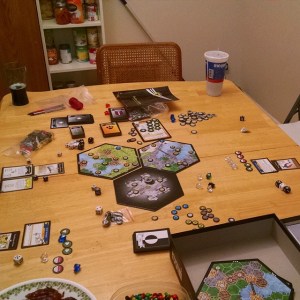
Basics-Fight the darkness!  In Shadows of Malice, an ancient evil is stirring, and the players take the rolls of avatars of light trying to stop it.  To do this, players must find the hidden strongholds of light among all the strongholds that have fallen to darkness before the vile Xulthûl.  Each player starts with an item, soulshards, and a special power.  Over a series of turns, the heroes move across the map revealing towns, mystics, monster lairs, and strongholds while shadow tries to find the strongholds of light.  Each turn, players roll two six sided dice, one for movement and one for fate.  If the player rolls doubles they draw a fate card.  Fate cards range from great effects like doing extra damage to horrible effects like permanently getting a negative on all dice rolls.  Fate cards last until they are spent or until a new fate card is drawn.  The players can then spend movement points to move across the map.  If player end on tokens or monster lairs on the map, they can encounter what’s there.  In towns, you can spend soulshards to get items like potions or treasure.  Mystics will heal or remove fate cards and make potions.  Monster lairs and stronghold have monsters.  When players encounter a monster, they roll to see the monsters type, the monsters power, and how many abilities the monster has.  The type affects some powers and treasures, but provides flavor for the encounter.  The power determines how much damage the creature does, how much the creature adds to its attack, and how much life the creature has.  The abilities add new flavor to each combat like preventing damage or adding to the monsters attack.  Combat is pretty simple.  Both sides roll a six sided dice and add bonuses based on treasure, monster’s power and other cards.  Before each roll, players can spend soulshards to activate abilities or to increase their dice rolls.  Whatever side has the higher combat check does one damage to the other side.  Some treasure, abilities, and powers allow monsters and character to possibly do extra damage depending on random dice rolls.  Combat continues over these rounds until one side runs away or until someone dies.  If the players win, they gain soulshards based on the powers available and have a 50/50 chance to gain clear soulshards on a one for one basis for each the monsters life points.  If players travel together (forming a band), each character beyond the first player add an extra six sided die to the player’s combat roll.  After the players turn, the shadows take a turn.  Shadows randomly remove one seal from their realm each turn.  Then, either spawn a new shadow or randomly move a shadow present on its own game board.  If a shadow moves onto the spawn point, it gains life.  However, if a shadow moves onto an open portal, the shadow moves to the player’s side.  From now on, this shadow will move one to two spaces toward the closest stronghold.  If the shadow gets to that stronghold, and the stronghold is a light stronghold, then the shadow becomes Xulthûl and fights the players.  Players can fight shadows in the normal world to prevent this, or kill Xulthûl.  Play repeats like above with players having a turn, then the shadows.  The player’s goal is to find the hidden light strongholds among the shadow ones.  For each light one found, the players gain power.  However, for each shadow one found or uncovered by the shadows in the main world, the darkness gains power and all monsters are harder to fight.  Once players find the one light stronghold per map tile, they win!


Mechanics-The mechanics are pretty simple with lots of randomness from the dice. When you know what you’re doing, you can generate monsters and end fights quickly, moving the game closer to two hours rather than the six..  The randomness can really bite you in some cases, but since you roll tons of dice, the swingyness of the dice is counteracted by probability.  This game feels a lot like Arkham Horror with moves, combat, and some events determined by dice.  That’s some good company to be in.  4.5/5


Theme- This game really excels at the theme.  The game starts with an interesting story, and adds random elements that are on point.  The game is a quest to discover things and defeat monsters.  You get the feel of combat and exploration with lots of variation.  Some changes are pretty cosmetic like the type of monster, but even those simple changes do allow you to build a story in your mind.  It’s not perfect as some elements like the monster abilities can randomly generate monsters that don’t make sense (vampire ooze with an exoskeleton!).  But, you get the chance to start on a story from the book and build on the story of being a god if you want too. 4.5/5


Instructions-I don’t like how the rules are laid out.  The rules use a numbers system with subsections numbers, kind of like a legal document.  I haven’t seen that done really well, and that kind of hurts this book.  Also, this book really needs a quick turn-order page.  The order of turn actions is all in the book, but the book is a bit unorganized and you will get lost for a while trying to determine how turns work.  However, if you read a rule a few times, you do get a decent sense of how to play.  And, this document does list all the pieces (AND give little pictures of the pieces!) and what they do instead of assuming each piece will make sense.  Those details really do help make the game that much easier to understand and play.  While I try to just read the rules when I play, Devious Weasel has several videos explaining the game.  They do a good job, but by themselves, the rules do a decent job of explaining how to play this game. 3.75/5


Execution-This game is as third party as they come.  It’s from a smaller company.  I have to admit, even as a well versed gamer, I’ve always been a bit hesitant to play games by smaller, local companies.  They sometimes don’t have the production quality or art skill of larger companies.  I’ve seen quite a few badly drawn maps with cheap quality cardboard pieces that just don’t stand up to any plays.  This game convinced me to give up the prejudice.  The pieces are nice, chunky cardboard.  The art is generic but well done.  You can tell this is a small company, but it’s not bad.  In fact, I’m pretty happy with what’s in the box.  Heck the box is even well done!  My problems are with the dice.  I would like a few more different colors instead of different size dice.  Also, turn guide or turn order cards and extra terrain/monster generation cards would have really knocked this one out of the park.    4.5/5


Summary– If you’re looking for a fantasy version of Arkham Horror, this is the game for you.  Honestly, I had a blast playing this one.  It’s got simple mechanics that generate a near infinite series of combinations of games as players get the chance to explore a new world every game. It’s not perfect as randomness can make some games simply not fun to play due to some crushing difficulty, random monsters that don’t make sense, or just monsters making all the right moves.  However, if you can get past the standard problems of American style games, you will get to be a god and save the day!  If someone asks you to play a god in Shadows of Malice, SAY YES! 86%