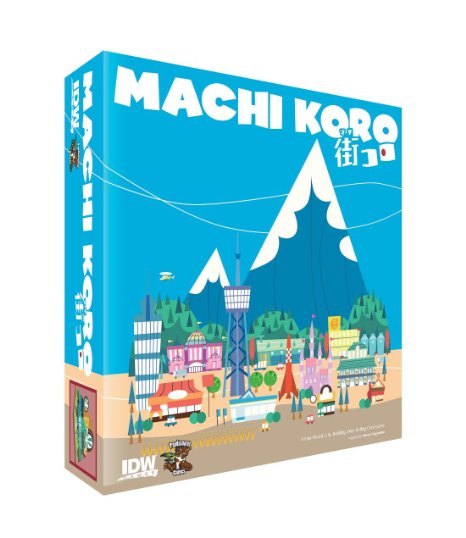
Ring Side Report-Board Game Review Machi Koro

71ejd-+L7TL._SX466_

Product– Machi Koro

Producer– IDW Games and Foxgames

Price– $30 here http://www.amazon.com/IDW-Games-665IDW-Machi-Board/dp/B00JGHCBZA/ref=sr_1_1?ie=UTF8&qid=1422494958&sr=8-1&keywords=machi+koro

Set-up/Play/Clean-up– 20-30 minutes (2-4 players)

Type-Euro

Depth-Light

TL; DR– A good lighter, quicker version of Settlers of Catan. 88%


Basics-Who’s the best mayor of Machi Koro?  In this game each player has just been elected the mayor of the city and starts with two cards that represent the building in the town along with four public works.  The building come with numbers ranging from one to 12 while the public works give you new abilities to the ability to roll two dice or reroll.  On a players turn, he or she rolls one six-sided die and every player consults the cards they have.  Some cards give you money on anyone’s turn, some only on your turn, and some steal from the player who rolled the dice.  After rolling the dice, the player can buy a card or build a public work.  Then, play continues with the next player doing the same.  The game ends when one player builds all four of their public works and is the best mayor!


Mechanics– This game is like a less complicated version of Settler of Catan.  That doesn’t make it bad, but it somewhat simpler.  There are some choices, but don’t look for Rococo level’s of depth or strategy here.  It’s fun and you can make some plans.  However, even the best strategy can be ruined by rolling like crap for half an hour straight.  Also, there is no real way to deal with a runaway leader.  That person either rolls something or the other players have to luck out and steal from him/her with specific buildings.  It’s fun, but has some balance issues. 3.75/5


Theme- The theme in this game is kind of off.  It’s cute and easy to play, but why are there up to four mayors of the same town?  I felt more like a land developer than a mayor.  I did have fun, and I did feel like I was building something, but I didn’t feel like the leader of a town.  In addition, I also don’t understand why some buildings hurt other players.  Why does my cafe steal from the other players?  It does feel light and cute, but I don’t get some of the feelings the designers hoped I would have. 3.75/5


Instructions– You can open this game up, read the rules, and be playing in less than five minutes.  The game isn’t super complicated, and the rules don’t over compensate things either.  I like what I’m seeing here! 5/5


Execution– The game is some dice, some money tokens, and some cards.  It’s not much, and others have done similar things.  But, this game is one of the best executions of these basic components.  The dice get their own separate areas of the box while the cards have nice dividers to keep things from getting messy.  Also, the art is nice and cutesy.  And the best part is all this is on some nice high quality cardboard and plastic box inserts, so the box doesn’t feel like it’s going to fall apart! 5/5


Summary– I love Settlers of Catan, but sometimes it’s hard to get a game in.  This one feels like Catan, but is much quicker and lighter.  You can’t expect a ton of strategy though, and the theme of being a mayor feels a bit off.  However, if you just want that quick Catan-like game experience or need an under half an hour quality game, this is a great option to have.  90%

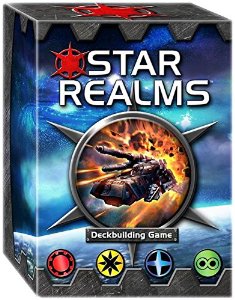
Ring Side Report-Board Game Review Star Realms

61PnzYzKHyL._SY300_

Product– Star Realms

Producer– White Wizard Games

Price– $15 here http://www.amazon.com/White-Wizard-Games-Realms-Deckbuilding/dp/B00HRGMPIU/ref=sr_1_1?ie=UTF8&qid=1421897585&sr=8-1&keywords=star+realms

Set-up/Play/Clean-up– 15-20 minutes (2 players, but multiplayer options available)

TL; DR– Lack of theme hurts an excellent game.  83%


Basics-Ready to rule the galaxy?  In Star Realms, two players face off by trying to destroy the authority and fleet of the other player.  Each player starts with 50 authority and ten cards.   These ten cards are eight one-trade cards and two one-attack cards.  Players have a hand of five cards.  On your turn, you can play as many cards from your hand as you want to give you trade (money), attack, more authority, or other effects.  From the pool of trade and attack, you can spend trade to buy as many cards as you can from a row of five cards set between the players and attack the other player.  Cards you buy are placed in your discard area.  Each card you buy will have a trade cost and can be one of two types: bases and ships.  Ships function just like the starting cards providing trade, attack, and authority.  Bases function like ships except that they are played in front of the player and act as a shield for an amount of damage.  Both of these may also have faction abilities and scrap abilities.  Faction abilities provide additional resources, but you have to have another ship or base in play of the same faction to trigger the ability.  Scrap abilities permanently remove a card from your deck, but provide you with a onetime ability.  With your attack you can attack bases first, then the player’s authority.  At the end of your turn, you discard all cards you cannot play, and then you draw a new hand of five cards.  If you cannot, you shuffle your discard pile and draw from the new stack of cards.  Play continues like this until one player has zero authority left, and the other player wins!


Mechanics– This is a game like magic made by two guys who won the pro tour.  They knew what they were doing when they made this game.  It’s sleek, quick, and full of tactics.  You get all the fun of combo building for magic with a onetime price tag for a trip to McDonald’s. 5/5


Theme- Here is the weakest part of this game.  The rules don’t have much more than a simple paragraph on what’s going on.  The factions are never really discussed in any detail.  The cards have some great art and flavor text, but aside from that there is no theme or story here at all.  It’s just deck building.  2/5


Instructions– The game is easy to play, and even easier to learn.  The rules are less than a double sided sheet of paper.  Honestly, I sat down with a sealed box, and was playing in five minutes.  My wife who hates to have to learn new games on the fly absolutely whooped my butt.  That’s a testament to how good the rules are. 5/5


Execution– It’s a box of cards with two rules sheets.  The best part is the point cards.  Rather than have you write down your score like in magic, this game has double sided cards for your points.  It takes a bit to get used to as they are double sided 10/20 and 1/5 denominations, but it’s a nice touch.  However, the card stock is a bit low quality.  I’ve played about five times now, and some of the cards are already bending and ripping.  4.5/5


Summary– I feel a little bad about the score of this one.  It’s honestly an awesome game, but the severe lack of theme in this one really hurts it.  It plays quick and teaches as quick.  I think I’m going to have to buy some card sleeves because this one isn’t as well put together as some other card games.  This is a fun game, but don’t come into this one looking for any story.  83%

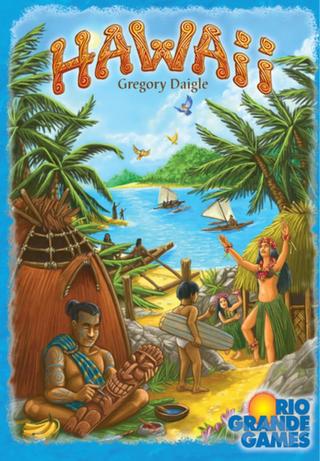
Ring Side Report-Board Game Review Hawaii

phpThumb_generated_thumbnailjpg

Product– Hawaii

Producer– Rio Grande Games

Price– $150! at Amazon-Good Luck anywhere else! http://www.amazon.com/Rio-Grande-Games-469RGG-Hawaii/dp/B007515EVC/ref=sr_1_1?ie=UTF8&qid=1421289771&sr=8-1&keywords=hawaii+board+game or FREE at Board Game Arena!

Set-up/Play/Clean-up– 90-120 minutes (2 to 5 players)

TL; DR– In depth strategy from a simple game. 85%


Basics-Are you ready to become the big Kahuna?  In Hawaii, players battle to see who will be the next best chief.  Hawaii is a game with several different sides to it.  The main goal is most points.  There are a few ways to go about that though.  Each player has several different villages that they can grow to score points at the end of the game.  To get points for each village, it has to be long enough to reach the tiki for that column it reaches and have a Kahuna at its start on the beach.  For now, just think you have to have a start point marker as well as a distance marker for the villages.  To get village tiles, the players take turns gathering people, places, gods, and resource tiles from the main island.  This main island has several different buying tiles that are separated randomly into three rows.  Each turn during set up, you randomly select different cost tokens for each tile.  The last buying space on each tile will show the maximum total cost to all these tokens.  If you ever draw a token that would put the total cost over the maximum cost, then that token is flipped upside down and placed in the fishing lagoon as all tokens have a cost side and a fishing side.  Cost tokens are also placed on all the order selection spaces besides the first one.   This game has a two sided economy for these tiles.  You have to play to move to a place with feet and pay to buy things at a tile with shells.  To move to a tile, it costs feet.  To stay on a tile, costs feet.  To go back to the beach is free.  Players then go in turn order moving to the tiles and buying what’s there by moving onto one of the cost tiles and placing that location in one of their villages on their own player board.  Therefore, cost tokens limit what can be bought each turn.   Further complicating things when you buy a tile, you can decide to pay double the cost of the cost token you moved to.  If you do this, you buy the more amazing side of the tile for the location.  The more amazing sides reduce costs, give your extra points, give you extra money, and in general are better.  At the beach players can use boats (something that you can buy from a tile) to go to the islands.  These islands give you point as well as locations and money to spend.  Also at the beach players can use boats to get the fish tiles that were placed in the lagoon earlier.  And finally, players can move on to the turn order track to determine next turns order.  While this seems pretty simple, what compounds this is the spending requirements for each round.  Each round a token indicates how much players have to spend to get more points.  Whoever spends the most gets more points, second most gets slightly less, and then anyone who at least spends the minimum gets a point amount too.  However only the token and fish tokens you have count for this spending requirements!  Thus if you spend double to get the better version of a tile, it only counts for the original amount.  This massively increases the strategy of the game as buying the most expensive thing might backfire in a large way, and deals are an even more amazing values you have to really look for.  After all players are on the turn track, the round ends, players get points if they spend enough, the turn spending token indicates how much money everyone gets for the next round, and new spending tokens are placed on all the different buying locations.  At the end of the fifth round, players count up points from their villages, and the player with the most is the big Kahuna and next chieftain of the tribe!


Mechanics– When I played this the first time I hated it.  I constantly got mixed up in the rules, didn’t understand the general mechanics, and overall was a mess.  However after really dissecting this one, it’s amazing.  The two different resources are an amazing way to make the game stand out.  Feet and shells are not tradable.  There is no exchange rate between movement and money, and this makes you have to really decide what parts of your villages you need and must built to win.  And built you must.  Your village not only gets you end game points, but it also gets you more resources each round.  This game forces you to think on about three fronts as well and have to second guess all your opponents to make sure they don’t move to the spot you need next.  It’s not perfect as a runaway victor can easily destroy everybody else, but that’s a problem of the other players not seeing the strategies and values that are available.  A well versed gamer will decimate a new players, but this game despite having some randomness, is a hard Eurogame. It’s not perfect, but it is some great, thinky fun.  4.5/5


Theme- There is a lot of different Hawaian things here, but not everything feels like it belongs.  Surfers reduce the amount have to spend each round to get points by 2 or 4 shells.  I don’t know why.  Some huts get you extra feet.  Also why?  What is in this game does feel like something that would come from a tribal island group.  They tokens and board all do feel like Hawaian stereotypes.  That’s pretty fun.  However, I’m not sure why I have feet and shells.  Is my chief like Homer Simpson and after too much work, he’s tired for the day?  It’s not a perfect fit, but some aspects do feel like they fit. 3.5/5


Instructions– Rio Grande Games does a good job explaining their games.  This game has not one, but two rule books!  One book gives the basic rules, and the second explains all the pieces in depth.  I like that.  The game has some sticking points, but honestly, by rereading a few times, you can easily figure out what’s going on. 4.5/5


Execution– The pieces are not bad.  It’s well done cardboard with some good wooden tokens.  The box is pretty decent, and the components hold up to some wear and tear.  It’s not perfect as it’s a bit small, and you have to shuffle some hard cardboard pieces, but overall it’s reasonably well done.  4.5/5


Summary– Time for a personal story.  My mother player this game online-once.  The next time I come home, she had BOUGHT a physical copy of the game!  She paid the over $70 for this game and loves everything about it.  Now, we make a point to play this game when I get home.  It’s honestly a fun game that has some amazing depth.  It’s not perfect as some aspects don’t quite make sense or are not executed as well as may be needed.  However, if you see this game online or at the GenCon Game library, pick this one up.  When you know what you’re doing, it’s a fast paced game with lots of levels to it that will have you thinking on your feet the entire game.  85%

Blurbs from the Booth-Top 10 Reviewed Games of the 2014

Everybody else gets to put out there top 10’s, well, so do I!  Qualifications are I had to review your game in 2014.  Only 52 (wow, I play a lot of games!) were selected, and I narrowed it down to 10.  Let’s see if your favorites on the list.


10- Shadows of Malice-$50- Review here –https://throatpunchgames.com/2014/11/30/ring-side-report-board-game-review-of-shadows-of-malice/  It’s not the prettiest one on the list, but it makes up for that in sheer effort.  This game covers a ton of ground from world building to theme.  It’s completely random, but if you don’t mind lots of dice rolling, it’s a blast for a co-op game.


9-Terra Mystica-$80- Reviewed here- https://throatpunchgames.com/2014/04/09/ring-side-report-board-game-review-of-terra-mystica/  The first euro on the list.  This is a fun game, but man is it deep.  Think Mariana Trench deep.  It’s a fantasy game about terraforming, but worker placement and action selection blend together into a beautiful game.  Also, you could beat someone to death with the components in the box-lots of wood pieces in this one for a great value.


8- Viva Java: The Coffee Game: The Dice Game- $30- https://throatpunchgames.com/2014/06/24/ring-side-report-board-game-review-of-viva-java-the-coffee-game-the-dice-game/  And now the first family game on the list.  This one is an extremely light game, but it’s got a few sneaky elements of depth that will surprise you.  It’s quick, teaches in less than five minutes, and you can master this in 10 minutes.  Quick fun.


7-Eminent Domain- $40- https://throatpunchgames.com/2014/05/05/ring-side-report-board-game-review-of-eminent-domain/  An awesome 4X game that is also a deck builder with a twist.  Every action you take also gives your opponents the same action.  That’s a fun twist that blows Dominion out of the water for me.


6-Tiny Epic Kingdoms- $20- https://throatpunchgames.com/2014/10/22/ring-side-report-board-game-review-of-tiny-epic-kingdom/ How about a 4X game the fits in your pocket, plays in 45, and has more depth than most games out there?  How about if that game costs about as much as a quarter of the other games out there?  SOLD!


5-Firefly the Board Game- $60- https://throatpunchgames.com/2014/02/27/ring-side-report-board-game-review-of-firefly-the-board-game/  Take Shadows of Malice and wrap it in an IP I love.  Give it awesome components, and you get this amazing game.  Randomness can bite you in the butt hard core, but all American-style games like this have that problem.


4-Panamax- $50- https://throatpunchgames.com/2014/12/23/ring-side-report-board-game-review-of-panamax/ Ya, I know, it’s a game about moving ships.  That might seem boring, but honestly its one of the more impressive semi-cooperative games out there.  You can’t win unless you invest in the others.  You can ship if you don’t work together.  Lots of tough choices have to be made to make this game work and for you to win.  And that a fun brain buster of a game.


3-Sushi Go!- $13- https://throatpunchgames.com/2014/12/23/ring-side-report-board-game-review-of-sushi-go/ It’s a drafting game about making the best sushi choices you can.  It’s quick, it’s fun, and you don’t need to be able to read to play.  Family fun at its best!


2-Skull and Shackles Adventure Deck 2- Raiders of the Fever Sea- $20- https://throatpunchgames.com/2015/01/02/ring-side-report-board-game-review-of-skull-shackles-adventure-deck-2-raiders-of-the-fever-sea/  I love the Pathfinder Adventure card game, but I also think this is the best version of it out there.  Simply put, you will feel like a pirate and an adventurer as you play this adventure deck.


And finally, NUMBER ONE…


1-Rococo- $60-https://throatpunchgames.com/2014/06/30/ring-side-report-board-review-of-rococo/  Yes, my favorite game of the year is a game about making frilly dresses.  No, I don’t have a problem with that.  Take anything I said about any of the above Euro-style games out there and multiply it.  This game has action selection, worker placement, multi-part economies, area control, deck building, multiple paths to victory, and the King of France!  If you want a game where you can build the best strategy you can completely different every time, this is your game.  I played this game by accident at Origins, but honestly, it’s one of the best choices I’ve made all year.

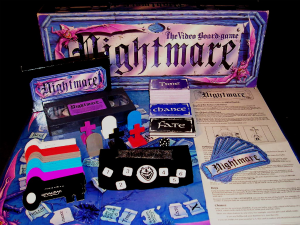
Ring Side Report-Board Game Review Nightmare


nightmareblogfull

Picture from magisterrex.wordpress.com


Product– Nightmare

Producer(s)– A Couple of Cowboys and many others

Price– ~$10 at http://www.ebay.com

Set-up/Play/Clean-up– 60 minutes exactly! (2 to 6 players)

TL; DR-90’s-riffic horror game on a VCR! 90%


Basics-Ready to play MY game?  Nightmare is a big bowl of the early 90’s in a VHS cassette.  Yes, I said a VHS cassette.  Go dig in your garage and find a VCR.  In Nightmare, each player takes the role of some poor damned soul ranging from a werewolf to a vampire.  This is chosen by the tombstone you randomly draw from a bag.  Also from this bag, you draw a number that you slot into your tombstone.  You then place your character on the board on your gravestone.  Next, each player then writes down their worst fear with china markers on the nightmare cards.  These cards are shuffled, placed on the center space of the board, and then the game begins.  Players start the VHS tape, and the Gatekeeper gives you the rules.  When he’s on the TV, all play stops.  When he’s not on the TV, you roll a six sided die and move.  The Gatekeeper will randomly appear during the game, given random orders or outright be a pain to just one player!  Players try to go around the board as fast as they can collecting chance cards, time cards, and fate cards.  Chance cards are random events that might give you keys.  Time cards give you specific times and an action that range from taking extra turns to yelling out loud to scare everyone to get them put in the black hole (basically jail from Monopoly).  Fate cards are random cards that give you extra powers and opportunities to win keys.  The goal of the game is to earn all six of your keys that grand you extra powers, move to the center of the game board exactly, and reveal to top nightmare card.  If it’s yours, you instantly lose.  If it’s not, you win!  If the game goes sixty minutes, then the Gatekeeper wins, all the players lose, and the nightmare is just beginning!


How about a picture of the Gatekeeper?

images (1)

From www.kotaku.com.au


Mechanics– This is roll to move madness.  You will roll the dice as fast as you can to move your characters as quickly around the board as possible.  Let’s face it, this is not modern (or good) game design.  The cards that you get are completely random and might not be helpful at all.  And, if you really want to remove all the fun from the game, you could easily memorize what times the Gatekeeper pops on screen and work out the math of how to win.  But, that’s not fun.  This game is an experience, not a Spiel des Jahres candidate. 3/5


Theme- This game is theme.  From the instruction that tell you to dim the lights, to the Gatekeeper constantly messing with the players, you WILL experience some scares from this game.  It’s like a haunted house in a board game. 5/5


Instructions– For as much crap as I give this game, the instructions are not bad!  They leave a few holes, but overall, they teach the rules pretty well.  Also, if you compulsively have to debate the rules of a franticly moving game, then this game is not for you! 4.5/5


Execution– The box looks like a coffin.  That right there should set the tone.  The pieces are all nice plastic.  The board looks creepy.  The game even comes with a felt bag to randomize the pieces.  The designers went an extra mile to really put out a quality game.  5/5


Summary– This is pure, uncut nostalgia for me.  I got this game for Christmas when I was 11.  When I moved, it was destroyed by some flooding.  I picked this game up for 8 bucks at a con, and that was the smartest move I’ve made in a while!  I love this game!  It’s become a tradition with my family that we now play this as the last game I play when I visit home for Christmas. Not even close to the right season for ghouls, but I don’t care.  Honestly, for 10 bucks on ebay, you can’t beat this retro game!  It’s the most theme you’ll get all year.  And, you get awesome early 90’s special effects!  Now you just have to find a VCR.  90%

Ring Side Report-Board Game Review of Skull & Shackles Adventure Deck 2 – Raiders of the Fever Sea

Product– Pathfinder Adventure Card Game: Skull & Shackles Adventure Deck 2 – Raiders of the Fever Sea

Producer– Paizo

Price– ~$20 here http://paizo.com/products/btpy95dj?Pathfinder-Adventure-Card-Game-Skull-Shackles-Adventure-Deck-2-Raiders-of-the-Fever-Sea

Set-up/Play/Clean-up– 30 to 60 minutes per scenario (1 to 6 players, five scenario)

TL; DR-BEST AD SO FAR! 98%


Basics-Let’s be bad guys!  In the last adventure deck, the pirates get their first ship.  Now it’s time to be real pirates.  Loot as many ships as you can, earn the favor of Tidewater Rock, and go on an adventure in the deep sea!


Mechanics– The game really ties the theme to the mechanics.  It still has the randomness that somewhat hurts the theme, but the new mechanics really hit the theme hard like a sledgehammer on a tack.  Pirate hunting with the chance of catching the attention of the authorities?  Awesome.  Having to find a particular villain to open up a dungeon?  Even better!  It’s a well done adventure deck! 5/5


Theme- This game really hits home the theme.  It has lots of piracy with the mechanics to back it up.  Also now new mechanics for the specific missions are introduced to really make a dungeon crawl come alive.  Well done!  Do this more often! 5/5


Instructions– The base instructions are all you get besides the stuff on the cards.  I still want a sheet with more story and instructions for the game.  What is on the cards is good, but I still want a bit more.  Also, explaining who the characters are, especially the allies, would help me get a bit more into the feel of things. 4.5/5


Execution– Tell you what, Paizo has heard some of what I’ve said and this proves it.  It’s a card game, so it’s got good card stock and art.  Fine, I expect that.  But you know what, SIDE OPENING FLAPS! I can open up the package while not destroying the box.  Here is your five for that. 5/5


Summary– This adventure deck is the best adventure deck so far for either season of the card game.  I felt like a pirate.  The mechanics are slick.  The theme is awesome.  THE BOX OPENS ON THE SIDE!  Well done!  98%

Ring Side Report-Board Game Review of Sushi Go!

Product– Sushi Go!

Producer– Gamewright

Price– ~$13 here http://www.amazon.com/Sushi-Go-Pick-Pass-Card/dp/B00J57VU44/ref=sr_1_1?ie=UTF8&qid=1419311517&sr=8-1&keywords=sushi+go

Set-up/Play/Clean-up– 30 minutes (2 to 5 players)

TL; DR– Quick family fun. 90%


Basics-Hungry for some more quick sushi games?  Sushi Go! is a simple family card game that follows many of the same drafting mechanics popular in 7 Wonders and Among the Stars.  Players start with a hand of cards and choose a card.  All players reveal their chosen cards simultaneously.  Some cards are instant point cards like nigiri cards.  Other cards are worth more as you gain more of the same card like dumplings.  Yet others need a specific number of cards of one type to get any points like tempura where every two score points.  And some are worth more depending who has the most of them at the end of the game.  There are also wasabi that multiply other cards, and the chopsticks card.  If players have a chopstick card, they can shout “Sushi Go!” and take a second card from the same hand of cards.  After selecting your card for the round, you pass the cards to the left.  When you only have two cards, you choose one card, and then throw the other into the center.  After three total hands like this, players determine who has the most points and is the winner.


Mechanics– I like a good drafting game.  This one plays quick and teaches even quicker.  My sister who can’t read scored as many points as I did while my mom scored the least points.  It’s a blast to play and won’t require encyclopedic knowledge of some obscure rules.  5/5


Theme- Here is where the game suffers.  I don’t get the feeling I get from Wasabi of being a chef.  This game has cute sushi, but beyond the box and the art, there isn’t really a story here.  If story doesn’t matter to you, then this game is great.  3/5


Instructions– The instructions are a single booklet that’s less than ten pages.  It doesn’t take much to learn and play this game. 5/5


Execution– The cards are decent quality and the whole game comes is a metal tin.  The art is great and all cutesy.  And for less than 15 bucks?  Well worth the price of admission.  5/5


Summary– This game has the family board game awards all wrapped up, and I can see why.  It’s cheap, easy to play, and doesn’t require a ton of priming to get into.  It’s a great intro board game that doesn’t break the bank and travels well too. 90%

Ring Side Report-Board Game Review of Panamax

Been teasing this one for a while.  Here it is, my review of Panamax!

Product– Panamax

Producer– Stronghold Games

Price– ~$50 here http://www.amazon.com/Stronghold-Games-6001SG-Panamax-Board/dp/B00OMXW4U0/ref=sr_1_2?ie=UTF8&qid=1419308500&sr=8-2&keywords=panamax

Set-up/Play/Clean-up– 60-90 minutes (2 to 4 players)

TL; DR– Lots of fun stress between your life and the company. 94%


pic1786212


Basics-All Aboard!  Panamax is a game of becoming the best shipping moggle out on the Panama Canal.  The game even gets its title from a shipping designation Panamax which means the largest measurements a ship can be and still go through the canal.  This is a relatively simple  to play Eurogame.  During set up, players get personal stock and money, and their companies also get money as well as shipping contracts and starting boats.  The shipping contracts are represented by dice on a small card with one to three numbered boxes.  The numbers on the boxes are used to indicate the face up side of the dice placed on them of your color.  Boats have numbers on them ranging from 2-5, 9-18, and so on.  These are the minimum and maximum total dice value that can be placed on a ship.  Players get a chance to load up their dice on ships on the proper sides of the canal during set up.  When a player clears a shipping contract, either in setup or the regular game, they get to place a country flag marker on their companies’ board.  The markers may cover extra powers such as adding shipment dice to the rail board, moving ships, buying stock, and loading extra dice.  Then the main game starts.  For a four player game, twelve dice are rolled, and the dice are placed in columns covering the die face it rolled to indicate different actions a player can take.  At its most basic level, this game is an action selection game.  Players select a die, do the action associated with it, and the turn passes.  You draw three dice a round, and then pay for where your company’s cargo still is and get money from your stock options for the different companies stock you own.  Sides one to three of the action dice indicate ship movements.  When a ship has enough dice on it to cover its minimum value, the ship can be moved.  There are two types of movements: lock and waterway.  Each movement is well indicated on the board with different icons.  When you select a movement die, you use a small tracker at the top of the board to show what movements you have left. When a player selects movements, they have to move all the ships that they can possibly move.  Hidden in movements in a major factor of the game-pushing.  The title of the game refers to how large a ship can be, and that’s the most important factor for pushing.  When you move ships out of a large body of water like an ocean or lake, you can group ships together.  The ships come in sizes ranging from one dice to four dice.  The maximum size that can fit in one lock is four dice.  So, if you would move a group of three wide ships into an area where a three wide ship already is, you push that three wide ship ahead one space.  This can result in chain reactions where tons of ship will move through the canal.  Mastering this will get you the win!  When a ship crosses the canal, players earn money from the die’s values on the ship, and the player who owned the ship can get cards that give you extra moves, load cargo, or give you extra money at the end.  Sides four to six of the dice represent loading cargo actions.  Just like in set up, you take a card with different cargo values on it with the different countries.  The dice you pick up will also show you how much cargo you can load this turn ranging from one to three dice.  If you don’t load cargo from the warehouse, it costs lots of money per die, while having cargo waiting to go into the canal still costs a ton, but slightly less.  Having cargo moving through the canal is slightly less expensive.  And, just like setup, completing country cards will get you markers for each country.    In addition, four more dice are rolled and these are placed on a separate area for executive actions.  These extra actions allow you to buy more stock, have three unrestricted moves, load new cargo/take country cargo cards, and change the value of your stock.  You can only take an executive action die after all the other dice of that number have been used up.  While that’s a lot of words, this game is surprisingly simple, but deviously complex.  Know when and what to do will help you maximize your income.  There are also military ships, cruise ships, and rail cargo.  Moving military ships will earn you a once per turn money bonus equal to the number of country cargo markers on your company’s board.  Cruise ships earn your cruise ship markers that have values from 1 to 5, and you get to place that marker on your company board earning your permanent powers like extra loads and extra cargo cards to choose from.  Some cargo has a rail icon next to it, and you place that cargo on a separate section of the board. Rail cargo dice number is used to change what player goes first and get you extra country cargo markers.    After three rounds, you sell off your stock to the bank, count all your money, and just like life, player with the most money wins!


Mechanics– This is a hard Eurogame.  Nothing is too difficult here once you get the hang of it.  However, knowing what you need to do make this game some brain burning fun.  This game has two levels to it:  your personal money and your companies.  You might be the best player in the game, but if you don’t invest wisely, you could lose.  Those levels of the game make this much more interesting that just who has the largest company at the time.  Also, these different levels of play make a player have to consider when that player will take stock market options to be selfish and when a player will take actions to better his company.  Constantly having smart choices to make makes this an amazing experience.  My only problem is you will most likely only get the option to buy stock on round one and round three.  I haven’t found a way to buy stock all three turns.  Wish there was a way to make a bit more personal money.  4.75/5


Theme- This game does make you feel like an executive at a cargo company.  Do you better your own company or do you better your own stock portfolio?  Focus too much on one you will fail.  Focus too much on the other and you won’t have enough personal money to win.  Choosing what to do makes you really have to think and adds a tension to the game you will enjoy.  Also moving all the ships is fun and does make you feel like a shipping magistrate.  All said and done, it’s a blast.  5/5


Instructions– This game plays like chess, and to win you need to really understand the rules.  The rules do a decent job of communicating the game, but lots of little details are semi-hidden in the rule book.  They are there, and after two read through of the rules, you will get them all.  But that’s after two good read throughs.  4.5/5


Execution– Stronghold Games makes great games, but for some reason, their Eurogames tend to get light-weight boxes.  My copy of CO2 is flimsy and this box is flimsy as well.  My copy of Panamax even came dented up.  Inside the box, the game is great.  AND IT COMES WITH BAGS!  That right there is worth a 4!  I did have a small problem with the layout of the game.  I would have liked an area where my personal stuff went besides just in front of me, not on my clipboard.  All told, few small changes would easily get this up to a 5.  4.5/5


Summary– I love Stronghold Games and the hardest working man in board games Stephen Buonocore. I’ve been waiting for Stronghold to make some more hardcore Eurogames.  And, when this one came out, I bought it as soon as I could.  I’m happy to say this is an awesome game that gives you a great Eurogame experience.  Choices on what to do each turn, how to maximize your actions, and still get enough money to be better than the Joneses dominate this game and provide the positive stress that makes Eurogame so much fun.  Want a new game that focuses on ships and international relations?  This game is well worth the price of admission. 94%

Ring Side Report-Board Game Review of Wasabi! now Sushi!

Product– Wasabi!

Producer– Z-Man Games!

Price– ~$50 here

Set-up/Play/Clean-up– 45 minutes (2 to 4 players)

TL; DR– PLAY AT A SUSHI-YA!  98%


Basics-Irasshaimase!  In Wasabi, you play a sushi chef trying to make as many orders happen as you can.  Each player starts with a recipe book, point tokens turned over to the number of ingridiants side, and a bowl for wasabi.  To start, players go around the table selecting three pieces of sushi that are handed to the next player, so you don’t get to pick your starting sushi.  After this, each player then chooses three different types of sushi to make ranging from easy two sushi piece combinations to the extremely hard five piece sushi.  Once every player has their three sushi pieces and their three recipes, the real game starts.  On your turn you can do two things: place a sushi piece or discard as many recipes as you want and draw new ones.  When you place sushi piece, you check to see if it creates any of the recipes you want to create.  If you do, you get to turn over a point token possibly gaining extra wasabi cubes (points and tie breakers), gain a power card, and draw a new recipe.  If you don’t finish a recipe, then you just draw up to your three sushi pieces.  Power cards allow you to change tiles on the board, place on top of other tiles, remove other pieces, and even place two tiles.  You can only gain one power card per turn, and you can only use one power per turn.  Discarding and drawing new recipes is pretty simple; discard what you don’t want, and draw up to three recipes.  The game continues until someone finishes all their for point recipes tokens, or until no more legal moves can be made.  The best chef is the person with the most points and wasabi cubes.


Mechanics-This is a fun one that can be pretty frustrating if played poorly.  There are some strategies that will work like doing your five point recipe first, then moving to your four, and so on while keeping a few easy two piece recipes in your plans to keep getting power cards.  That kind of makes the game less fun as there are less smart ways to play than different way to play.  However, if you want a simple game that is a much smarter version of tic tac toe, this is a good one to have on hand.  4.5/5


Theme- The game starts you out with soy sauce bowls and recipe books that look like menus from a Japanese dinner.  That right there fills that game with some awesome theme.  The board looks like a matt, and the tiles all look great.  I have never played this game and not left hungry for sushi.  You will feel like you spent 45 minutes in a sushi restaurant staring at the menu. 5/5


Instructions– The instructions are done fairly well.  There are a few minor English issues, but overall they communicate the rules well and explain the game quickly. 5/5


Execution– I love chunky cardboard!  This game has a ton of heavy cardboard pieces with all kinds of sushi ingredients on them.  The board is nice, and the art is great. You will leave this game hungry.  Also, I flat out love the menus that serve to hide a player’s pieces and the soy sauce bowls for wasabi points. 5/5


Summary-This is a fun, quick game that anyone can play. Players don’t need the in depth strategy that some games require.  It’s a simple tile laying game that you learn in a minute, and master in about five.  Some of the mechanics can lead to players losing through no fault of their own, but overall it’s a blast to play.  Moreover, all the different ingredients will leave you hungry!  The theme is so awesome that you will want to go to your favorite Sushi restaurant after playing this one. 98%

Ring Side Report-Board Game Review of Shadows of Malice

pic2037527_t


Product– Shadows of Malice

Producer– Devious Weasel

Price– ~$50 here http://www.amazon.com/Devious-Weasel-Games-IMPDWE1000-Shadows/dp/B00NAG5YCK

Set-up/Play/Clean-up-2-6 hours (2 to 8 players)

TL; DR– Say yes to being a God in the American style game. 86%
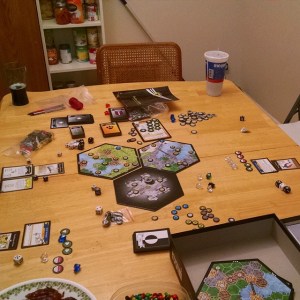
10817844_1503711186566683_1116632659_n

Basics-Fight the darkness!  In Shadows of Malice, an ancient evil is stirring, and the players take the rolls of avatars of light trying to stop it.  To do this, players must find the hidden strongholds of light among all the strongholds that have fallen to darkness before the vile Xulthûl.  Each player starts with an item, soulshards, and a special power.  Over a series of turns, the heroes move across the map revealing towns, mystics, monster lairs, and strongholds while shadow tries to find the strongholds of light.  Each turn, players roll two six sided dice, one for movement and one for fate.  If the player rolls doubles they draw a fate card.  Fate cards range from great effects like doing extra damage to horrible effects like permanently getting a negative on all dice rolls.  Fate cards last until they are spent or until a new fate card is drawn.  The players can then spend movement points to move across the map.  If player end on tokens or monster lairs on the map, they can encounter what’s there.  In towns, you can spend soulshards to get items like potions or treasure.  Mystics will heal or remove fate cards and make potions.  Monster lairs and stronghold have monsters.  When players encounter a monster, they roll to see the monsters type, the monsters power, and how many abilities the monster has.  The type affects some powers and treasures, but provides flavor for the encounter.  The power determines how much damage the creature does, how much the creature adds to its attack, and how much life the creature has.  The abilities add new flavor to each combat like preventing damage or adding to the monsters attack.  Combat is pretty simple.  Both sides roll a six sided dice and add bonuses based on treasure, monster’s power and other cards.  Before each roll, players can spend soulshards to activate abilities or to increase their dice rolls.  Whatever side has the higher combat check does one damage to the other side.  Some treasure, abilities, and powers allow monsters and character to possibly do extra damage depending on random dice rolls.  Combat continues over these rounds until one side runs away or until someone dies.  If the players win, they gain soulshards based on the powers available and have a 50/50 chance to gain clear soulshards on a one for one basis for each the monsters life points.  If players travel together (forming a band), each character beyond the first player add an extra six sided die to the player’s combat roll.  After the players turn, the shadows take a turn.  Shadows randomly remove one seal from their realm each turn.  Then, either spawn a new shadow or randomly move a shadow present on its own game board.  If a shadow moves onto the spawn point, it gains life.  However, if a shadow moves onto an open portal, the shadow moves to the player’s side.  From now on, this shadow will move one to two spaces toward the closest stronghold.  If the shadow gets to that stronghold, and the stronghold is a light stronghold, then the shadow becomes Xulthûl and fights the players.  Players can fight shadows in the normal world to prevent this, or kill Xulthûl.  Play repeats like above with players having a turn, then the shadows.  The player’s goal is to find the hidden light strongholds among the shadow ones.  For each light one found, the players gain power.  However, for each shadow one found or uncovered by the shadows in the main world, the darkness gains power and all monsters are harder to fight.  Once players find the one light stronghold per map tile, they win!


Mechanics-The mechanics are pretty simple with lots of randomness from the dice. When you know what you’re doing, you can generate monsters and end fights quickly, moving the game closer to two hours rather than the six..  The randomness can really bite you in some cases, but since you roll tons of dice, the swingyness of the dice is counteracted by probability.  This game feels a lot like Arkham Horror with moves, combat, and some events determined by dice.  That’s some good company to be in.  4.5/5


Theme- This game really excels at the theme.  The game starts with an interesting story, and adds random elements that are on point.  The game is a quest to discover things and defeat monsters.  You get the feel of combat and exploration with lots of variation.  Some changes are pretty cosmetic like the type of monster, but even those simple changes do allow you to build a story in your mind.  It’s not perfect as some elements like the monster abilities can randomly generate monsters that don’t make sense (vampire ooze with an exoskeleton!).  But, you get the chance to start on a story from the book and build on the story of being a god if you want too. 4.5/5


Instructions-I don’t like how the rules are laid out.  The rules use a numbers system with subsections numbers, kind of like a legal document.  I haven’t seen that done really well, and that kind of hurts this book.  Also, this book really needs a quick turn-order page.  The order of turn actions is all in the book, but the book is a bit unorganized and you will get lost for a while trying to determine how turns work.  However, if you read a rule a few times, you do get a decent sense of how to play.  And, this document does list all the pieces (AND give little pictures of the pieces!) and what they do instead of assuming each piece will make sense.  Those details really do help make the game that much easier to understand and play.  While I try to just read the rules when I play, Devious Weasel has several videos explaining the game.  They do a good job, but by themselves, the rules do a decent job of explaining how to play this game. 3.75/5


Execution-This game is as third party as they come.  It’s from a smaller company.  I have to admit, even as a well versed gamer, I’ve always been a bit hesitant to play games by smaller, local companies.  They sometimes don’t have the production quality or art skill of larger companies.  I’ve seen quite a few badly drawn maps with cheap quality cardboard pieces that just don’t stand up to any plays.  This game convinced me to give up the prejudice.  The pieces are nice, chunky cardboard.  The art is generic but well done.  You can tell this is a small company, but it’s not bad.  In fact, I’m pretty happy with what’s in the box.  Heck the box is even well done!  My problems are with the dice.  I would like a few more different colors instead of different size dice.  Also, turn guide or turn order cards and extra terrain/monster generation cards would have really knocked this one out of the park.    4.5/5


Summary– If you’re looking for a fantasy version of Arkham Horror, this is the game for you.  Honestly, I had a blast playing this one.  It’s got simple mechanics that generate a near infinite series of combinations of games as players get the chance to explore a new world every game. It’s not perfect as randomness can make some games simply not fun to play due to some crushing difficulty, random monsters that don’t make sense, or just monsters making all the right moves.  However, if you can get past the standard problems of American style games, you will get to be a god and save the day!  If someone asks you to play a god in Shadows of Malice, SAY YES! 86%