Ring Side Report-Board Game Review of Kanban: Automotive Revolution

pic2041406_md

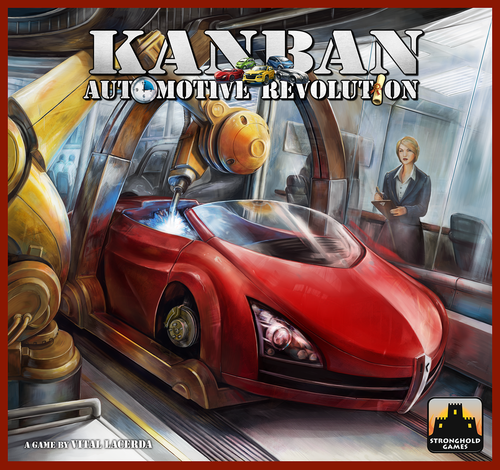
Product– Kanban: Automotive Revolution

Producer-Stronghold Games

Price– $60 here http://strongholdgames.com/store/board-games/kanban-automotive-revolution/

Set-up/Play/Clean-up– 60-90 minutes (2-4 players)

Type-Euro

Depth-Heavy!

TL; DR– Almost too complex…Almost 90%

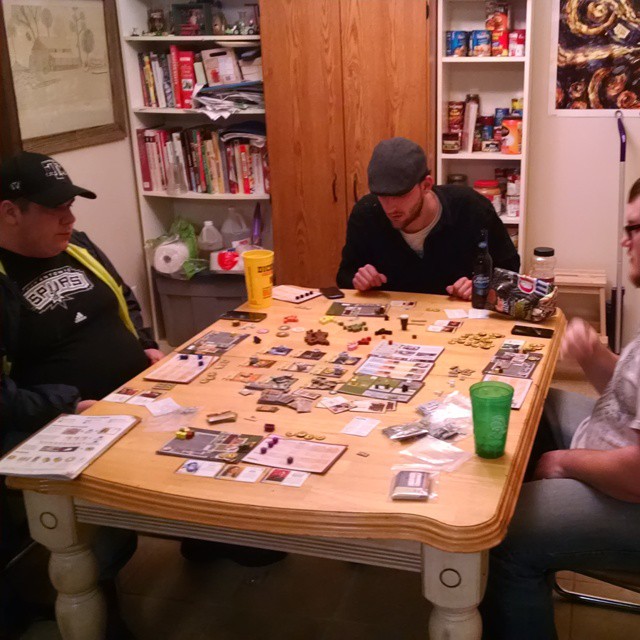
Basics-Who can build the best car?  In Kanban, each player takes the roll of a car designer in the Kanban Company.  Under the careful eye of your supervisor, players choose what departments they want to work in each day for three weeks or until there are three companywide goal assessment meetings.  I won’t go as in depth as the rule book, but here is a quick summary of the rules.  The departments players can work in each day include: administration, design, logistics, the assembly line, and testing and innovation.  Players can choose which department they want to work in and place a worker on one of two spots in that determent.  These spots determine how many shifts a player can take in that determent, usually two or three, an in which order they get to work with the first having fewer shifts, but being first.  Each shift in a department allows you to do a few different actions.  Here is a quick summary of the different actions:

Design: get car designs and car designs with upgraded parts

Logistics: pick up car part cubes for yourself or place part cubes on the main board for all

Assembly: spend car part cubes to build cars

Testing and Innovation: spend car designs to get cars OR spend car designs with upgrades and a car part cube to improve a car part

Administration: use one other area’s abilities

Players also have the option to train in each area.  By training players can unlock new abilities in each area as well as allowing more storage on their player board.  In addition, when it comes time to score points later, players order is determined by who is the most training in more areas.  The supervisor will move around the board, and if you take a shift in a location with the supervisor, the boss will evaluate your performance in that section.  Here is where the game adds an extra layer with two modes of play.  One mode the boss is nice and gives you extra points if you are being productive.  In the other, the boss punishes you if you fall short!  The boss also moves between sections to move the game forward.  When she moves back to administration, she advances the week marker.  When the game reaches the third week, the game is over.

Also, when players use car designs to put cars in their personal garage on their player sheet, this moves a pace car in testing and innovation depending on how far back the car they took was.  When the pace car in testing and innovation moves to a certain point on the testing track, you have a meeting at the end of the business day.  Meetings are the major way to score points.  As you do other actions in the different departments, you will earn chairs at the business meeting.  Some of the actions to earn chairs are building specific cars or training in a number of different departments.  At the meeting, players can place chairs on goal point cards to score those points.  Most cards will allow you to have multiple chairs, but the boss will want to hear less and less about the same topic, so scoring later on the same goal card will win you less points until no one can score on that goal at all.  Also, each player can play one card from a hand of goal cards as a pet project that they and anyone else can now score on.  The first set of public goal cards are random, but the second and possibly third set of cards all come from the players hands as you start with three, use one each meeting for a pet project and then play one as a new public goal before being dealt two more cards.  The most important thing to know here is if you don’t have seats, you can’t score points!  The game can also end when the third meeting happens.

The last thing the happens at the end of the game is players can use seats to score points on the game goal conditions.  These end game goals can be scored by as many players as are out there and, as an examples, are having five cars, being training in so many departments and so on.  Then, players get points for each car they have in their player board garages, and they score points for how upgraded each car they have, but only if they have they have the upgraded the car part in one of those cars he or she has.  Players also get points for being first, second, or third on each sections training track and for how many resources they still have at the end of the game. Person with the most points in the end is the winner and best designer in Kanban!

Mechanics– WOW there is a lot going on in this one!  But, honestly in a one page summary without the pieces to play with, it’s a bit harder to digest than when you sit down and play.  It’s still a lot to digest, but it’s not nearly as bad.  The hardest thing for me to wrap my head around was scoring.  How to get the chairs at the meeting is really important, but you can make up for blowing a meeting if you have the right cars and upgraded car parts at the end of the game.  It’s a ton of fun making sure you choose the right department and actions at the right time.  It’s not too hard, and it is a lot of fun.  But, it is a brain burner to understand initially. 4.75/5

Theme– Now, the theme of being an office worker in a car company might not sound like the most fun thing in the world (I’m from Michigan, I know this!).  But, it does feel like you’re part of a company competing to be the best.  Having to get seats at the meeting does feel like you maneuvering politically to get noticed by the boss at the right time.  Having to move between the department really did feel like you were doing different jobs each day to make sure that you got everything lined up to succeed.  Even the limits on the number of activities you could do feel like a really like job.  I can’t work 30 hours in a 24 hour day.  It all adds up to some positive stress that makes a good Eurogame fun!  It’s not perfect though.  While I know Ford gives some good discounts on cars to its employees, you don’t just get to take them home for free!  It’s a few minor things that break some of the illusion of the game.  It’s fun and feels like the real offices experience, in a good way, but some minor things do break the fourth wall a bit. 4.5/5

Instructions– The instructions to this game are good, but they are not perfect.  The game comes with a link to an instructional video, and that really helps.  Also, the designer is spending a ton of time answering anybodies questions on board game geek in a thread.  It’s a really great effort by Stronghold to present this game to the players and to make sure everybody knows how to play it.  That said, the rules by themselves are ok, but it’s got a lot going on!  Even the rules themselves say that you have to read everything!  That should go without saying, but if you skip a little bit of say the Splendor rulebook, you’re going to be ok.  Miss or skim a paragraph in this one?  You will be lost and play the game completely wrong.  But, if you just want to complete board game experience without any internet guidance, the rule book itself will teach you how to play, but you have to make sure you really read this one! 4/5

Execution– As I’ve been doing lately, I made an unboxing video for this game!  Here is a link to the video https://www.youtube.com/watch?v=6628QbxggOs  All I have to say to make my day with this one is: CAR MEEPLES!  I love what’s in this box.  It does come with some bags showing that Stronghold Games does love me!  It also comes with a ton of cardboard for seats, tokens, and car designs.  The car designs are nice chunky cardboard, which makes it hard to shuffle, but it also makes it easy to pick up and play with, so I’m happy. The art on the tokens and the main board is also great.  It’s got a lot going on, but it also doesn’t overwhelm you.  One problem I do have with this game is the same problem I have with many of Stronghold’s Eurogames.  The box is somewhat thin.  I’d like the box to be made of a bit more sterner stuff. Overall, this game has some top notch components that really stand out. 4.8/5

Summary– I really like this game.  It’s truly a puzzle.  Kanban has levels and layers that will make even the most determined and smart players have to really consider what they have to do next.  That also makes it a bit harder to explain, teach, and understand.  I love this game, but I had to work at it to get to that point.  This game is almost too hard for me to understand.  That’s the double edged sword of Eurogames.  Too simple and no one will play it.  Too hard and no one CAN play it.  This might not be my favorite Eurogame of all time, but this is one I will keep going back to as, no matter what I do, I still see new options in this game all while having a blast playing it.  If you want something simple to play game at the end of the night after you might have had too many beers to do calculus, then this is not the game for you. However, if you want a well done, extremely intellectually, surprisingly quick game, then this is for you.  I know I can’t wait to get it back to the table.  90%
Ring Side Report-Board Game Review Ortus Regni


Core_TEST_5_1024x1024


Product– Ortus Regni

Producer– Jon Sudbury Games

Price– $45 here http://jon-sudbury-games.myshopify.com/collections/frontpage/products/ortus-regni-core-box

Set-up/Play/Clean-up– 30-60 minutes (2-6 players)

Type-American

Depth-Medium

TL; DR– This is the coffee table game you need! 95%


2015-03-02_1425265486

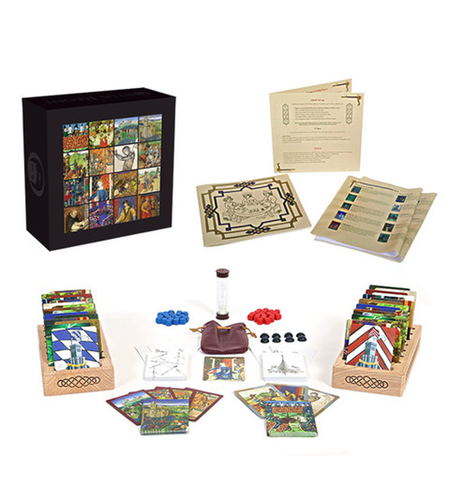
Basics-Forge your kingdom!  Ortus Regni, “Origin of the Kingdom,” is a two to six player card game of dueling earls fighting to create their own kingdom.  The only way to do that is to be the last man or woman standing.  Each turn, a player can take one action and then has to draw one card.  That’s honestly the whole game, but don’t let that simplicity fool you.  The actions range from declaring battle, starting a joust, using a monk to look at another players hand, sending emissaries to the Vikings, and just playing any card from your hand face down to act as a defense of a location.  Every player starts with one location:  their palace.  From there, cards will give you new locations, such as castles which can start a new location, lands to get more soldiers, churches to get favor in battle, and even markets to get more soldiers from lands.  Other cards can be played from your hand, like vassals and champions, whom you can make lords of your various locations, or intrigue cards that can kill other players’ lords or steal soldiers.  Battles are also very simple, as the attacker sends a number of cards at the defender.  Some of the cards may come from the soldier draw deck and some may be lords of fiefs.  The defender can play cards just like the attacker. Then a card is drawn from the battle deck which randomizes the results of the battle, with results ranging from determine damage as normal to a side may not be damaged in this battle.  The other aspect of the game is the Vikings.  The Vikings represent the wild cards of the game.  Each round, if no player attacks, a black token is placed next to the Viking deck. After eight black tokens are placed near the deck, the Vikings arrive.  Control of the Vikings is determined semi-randomly; influence cubes corresponding to each player are placed in a bag and drawn blindly.    Every player starts with a cube in the Viking bag, but some cards allow you to put extra cubes in the bag.  Whoever’s cube is drawn from the back gets to use the Vikings like a club against other players in battles described like above.  The last area I want to talk about is the joust.  Jousts allow earls to steal land from other players.  A player can use a banner card to cause another player to ante up a piece of property as well as ante up a wagered property of his or her own.  Players then draw two cards from the joust deck and see who makes the better hand with the lord they send to the joust with the winner taking the anted lands.  This isn’t all that complicated a game, but the most interesting part of all this is the fact that the game isn’t played with any rules on the cards!  That’s right; every card is just a gorgeous medieval painting.  If that doesn’t grab your attention, I don’t know what will.


Mechanics– Let’s start with the bad before I start heaping praise on this game.  Ortus Regni doesn’t add anything completely new to the card game genre.  It’s got deck building, attacking card bases, different paths to victory, as well as non-player characters that attack other players.  However, what this game does really well is incorporate all those things together.  When I say it doesn’t add anything new, that kind of like saying eggs, flour, butter, and sugar are not really new.  Separate, they are all great things that are done well by others, but together they make an amazing cake.  This is a cake game. Good pieces mixed well together.  It’s not the most revolutionary card game out there, and for some, it won’t kill their Magic addiction.  However, if you want a card game with a single buy in with multiple strategies to exploit, then this is well worth your time and money. 4.5/5


Theme-If you’re willing to invest in theme so much you’ll exclude words on your cards to keep players that engaged, you get a five.  It’s just that simple.  However, past the artistic choices in the game, the game does feel like a battle between lords.  It changes on a dime, shifting constantly as intrigue, Vikings, and straight out battles all cause the world to shift as any political landscape would.  While there are points where the writing is on the wall for an individual game, even then a few events like defenders don’t get damaged, or a random draw of the Vikings can change a game’s outcome.  It feels like I’m making good choices as well as walking the luck line.  I don’t feel like I’m cheated when I lose by luck or win by luck.  It’s got that balance down phenomenally. 5/5


Instructions– The rules are good, but a few things could help them be great.  First the good.  The rules are well done with lots of spacing, examples, and pictures to help new players learn how to play the game.  This is even complemented by the quick start rules that get players into the action really fast.  However, the rules tend to be a bit long, and the absence of an index really hurts quick look up when you need it most mid-game.  The game is simple enough that after that first, semi painful game where you have to constantly look up the rules over and over again you won’t need anything more complicated than the quick rules.  Adding an index would make that first game a little smoother, and make future trips to the rules move even faster.  However, overall the rules do a good job, but need a few tweaks to be excellent. 4.5/5

2015-03-02_1425265596


Execution-Hands down a 5!  I can completely understand the apprehension players may have with a card with no instruction on the cards.  But, anyone who sees this game absolutely is astounded by the art and the packaging.  Here is my video of the unboxing of this game. https://www.youtube.com/watch?v=2GnAYl-tCwc  Just look at those parts!  Everything in this game is a painting.  The box is nice thick cardboard that won’t fall apart.  The instructions are well done, with a few small problems, but they are printed on nice thick paper.  Heck, even the paper is the nice textured paper that feels more like an ancient manuscript than a simple rule book.  It’s got quick start rules to help you get right into the game, and the training decks teach you the rules without having to spend a ton of time even learning the rules from the book itself.  This is the kind of game you buy and put on a coffee table as an art piece.  5/5


Summary– I’ll admit I was a little hesitant to dig into this one.  It looks beautiful, but the loudest question you will have going in is “How do you play a card game with no printed rules?”  But, honestly, you don’t need them.  The fact the game comes with such top notch components like a cloth card indicator really helps you as a quick reference.  And the lack of words makes the game that much more immersive.  The only way I could have gotten more into this card game was some mead and a turkey leg roasted on a spit.  You do feel like an earl in your hall trying to dominate the others at the table.  The instructions are good, but a few tweaks would make them great.  However, the execution of this game steals the show.  The card game isn’t the most unique game that I’ve ever played, but when you see the parts work together and how they look on the table, it’s honestly the most beautiful game out there.  Heck, the game even comes with wood deck holders!  This is a game you set out for other to see, and play when you get a chance.  Deck building isn’t that long, and it will well be worth your efforts to do so.  For the price, fun, and sheer look of the thing, this is a must add game for your collection.  95%

Ring Side Report-Board Game Review Brew Crafters

2015-02-01_1422748959

Product– Brew Crafters

Producer– Dice Hate Me Games

Price– $60 here http://www.dicehatemegames.com/games/brew-crafters/

Set-up/Play/Clean-up– 90 minutes (2-4 players)

Type-Euro

Depth-Medium

TL; DR-An excellent intro to hard core Eurogames with a clean aftertaste. 97%


Basics-Crack open a cold one!  In Brew Crafters, players take the role of different microbrewers trying to be the local best.  While this is a Eurogame through and through, it’s actually not that complicated.  Each turn is divided into two basic rounds.  Round one is action selection at a market.  Here each player takes turns placing two meeples on different market spaces that get you money, the first player marker, specialist for your brewery, hops, malt, yeast, and special ingredients.  Next, players enter the brewery and place their brewery worker meeples on either brew beer, expand, or research with multiple workers from multiple players being able to take the same action.  To brew beer you have to spend the ingredients for each type of brew, and then the brew enters the pipeline.  The initial pipeline brews one beer at a time, but it takes two extra brew actions to be able to sell that beer.  When you start to brew a beer, you get victory points for the brew.  Also, if you are the first player to brew a beer, you also score extra points.  The expand action gets extra locations for your brewery from a garden that makes fruit or hops to a tasting room that brews beers in two rounds instead of three.  The research option lets you move up tech tracks that start by giving you extra resources, provides a resource every four turns in winter, increases productivity, and ends with a way to story extra victory points at the end of the game.  Each turn is one season starting with spring moving all the way to winter.  At the end of each year’s winter, each player has to pay for their brewery workers, specialist, and add-ons to their brewery.  If you can’t pay for your additions, you get money from the bank, but take a small victory point penalty.  At the end of three years, the player with the most victory points wins.


Mechanics– This game is deviously simple for a middleweight Eurogame.  Place two workers to buy ingredients, then place one action worker to do stuff at the brewery.  That will be about ~60% of your turns till you get a second action worker.  That seems simple, but the complexity comes from what that brewery worker does in your factory.  Players get a ton of options, and finding the best interplay of those options is how you win, and you don’t need encyclopedic knowledge of the rules to find that optimization strategy.  And, just like any good euro out there, just because you find one working strategy doesn’t mean it won’t get trounced during the next play through as the other players may be refining a strategy of their own.  It’s all amazingly well done as the mechanics work together like a well-made clock. 5/5


Theme- I liked this one.  I did feel like I was creating a microbrewery from the funny names of the beers to the farmers market where I got the ingredients to brew.  Also, the mechanic of not having to pay until the end of a year is interesting twist in the theme and mechanics.  I don’t pay to build on the brewery at the time, but I have to pay a bank for the loan to build my stuff and pay my workers after a bit of time.  That honestly feels more real than paying up front like in other Eurogames.  Like all themes in Euro-worker placement games, there are a few hiccups like “why can’t I buy more hops from somewhere else?”, but overall this is a slam dunk. 4.8/5


Instructions– The rule book is thick, but not too heavy.  It describes the rules well.  It’s thick but not so heavy to be overwhelming.  That said, I don’t want to give a backhanded compliment, but this game does the absolutely best at the worst thing in game design.  The game makes use of both iconographies to show some action as well as some wordy patches.  That’s not bad, but the heaviest word section is the different additions to the brewery and how they affect game play.  All of the brewery additions can’t be written in simple symbols. So the book does do a deep, well done explanation of each addition.  Also, each player gets a player card that describes how each place works in the brewery.  That in my opinion is the best way to deal with the bad situation of complex addition in a game.  It’s not perfect.  It’s a little clunky, but it does do a good job of getting the rules across.  4.5/5


Execution– More videos!?  I put up an unboxing video to show off all the components of this game right here http://youtu.be/7ONr50Lvfo4 . And, man, are there a ton!  All the pieces are well done and made from some nice chunky cardboard.  I like what’s in this box.  Nothing’s like a five pond board game.  I would have liked some more bags, but bags did come with this box so I’ll take what I can get.  Keeping your parts organized will be the best thing you can do to keep this game playable.  If your parts get mixed up, you are going to hate the amount of time it will take to play the game the next time.  But for $60 bucks, you get a ton of well done stuff in this heavy package.  5/5


Summary– This is an awesome version of Agricola that I can get my wife to play.  It’s got development of your property while still having worker placement, action selection, resource management, and tough choices while not being the punishing experience that Agricola can be.  Even if you don’t get what you want, you can still get some great options that allow you to build for you next turn.  I get all the fun development aspects of the classic worker placement Eurogames while not having the getting destroyed because I didn’t get the option I needed that turn.  That right there makes this a great introduction to hard core Eurogames.  Great components, theme, and mechanics make this an awesome game. 97%

Ring Side Report-Board Game Review Dwarves, Inc.

Product– Dwarves, Inc.

Producer– Assa Games

Price– I got a prerelease copy!  Here’s the general website http://www.assagames.com/default.htm

Set-up/Play/Clean-up– 30 minutes (2-4 players)

Type-Euro

Depth-Light

TL; DR– A surprisingly deep game of stock market manipulation and underground mining. 98%

2015-01-29_1422574765

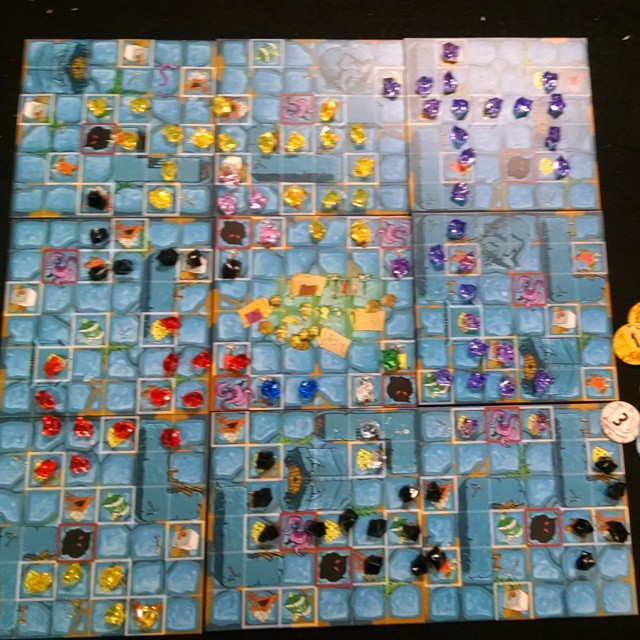
Basics-Let’s get rich!  Dwarves, Inc is a game of mining underground trying to strike it rich. The game is deceptively simple.  Players assemble a modular board of nine squares with the only rule being that the center square is the square with all of the different types of start locations for each mining company.  On a players turn, that player will select three gems and place them on the game board extending a company’s mines off of already played gems.  Some spaces you cannot cross, unless you have a card that says you can, and are marked in red.  If a play extends the mine into a specific space that player gets something for his/her player board.  These space bonuses range from finding extra dwarves who score gold later, tunnels to teleport across the game board, lock boxes to put more gems in your player board safe, treasure chests to earn random effect cards, and gold cashes to earn gold.  The player with the most gold wins, but how you earn gold is the interesting part.  When a mine extends to a cash of gold, all players look to see who has the most gems of the company’s type that landed on the gold space each player in their player board safe.  The person with the most gets a number of gold depending on their number of dwarves.  The person who has the second most gems of that type gets less gold per dwarf they have on their board.  And finally, if the person who extended the mine onto the gold space didn’t get gold because other players had more of that company’s gems on their player board, then that player gets a smaller amount of gold.  Each player starts with four different types of gems (the player’s choice) and four dwarves.  After extending the mines for on a player’s turn, that player can trade one gem from their player board for a different gem from the bank.  Once all the different gold cashes on the map have been claimed by the various companies, the games over and the player with the most gold wins!


2015-01-29_1422574847

Mechanics– This game feels simple, but it’s nothing like that.  The entirety of you turn is placing three gems, and then exchange up to one gem in your storage area.  But, the manipulation of how mines/companies are extended is amazing.  Do you remember that simple game where you have to complete boxes on a field of dots one line a turn, but whoever completes the box get points?  This game feels like that in a good way. Having the most gems of a type is good, but having too many of a type is not great.  You have to subtly manipulate the gem stock market to make other players think that they can score more points than you.  Also, making sure off turn other players are earning you gems by having the second most gems is an amazing way to get ahead.  It’s a surprisingly devious game that plays out in a relatively short time span.  I love it! 4.8/5


Theme- The theme isn’t perfect, but for as quick as this game is, I love what I see. The game uses these little gems for everything which is amazing and a tiny bit off.  The gems represent your investment in a company and work great in your safe box, but at the same time they are also used as your tunnels on the board.  That’s the little bit off part.  But I do like the nice tactile feel of them.  Aside from my nitpicking on that, the game does feel “dwarfy” enough.  The dwarf companies are competing underground at digging companies and you are alternating between directing them and speculating on their progress.  More dwarves will earn your more gold as more dwarves can do more work.  Overall, this does feel like an underground dwarf game even with my tiny nitpicking criticisms.  4.8/5


Instructions– The instructions are short, but really well put together.  There is enough white space for the rules to be read quickly, and the explanation is done really well.  I was playing this game in less than 5 minutes from cracking open the box.  No fuss, no muss, just well done rules that explained things for me. 5/5


Execution– It’s time for a video!  I did an unboxing video for this game, so check it out here!  https://www.youtube.com/watch?v=LJDLmxWt2rI  I have a preproduction copy, but this is what you can expect to get in the box.  In the theme section of this review, I mentioned how I had some problems with the gems, but I’m of two minds on this one.  Unless Assa game cranked up the cost of the game and made little dwarf meeples, gems do a decent-to-good job representing the mines and investment in the different companies.  I do like the nice 3D shape that they are and the feel that have.  The board is well done and the modularity makes for some replay even with how short this game is.  I even like the cards.  The event cards are not the standard cardboard that most games are, but the newer plastic cards I’ve seen more often lately.  I know it’s new and feels a bit different, but honestly, I prefer the plastic over the older stuff as the cards don’t fray as quickly.  All told, this is a well done game. 5/5


Summary– I have almost nothing bad to say about this game.  It’s a fun game who’s strategy comes at you like a sidewinder snake.  If you take this game as a simple game about mining dwarves, you will lose.  If you really think about your choices and learn to manipulate your fellow players, you stand a good chance of winning.  And I like that.  This game does not have Twilight Struggle levels of strategy, but this game is also easily playable in 30 minutes.  And it’s teachable in less than five minutes out of the box.  You will spend more time opening this game then having to explain this game, and that’s the sign of a good game.  It’s well worth your time and your money.  I look forward to what Assa Games comes up with next. 98%

Ring Side Report-Board Game Review Machi Koro

71ejd-+L7TL._SX466_

Product– Machi Koro

Producer– IDW Games and Foxgames

Price– $30 here http://www.amazon.com/IDW-Games-665IDW-Machi-Board/dp/B00JGHCBZA/ref=sr_1_1?ie=UTF8&qid=1422494958&sr=8-1&keywords=machi+koro

Set-up/Play/Clean-up– 20-30 minutes (2-4 players)

Type-Euro

Depth-Light

TL; DR– A good lighter, quicker version of Settlers of Catan. 88%


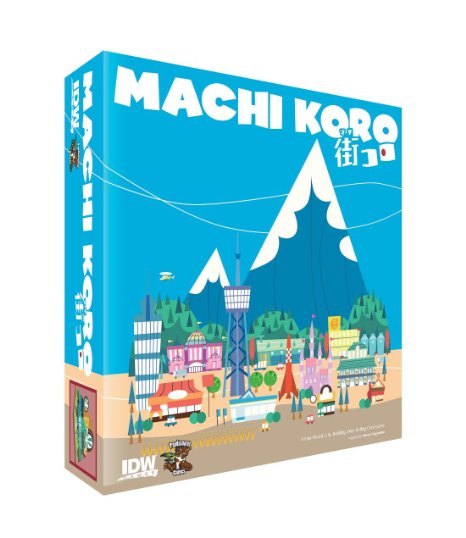
Basics-Who’s the best mayor of Machi Koro?  In this game each player has just been elected the mayor of the city and starts with two cards that represent the building in the town along with four public works.  The building come with numbers ranging from one to 12 while the public works give you new abilities to the ability to roll two dice or reroll.  On a players turn, he or she rolls one six-sided die and every player consults the cards they have.  Some cards give you money on anyone’s turn, some only on your turn, and some steal from the player who rolled the dice.  After rolling the dice, the player can buy a card or build a public work.  Then, play continues with the next player doing the same.  The game ends when one player builds all four of their public works and is the best mayor!


Mechanics– This game is like a less complicated version of Settler of Catan.  That doesn’t make it bad, but it somewhat simpler.  There are some choices, but don’t look for Rococo level’s of depth or strategy here.  It’s fun and you can make some plans.  However, even the best strategy can be ruined by rolling like crap for half an hour straight.  Also, there is no real way to deal with a runaway leader.  That person either rolls something or the other players have to luck out and steal from him/her with specific buildings.  It’s fun, but has some balance issues. 3.75/5


Theme- The theme in this game is kind of off.  It’s cute and easy to play, but why are there up to four mayors of the same town?  I felt more like a land developer than a mayor.  I did have fun, and I did feel like I was building something, but I didn’t feel like the leader of a town.  In addition, I also don’t understand why some buildings hurt other players.  Why does my cafe steal from the other players?  It does feel light and cute, but I don’t get some of the feelings the designers hoped I would have. 3.75/5


Instructions– You can open this game up, read the rules, and be playing in less than five minutes.  The game isn’t super complicated, and the rules don’t over compensate things either.  I like what I’m seeing here! 5/5


Execution– The game is some dice, some money tokens, and some cards.  It’s not much, and others have done similar things.  But, this game is one of the best executions of these basic components.  The dice get their own separate areas of the box while the cards have nice dividers to keep things from getting messy.  Also, the art is nice and cutesy.  And the best part is all this is on some nice high quality cardboard and plastic box inserts, so the box doesn’t feel like it’s going to fall apart! 5/5


Summary– I love Settlers of Catan, but sometimes it’s hard to get a game in.  This one feels like Catan, but is much quicker and lighter.  You can’t expect a ton of strategy though, and the theme of being a mayor feels a bit off.  However, if you just want that quick Catan-like game experience or need an under half an hour quality game, this is a great option to have.  90%

Ring Side Report-Board Game Review Star Realms

61PnzYzKHyL._SY300_

Product– Star Realms

Producer– White Wizard Games

Price– $15 here http://www.amazon.com/White-Wizard-Games-Realms-Deckbuilding/dp/B00HRGMPIU/ref=sr_1_1?ie=UTF8&qid=1421897585&sr=8-1&keywords=star+realms

Set-up/Play/Clean-up– 15-20 minutes (2 players, but multiplayer options available)

TL; DR– Lack of theme hurts an excellent game.  83%


Basics-Ready to rule the galaxy?  In Star Realms, two players face off by trying to destroy the authority and fleet of the other player.  Each player starts with 50 authority and ten cards.   These ten cards are eight one-trade cards and two one-attack cards.  Players have a hand of five cards.  On your turn, you can play as many cards from your hand as you want to give you trade (money), attack, more authority, or other effects.  From the pool of trade and attack, you can spend trade to buy as many cards as you can from a row of five cards set between the players and attack the other player.  Cards you buy are placed in your discard area.  Each card you buy will have a trade cost and can be one of two types: bases and ships.  Ships function just like the starting cards providing trade, attack, and authority.  Bases function like ships except that they are played in front of the player and act as a shield for an amount of damage.  Both of these may also have faction abilities and scrap abilities.  Faction abilities provide additional resources, but you have to have another ship or base in play of the same faction to trigger the ability.  Scrap abilities permanently remove a card from your deck, but provide you with a onetime ability.  With your attack you can attack bases first, then the player’s authority.  At the end of your turn, you discard all cards you cannot play, and then you draw a new hand of five cards.  If you cannot, you shuffle your discard pile and draw from the new stack of cards.  Play continues like this until one player has zero authority left, and the other player wins!


Mechanics– This is a game like magic made by two guys who won the pro tour.  They knew what they were doing when they made this game.  It’s sleek, quick, and full of tactics.  You get all the fun of combo building for magic with a onetime price tag for a trip to McDonald’s. 5/5


Theme- Here is the weakest part of this game.  The rules don’t have much more than a simple paragraph on what’s going on.  The factions are never really discussed in any detail.  The cards have some great art and flavor text, but aside from that there is no theme or story here at all.  It’s just deck building.  2/5


Instructions– The game is easy to play, and even easier to learn.  The rules are less than a double sided sheet of paper.  Honestly, I sat down with a sealed box, and was playing in five minutes.  My wife who hates to have to learn new games on the fly absolutely whooped my butt.  That’s a testament to how good the rules are. 5/5


Execution– It’s a box of cards with two rules sheets.  The best part is the point cards.  Rather than have you write down your score like in magic, this game has double sided cards for your points.  It takes a bit to get used to as they are double sided 10/20 and 1/5 denominations, but it’s a nice touch.  However, the card stock is a bit low quality.  I’ve played about five times now, and some of the cards are already bending and ripping.  4.5/5


Summary– I feel a little bad about the score of this one.  It’s honestly an awesome game, but the severe lack of theme in this one really hurts it.  It plays quick and teaches as quick.  I think I’m going to have to buy some card sleeves because this one isn’t as well put together as some other card games.  This is a fun game, but don’t come into this one looking for any story.  83%

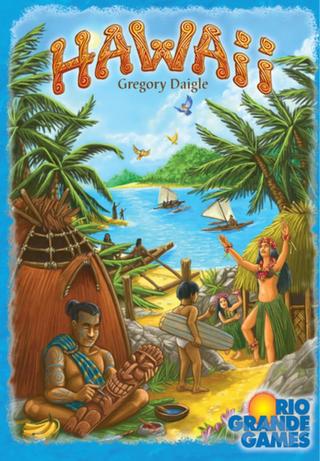
Ring Side Report-Board Game Review Hawaii

phpThumb_generated_thumbnailjpg

Product– Hawaii

Producer– Rio Grande Games

Price– $150! at Amazon-Good Luck anywhere else! http://www.amazon.com/Rio-Grande-Games-469RGG-Hawaii/dp/B007515EVC/ref=sr_1_1?ie=UTF8&qid=1421289771&sr=8-1&keywords=hawaii+board+game or FREE at Board Game Arena!

Set-up/Play/Clean-up– 90-120 minutes (2 to 5 players)

TL; DR– In depth strategy from a simple game. 85%


Basics-Are you ready to become the big Kahuna?  In Hawaii, players battle to see who will be the next best chief.  Hawaii is a game with several different sides to it.  The main goal is most points.  There are a few ways to go about that though.  Each player has several different villages that they can grow to score points at the end of the game.  To get points for each village, it has to be long enough to reach the tiki for that column it reaches and have a Kahuna at its start on the beach.  For now, just think you have to have a start point marker as well as a distance marker for the villages.  To get village tiles, the players take turns gathering people, places, gods, and resource tiles from the main island.  This main island has several different buying tiles that are separated randomly into three rows.  Each turn during set up, you randomly select different cost tokens for each tile.  The last buying space on each tile will show the maximum total cost to all these tokens.  If you ever draw a token that would put the total cost over the maximum cost, then that token is flipped upside down and placed in the fishing lagoon as all tokens have a cost side and a fishing side.  Cost tokens are also placed on all the order selection spaces besides the first one.   This game has a two sided economy for these tiles.  You have to play to move to a place with feet and pay to buy things at a tile with shells.  To move to a tile, it costs feet.  To stay on a tile, costs feet.  To go back to the beach is free.  Players then go in turn order moving to the tiles and buying what’s there by moving onto one of the cost tiles and placing that location in one of their villages on their own player board.  Therefore, cost tokens limit what can be bought each turn.   Further complicating things when you buy a tile, you can decide to pay double the cost of the cost token you moved to.  If you do this, you buy the more amazing side of the tile for the location.  The more amazing sides reduce costs, give your extra points, give you extra money, and in general are better.  At the beach players can use boats (something that you can buy from a tile) to go to the islands.  These islands give you point as well as locations and money to spend.  Also at the beach players can use boats to get the fish tiles that were placed in the lagoon earlier.  And finally, players can move on to the turn order track to determine next turns order.  While this seems pretty simple, what compounds this is the spending requirements for each round.  Each round a token indicates how much players have to spend to get more points.  Whoever spends the most gets more points, second most gets slightly less, and then anyone who at least spends the minimum gets a point amount too.  However only the token and fish tokens you have count for this spending requirements!  Thus if you spend double to get the better version of a tile, it only counts for the original amount.  This massively increases the strategy of the game as buying the most expensive thing might backfire in a large way, and deals are an even more amazing values you have to really look for.  After all players are on the turn track, the round ends, players get points if they spend enough, the turn spending token indicates how much money everyone gets for the next round, and new spending tokens are placed on all the different buying locations.  At the end of the fifth round, players count up points from their villages, and the player with the most is the big Kahuna and next chieftain of the tribe!


Mechanics– When I played this the first time I hated it.  I constantly got mixed up in the rules, didn’t understand the general mechanics, and overall was a mess.  However after really dissecting this one, it’s amazing.  The two different resources are an amazing way to make the game stand out.  Feet and shells are not tradable.  There is no exchange rate between movement and money, and this makes you have to really decide what parts of your villages you need and must built to win.  And built you must.  Your village not only gets you end game points, but it also gets you more resources each round.  This game forces you to think on about three fronts as well and have to second guess all your opponents to make sure they don’t move to the spot you need next.  It’s not perfect as a runaway victor can easily destroy everybody else, but that’s a problem of the other players not seeing the strategies and values that are available.  A well versed gamer will decimate a new players, but this game despite having some randomness, is a hard Eurogame. It’s not perfect, but it is some great, thinky fun.  4.5/5


Theme- There is a lot of different Hawaian things here, but not everything feels like it belongs.  Surfers reduce the amount have to spend each round to get points by 2 or 4 shells.  I don’t know why.  Some huts get you extra feet.  Also why?  What is in this game does feel like something that would come from a tribal island group.  They tokens and board all do feel like Hawaian stereotypes.  That’s pretty fun.  However, I’m not sure why I have feet and shells.  Is my chief like Homer Simpson and after too much work, he’s tired for the day?  It’s not a perfect fit, but some aspects do feel like they fit. 3.5/5


Instructions– Rio Grande Games does a good job explaining their games.  This game has not one, but two rule books!  One book gives the basic rules, and the second explains all the pieces in depth.  I like that.  The game has some sticking points, but honestly, by rereading a few times, you can easily figure out what’s going on. 4.5/5


Execution– The pieces are not bad.  It’s well done cardboard with some good wooden tokens.  The box is pretty decent, and the components hold up to some wear and tear.  It’s not perfect as it’s a bit small, and you have to shuffle some hard cardboard pieces, but overall it’s reasonably well done.  4.5/5


Summary– Time for a personal story.  My mother player this game online-once.  The next time I come home, she had BOUGHT a physical copy of the game!  She paid the over $70 for this game and loves everything about it.  Now, we make a point to play this game when I get home.  It’s honestly a fun game that has some amazing depth.  It’s not perfect as some aspects don’t quite make sense or are not executed as well as may be needed.  However, if you see this game online or at the GenCon Game library, pick this one up.  When you know what you’re doing, it’s a fast paced game with lots of levels to it that will have you thinking on your feet the entire game.  85%

Blurbs from the Booth-Top 10 Reviewed Games of the 2014

Everybody else gets to put out there top 10’s, well, so do I!  Qualifications are I had to review your game in 2014.  Only 52 (wow, I play a lot of games!) were selected, and I narrowed it down to 10.  Let’s see if your favorites on the list.


10- Shadows of Malice-$50- Review here –https://throatpunchgames.com/2014/11/30/ring-side-report-board-game-review-of-shadows-of-malice/  It’s not the prettiest one on the list, but it makes up for that in sheer effort.  This game covers a ton of ground from world building to theme.  It’s completely random, but if you don’t mind lots of dice rolling, it’s a blast for a co-op game.


9-Terra Mystica-$80- Reviewed here- https://throatpunchgames.com/2014/04/09/ring-side-report-board-game-review-of-terra-mystica/  The first euro on the list.  This is a fun game, but man is it deep.  Think Mariana Trench deep.  It’s a fantasy game about terraforming, but worker placement and action selection blend together into a beautiful game.  Also, you could beat someone to death with the components in the box-lots of wood pieces in this one for a great value.


8- Viva Java: The Coffee Game: The Dice Game- $30- https://throatpunchgames.com/2014/06/24/ring-side-report-board-game-review-of-viva-java-the-coffee-game-the-dice-game/  And now the first family game on the list.  This one is an extremely light game, but it’s got a few sneaky elements of depth that will surprise you.  It’s quick, teaches in less than five minutes, and you can master this in 10 minutes.  Quick fun.


7-Eminent Domain- $40- https://throatpunchgames.com/2014/05/05/ring-side-report-board-game-review-of-eminent-domain/  An awesome 4X game that is also a deck builder with a twist.  Every action you take also gives your opponents the same action.  That’s a fun twist that blows Dominion out of the water for me.


6-Tiny Epic Kingdoms- $20- https://throatpunchgames.com/2014/10/22/ring-side-report-board-game-review-of-tiny-epic-kingdom/ How about a 4X game the fits in your pocket, plays in 45, and has more depth than most games out there?  How about if that game costs about as much as a quarter of the other games out there?  SOLD!


5-Firefly the Board Game- $60- https://throatpunchgames.com/2014/02/27/ring-side-report-board-game-review-of-firefly-the-board-game/  Take Shadows of Malice and wrap it in an IP I love.  Give it awesome components, and you get this amazing game.  Randomness can bite you in the butt hard core, but all American-style games like this have that problem.


4-Panamax- $50- https://throatpunchgames.com/2014/12/23/ring-side-report-board-game-review-of-panamax/ Ya, I know, it’s a game about moving ships.  That might seem boring, but honestly its one of the more impressive semi-cooperative games out there.  You can’t win unless you invest in the others.  You can ship if you don’t work together.  Lots of tough choices have to be made to make this game work and for you to win.  And that a fun brain buster of a game.


3-Sushi Go!- $13- https://throatpunchgames.com/2014/12/23/ring-side-report-board-game-review-of-sushi-go/ It’s a drafting game about making the best sushi choices you can.  It’s quick, it’s fun, and you don’t need to be able to read to play.  Family fun at its best!


2-Skull and Shackles Adventure Deck 2- Raiders of the Fever Sea- $20- https://throatpunchgames.com/2015/01/02/ring-side-report-board-game-review-of-skull-shackles-adventure-deck-2-raiders-of-the-fever-sea/  I love the Pathfinder Adventure card game, but I also think this is the best version of it out there.  Simply put, you will feel like a pirate and an adventurer as you play this adventure deck.


And finally, NUMBER ONE…


1-Rococo- $60-https://throatpunchgames.com/2014/06/30/ring-side-report-board-review-of-rococo/  Yes, my favorite game of the year is a game about making frilly dresses.  No, I don’t have a problem with that.  Take anything I said about any of the above Euro-style games out there and multiply it.  This game has action selection, worker placement, multi-part economies, area control, deck building, multiple paths to victory, and the King of France!  If you want a game where you can build the best strategy you can completely different every time, this is your game.  I played this game by accident at Origins, but honestly, it’s one of the best choices I’ve made all year.

Ring Side Report-Board Game Review Nightmare


nightmareblogfull

Picture from magisterrex.wordpress.com


Product– Nightmare

Producer(s)– A Couple of Cowboys and many others

Price– ~$10 at http://www.ebay.com

Set-up/Play/Clean-up– 60 minutes exactly! (2 to 6 players)

TL; DR-90’s-riffic horror game on a VCR! 90%


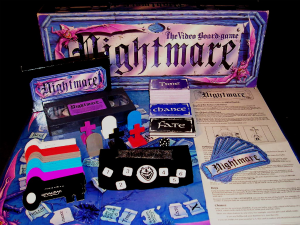
Basics-Ready to play MY game?  Nightmare is a big bowl of the early 90’s in a VHS cassette.  Yes, I said a VHS cassette.  Go dig in your garage and find a VCR.  In Nightmare, each player takes the role of some poor damned soul ranging from a werewolf to a vampire.  This is chosen by the tombstone you randomly draw from a bag.  Also from this bag, you draw a number that you slot into your tombstone.  You then place your character on the board on your gravestone.  Next, each player then writes down their worst fear with china markers on the nightmare cards.  These cards are shuffled, placed on the center space of the board, and then the game begins.  Players start the VHS tape, and the Gatekeeper gives you the rules.  When he’s on the TV, all play stops.  When he’s not on the TV, you roll a six sided die and move.  The Gatekeeper will randomly appear during the game, given random orders or outright be a pain to just one player!  Players try to go around the board as fast as they can collecting chance cards, time cards, and fate cards.  Chance cards are random events that might give you keys.  Time cards give you specific times and an action that range from taking extra turns to yelling out loud to scare everyone to get them put in the black hole (basically jail from Monopoly).  Fate cards are random cards that give you extra powers and opportunities to win keys.  The goal of the game is to earn all six of your keys that grand you extra powers, move to the center of the game board exactly, and reveal to top nightmare card.  If it’s yours, you instantly lose.  If it’s not, you win!  If the game goes sixty minutes, then the Gatekeeper wins, all the players lose, and the nightmare is just beginning!


How about a picture of the Gatekeeper?

images (1)

From www.kotaku.com.au


Mechanics– This is roll to move madness.  You will roll the dice as fast as you can to move your characters as quickly around the board as possible.  Let’s face it, this is not modern (or good) game design.  The cards that you get are completely random and might not be helpful at all.  And, if you really want to remove all the fun from the game, you could easily memorize what times the Gatekeeper pops on screen and work out the math of how to win.  But, that’s not fun.  This game is an experience, not a Spiel des Jahres candidate. 3/5


Theme- This game is theme.  From the instruction that tell you to dim the lights, to the Gatekeeper constantly messing with the players, you WILL experience some scares from this game.  It’s like a haunted house in a board game. 5/5


Instructions– For as much crap as I give this game, the instructions are not bad!  They leave a few holes, but overall, they teach the rules pretty well.  Also, if you compulsively have to debate the rules of a franticly moving game, then this game is not for you! 4.5/5


Execution– The box looks like a coffin.  That right there should set the tone.  The pieces are all nice plastic.  The board looks creepy.  The game even comes with a felt bag to randomize the pieces.  The designers went an extra mile to really put out a quality game.  5/5


Summary– This is pure, uncut nostalgia for me.  I got this game for Christmas when I was 11.  When I moved, it was destroyed by some flooding.  I picked this game up for 8 bucks at a con, and that was the smartest move I’ve made in a while!  I love this game!  It’s become a tradition with my family that we now play this as the last game I play when I visit home for Christmas. Not even close to the right season for ghouls, but I don’t care.  Honestly, for 10 bucks on ebay, you can’t beat this retro game!  It’s the most theme you’ll get all year.  And, you get awesome early 90’s special effects!  Now you just have to find a VCR.  90%

Ring Side Report-Board Game Review of Skull & Shackles Adventure Deck 2 – Raiders of the Fever Sea

Product– Pathfinder Adventure Card Game: Skull & Shackles Adventure Deck 2 – Raiders of the Fever Sea

Producer– Paizo

Price– ~$20 here http://paizo.com/products/btpy95dj?Pathfinder-Adventure-Card-Game-Skull-Shackles-Adventure-Deck-2-Raiders-of-the-Fever-Sea

Set-up/Play/Clean-up– 30 to 60 minutes per scenario (1 to 6 players, five scenario)

TL; DR-BEST AD SO FAR! 98%


Basics-Let’s be bad guys!  In the last adventure deck, the pirates get their first ship.  Now it’s time to be real pirates.  Loot as many ships as you can, earn the favor of Tidewater Rock, and go on an adventure in the deep sea!


Mechanics– The game really ties the theme to the mechanics.  It still has the randomness that somewhat hurts the theme, but the new mechanics really hit the theme hard like a sledgehammer on a tack.  Pirate hunting with the chance of catching the attention of the authorities?  Awesome.  Having to find a particular villain to open up a dungeon?  Even better!  It’s a well done adventure deck! 5/5


Theme- This game really hits home the theme.  It has lots of piracy with the mechanics to back it up.  Also now new mechanics for the specific missions are introduced to really make a dungeon crawl come alive.  Well done!  Do this more often! 5/5


Instructions– The base instructions are all you get besides the stuff on the cards.  I still want a sheet with more story and instructions for the game.  What is on the cards is good, but I still want a bit more.  Also, explaining who the characters are, especially the allies, would help me get a bit more into the feel of things. 4.5/5


Execution– Tell you what, Paizo has heard some of what I’ve said and this proves it.  It’s a card game, so it’s got good card stock and art.  Fine, I expect that.  But you know what, SIDE OPENING FLAPS! I can open up the package while not destroying the box.  Here is your five for that. 5/5


Summary– This adventure deck is the best adventure deck so far for either season of the card game.  I felt like a pirate.  The mechanics are slick.  The theme is awesome.  THE BOX OPENS ON THE SIDE!  Well done!  98%