Ring Side Report-Board Game Review of Crazier Eights: Camelot

Product-Crazier Eights: Camelot

Producer– James Gray

Price– $9 here https://www.kickstarter.com/projects/recoculous/crazier-eights-camelot

Set-up/Play/Clean-up– 20 minutes (2-4 players)

Type- American

Depth-Light

TL; DR-Fluxx and Crazy Eights! 92%

IMG_20161103_090132.jpg

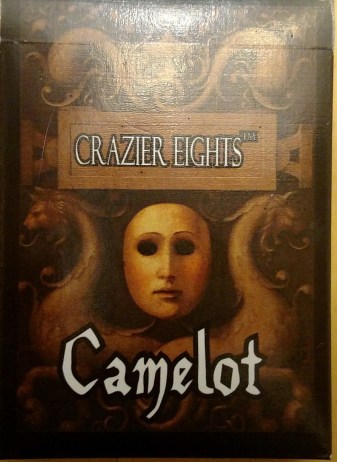
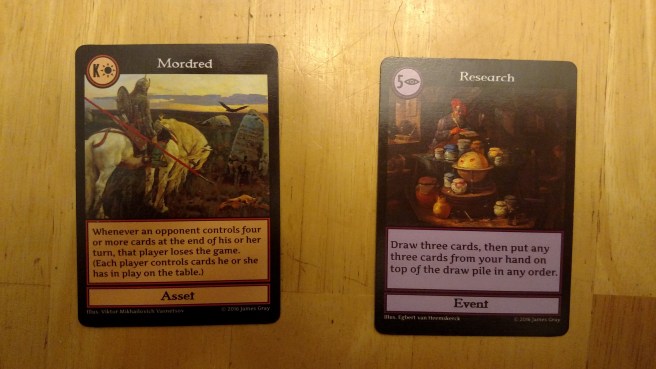
Basics-  Need a lightweight game, but also need a bit of depth?  Crazier Eights: Camalot is an awesome mix of the simplicity of Crazy Eights and Fluxx.  Each player starts with eight cards.  Then on a player’s turn, they draw a card.  That player can play a card and discard a card that matches to top card of the discard pile either in suit, number, or an eight.  The cards players play range from effects which are one time events that might cause a player to draw cards to assets that are permanent things in play that might destroy other assets, cause a player to draw a card, or even change how the game ends.  Then, the next player goes.  The game ends when a player gets to zero cards and wins, an asset makes that player the winner, or there is only one person left.  Long live the king!

Mechanics-I like the simplicity of Uno and the zannynes of fluxx.  This game is both.  It’s fast, simple (you just learned all the rules above), and easy to play.  My wife and I learned this game in the time it takes to order at Outback, and had played a full game before the appetizers came!  It also fits in a pocket, so it’s a blast all around. 4.75/5

Theme-The game doesn’t have perfect theme, but for a simple card game it’s about as much as I can ever hope for.  The cards do semi-appropriate things for the name and art on the card.  It’s hard to symbolize the holy grail in Uno, but this game does the theme enough justice to keep it going.  The game also has some great art, so that always helps theme.  4.5/5

img_20161103_072610909

Instructions-The instructions are one page, front and back.  I had a review copy, so there may be more pictures in the normal game, but it’s enough to get the point across.  I will admit something here, I never learned Crazy Eights as a kid!  But, this game taught me how to play and added on its own crazier rules, so that speaks well of the rules as written.  4.5/5

Execution-I like what I see here.  The art on the cards is good.  The cards layout is nice, and the cards are not too wordy.  I’d like the cards to be a bit thicker, but overall, it’s a well put together game.  4.5/5

Summary-You read my deep confession before, so this game should tell you how well done it is.  I like its simple nature, the rules work well, and the art and theme tie things together.  It’s not perfect, but the flaws are few and far between.  I think the fluxx comparison is a good one.  It doesn’t have the humor of Fluxx, but the serious art drives home the theme and keeps me in the game.  And for 10 bucks, you can’t lose on this one.  92%

Ring Side Report- RPG Review of Delta Green: Agent’s Handbook

ProductDelta Green

System-Delta Green

Producer-Arc Dream

Price– $20.00 here http://www.drivethrurpg.com/product/181674/Delta-Green-Agents-Handbook?affiliate_id=239993

TL; DR-Great RPG with one big problem 87%

29974577

Basics– ia ia cthulhu fhtagn- BUT NOW WITH GUNS! Delta Green is Call of Cthulhu if run by the government as secret agencies vie for power and try to keep the horrors from beyond time and space from destroying the world or taking over the United States!  Can you handle the truth?

Mechanics or Crunch-Let’s break the mechanics up and give the basics as well as my assessment.

Base Mechanics-Delta Green is a classic percentile based system.  You have a skill or an ability rating, and you roll under that number to succeed.  As I grow older, I like this no fuss/no muss methods of rolling dice to avoid overly math-y systems.

Difficulty-When a situation is harder or easier than normal, the GM might ask you to add or subtract 10% or 20% to or from your skill or ability total.  Again, it’s a simple and easy  way to modulate difficulty.

Combat–  Combat is basically simple.  Characters act in dexterity order from high to low.  On your turn you do one action.  These actions range from move, shoot, or aim among other things.  For actions that require a roll, you roll under a skill as above.  There is no given dodge roll if you are attacked.  If you haven’t acted in a round, you can forgo your next action to try to dodge an attack by rolling under the attack roll.  Damage is a single dice roll that subtracts from a hit point total.  Go too low on the hit point total and you pass out.  Also, some weapons have a lethality rating.  If you roll in that range, the weapon just kills the target in one go!

Personal Life and Sanity- Just like other horror RPG, Delta Green has a sanity system.  Characters lose sanity and gain mental illness as they go crazier and crazier dealing with horrors beyond time.  This system throws in bonds as a serious component as men and women lose family members, friends, and loved ones.  Think of the PTSD struck veteran, but now add the fact that he/she deals with monsters beyond human ken.  Players may lose family members or whole families as they slowly go deeper and deeper into the world of Cthulhu slipping away from normal.  That level of commitment to roleplaying in the mechanics is awesome.

Advancement-Advancement is a snap in this game as well.  When a player attempts a roll in this game and they fail, they mark the skill with an X.  At the end of the game session, any skill that you failed that you had at least 1% in, you gain an additional 1%.  Also, between sessions, a character can gain 1 in an ability or they can gain 1d10 in a skill if they spend time working on it.  If they do, they lose 1 level in a bond as they lose touch with someone they felt was important!

Summary- I really want to like this game more than I do.  The addition of solid role-playing psychology makes this a great way to blend the theme and mechanics of a world where things just can’t be and can’t be dealt with rationally.  However, combat just makes me irrationally angry.  I don’t like systems where you can’t move and act.  That’s a minor issue as if all the players and monsters abide by this rule, I can deal.  However, the rules as written basically make it better to have a lower dexterity.  You get to react to an attack, but people who go fast can’t.  I can understand not being able to take your next action if you dodge, but this game penalizes people who go first.  Sure, it can be a minor issue if you don’t fight much, and I can deal with not having a dodge roll at all.  But, this irks me deeply to my core.  Therefore, it’s an ok system with a serious flaw. 3.5/5

Theme or Fluff-I mentioned above how much I love the commitment to theme the game has in its mechanics.  This game might even be darker than Call of Cthulhu as this game brings the role of sanity and psychology to the forefront in a very post-9/11 way as the psychology of the soldier is experienced first hand.  The book is full of stories and fragments of people trying to handle the unhandable.  It’s deep and immersive in a way I can really dig, safely and from afar.  5/5

Execution-This is a well put together book.  It flows well, has great art, and the PDF is well done and hyperlinked.  I like the index, the layout, and the whole book overall.  Some things could use a bit more organization, but the book is an exhaustive reference on both the government and the paranormal for new players.  4.5/5

Summary-Delta Green is a great RPG with one serious flaw.  Now, as a gaming group, you can play this however you see fit.  It’s a flaw that you can fix by all deciding that this is how the game runs.  It’s a flaw I will fix instantly in my tables, but the rules as written make me spitting mad.  And it’s just that one part.  The rest is amazing.  I love the depth of little extra bits that the authors throw in about government jurisdiction and random trivia that are in the book.  The art is great and the treatment of psychological factors in our veterans is phenomenal.  Sure, this is a just a game, but the level of depth that game goes into to use these conditions as things a person would experience if they experienced Lovecraftian horrors is excellent. I like everything in this EXCEPT one thing.  If you can get past that one thing, this is a great RPG that really updates Lovecraft to the post 9/11 world.  And since it’s under $20, it’s well worth the look even if you just use it for a guidebook to government organizations in your horror games.  87%

Ring Side Report- RPG Review of Torment: Tides of Numenera-The Explorer’s Guide

51q0h9kpw-l

ProductTorment: Tides of Numenera-The Explorer’s Guide

System-Numenera

Producer-Monte Cook Games

Price– $40.00 here https://www.amazon.com/Torment-Tides-Numenera-Explorer/dp/193997951X/ref=sr_1_fkmr0_1?ie=UTF8&qid=1473811918&sr=8-1-fkmr0&keywords=Torment%3A+Tides+of+Numenera+-+The+Explorer%27s+Guide

TL; DR-What I want in a video game tie in book. 97%

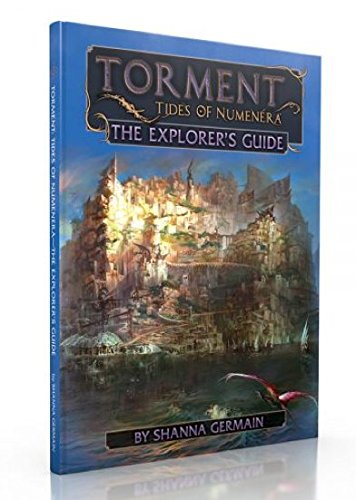
Basics– Are you excited about Torment, the computer game?  Do you want to run your Torment Numenera tabletop game?  Torment:Tides of Numenera-The Explorer’s Guide would best be described as the “companion” book based on the video game for the Numenera tabletop RPG.  It’s  DEFINITELY NOT a strategy guide, but it does have new mechanics and world building so you can play the compute game at your table.

Mechanics or Crunch-This might be the weakest part of the book, but that’s like finding a single spelling error in a classic book.  What’s here is good.  It’s new, it’s fun, and it’s well done.  There are the expected things to help build out the blanking blank who blanks as well as cyphers and artifacts, but there is also a whole new social interaction system built on how the characters act.  It’s a small thing as it doesn’t need to be added, but it’s something GMs can make as big or as small as they like.  My one complaint is there isn’t more blanking blank who blanks options.  It’s minor though. The system doesn’t need a book of feats as much as it needs flavor. 4.5/5


Theme or Fluff-There might be more in this book about one small section of the world than there was in the core book.  I am absolutely serious.  I love the depth put in this book.  The small piece of the world that the game covers get’s a massive world building.  Here is the rub-as a GM for the game, you will have all the information you need.  As a players, there might be almost too much as it could spoil the game or even the video game.  That…is the proper amount of information for me to run an RPG.  I kickstarted the video game, but my wife and I are more excited to get this to the table with our Cypher group.  5/5

Execution-Cypher system has the best use of space of any RPG I’ve read.  You describe a fearsome adversary in the text, and the stats are less than a tweet in a sidebar.  Describe the use of a little used rule in the text, and a sidebar lists where the rule is in the core book.  MORE COMPANIES NEED TO DO THIS!  As for the layout, its great.  Few pages have too much text, but there is enough art, either hand drawn or game images, to balance out the reading.  I loved reading this book. 5/5

Summary– I was asked to review this book, but give the direct warning that “this is not a strategy guide.”  that is absolutely true, but what this book is amazing.  It’s full of crunch, fluff, and is well made.  I get new mechanics to play in a new part of the world.  I love everything about this book.  My one problem is I want more.  If there were a bit more character options, I’d be in heaven.  If you’re getting the video game, if you love the cypher system, or if you just want a well done splat book for Numenera, don’t pass this up.   97%

Ring Side Report-Board Game Review of Mystic Vale


Product-Mystic Vale

Producer– Alderac Entertainment Group

Price– $45 here https://www.amazon.com/dp/B01DMZR1QU/ref=cm_cr_ryp_prd_ttl_sol_0

Set-up/Play/Clean-up– 60 minutes (2-4 players)

Type- Euro

Depth-Light

TL; DR-Not perfect but amazing none the less.90%

MysticVale3DBox

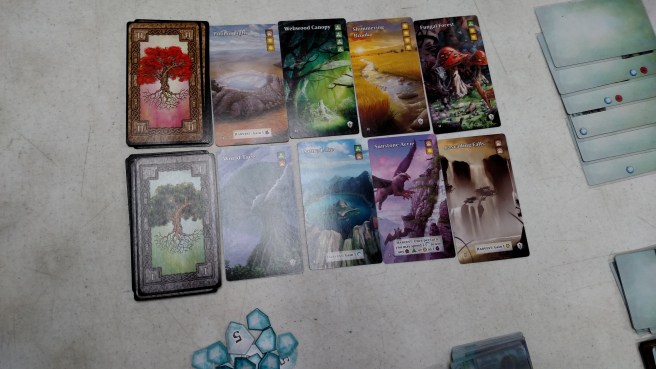
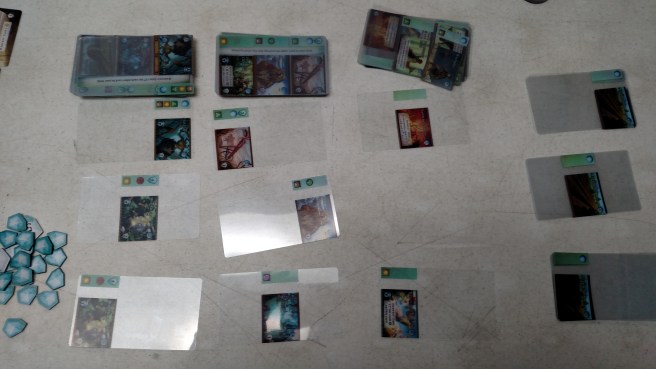
Basics-  Only you can save the vales!  In Mystic Vale each player takes the role of different druid clans attempting to restore the world after a magic calamity.  Each player has a deck of sleeved cards.  At the start of each of a player’s turns, he or she reveals cards until three spoils symbols are revealed.  The last card with a spoils symbol is placed on top of the player’s deck of cards and is “on-deck.”  Players can also push their luck and harvest their on-deck card.  If they do, they can continue to reveal new cards on-deck, and place them in their field.  If they do, they may get extra points, but if they reveal another spoil symbol, then their turn is over.  This game has a built in bonus for when a player does this however.  A player has a token that if they spoil, they get to turn this token over and it allows them to use it as an extra mana, or purchasing power, in a future turn. The on-deck card is not part of a player’s “field” or cards a player can use to buy cards or gain points.  

IMG_20160630_172052899

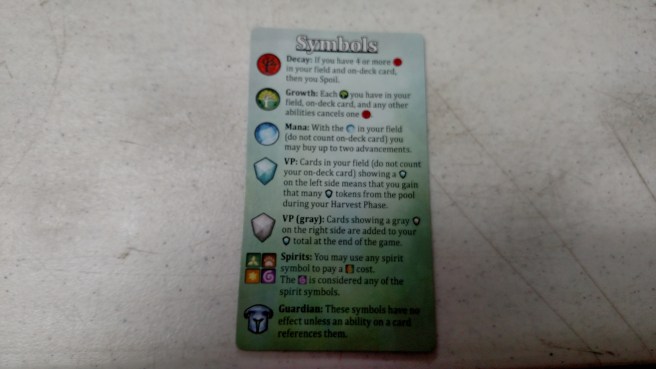
Here is where the game gets interesting.  Each card has a number of symbols on it.  These symbols are mana (money for extra card pieces), victory points, growth to counter spoils, and spirits (a second currency to buy vales or permanent cards).  If a player doesn’t spoil, that player gains victory points, and then can spend mana to buy card inserts or spirits to buy vales.  A player can buy two of each, each turn.  Vales are placed in front of a player and provide a constant benefit and inserts are inserted into cards in a player’s field.  Here is the major strategy of the game.  A player doesn’t build as many intercard combos, but instead crafts intracard combos as new inserts unlock new abilities based on the symbols on the card.  Additional symbols called guardians provide benefits only if a card has an ability that triggers off guardian symbols.

IMG_20160630_172038312_HDR

This game uses a victory point based mechanic to determine when it ends.  Each game starts with victory point pool.  When the pool is empty, each players receive an equal number of turns, but now take victory points from the box.  After everyone has the same number of turns, players count count victory points on their cards, their vales, and the physical victory points they earned during the game.  The player with the most points is leader of the best Druid clan and reigns supreme!
IMG_20160630_172027831

Mechanics-The card crafting mechanic of the game makes this an amazing game.  I had a blast building different card combos.  In addition, the nature of building your field means you can build off turn and have almost no down time.  I’ve seen games take as little as 20 minutes when four experienced players hit the table.  I also love any game that has two different markets.  I get bored when the victory strategy is build the biggest card to win, and this game doesn’t have that at all.  The drawbacks of the game are player interactivity and a runaway victory.  I am basically running a race against myself. Other other players steal cards from you, but only from the buying pool.  I really don’t need the other people at the table.  Furthermore, if someone has the best card inserts due to the available cards, then that person will win.  There is strategy, but if they play better, they will win and nothing you do will stop them.  You can only just be better at the start and not fall behind.  It’s not a bad game, but know that going in! 4.25/5

Theme- Mystic Vale has a ton of theme, but it is a theme you must find yourself.  The game can be simply played as deck builder with a new mechanic of building cards instead of decks, and this will not detract from the game at all.  However, if you are like me, you really want to have a massive amount of story to your game.  It’s here, but you need to dig for it.  From the terms like field being where you harvest your mana to the idea of spirits revitalizing the mystic vales, you get a story as you play.  But, that means theme is not front and center. 4/5IMG_20160630_172022720

Instructions-This is an awesome game that teaches quick, plays fast, and masters instantly.  You don’t feel stupid stepping up to this game as you get a quick intro with enough introduction to get you gaming quickly.  By the end of turn two you have the game down pat.  Also the helper cards are amazing!  They really do get you gaming faster. 5/5

Execution-I love everything in this box, but the game’s execution suffers from its main mechanic.  The art is amazing.  The cards are good quality.  The box has beautiful dividers.  This game is almost everything I want to see in a deck builder.  But, every card has three sections.  Since you want to have the new cards inserts work in each spot, you have to divide the card insert pool by one-third.  That means the game can grow a bit stale semi quickly.  Luckily two expansions have been announced already.  It’s a minor problem, but it’s one worth mentioning.  If you want to see a full unboxing check out our video here https://youtu.be/cPVRTU2h5bk 4.75/5

Summary-Mystic Vale is one of my new favorite games.  It’s fun to get to the table. It’s phenomenally fast to learn and play.  It’s gorgeous, and it’s fun to insert cards into sleeves and unlock their power.  That said, it’s not without it’s faults.  The game doesn’t fix common deck building problems.  The theme isn’t as strong as I’d like, and you might get tired of seeing the same card after 10 plus plays.  But if you play a game over 10 times, then the game is a win as it keeps you coming back for more.  It does for me.  Despite the faults, I’d recommend this over many other deck builders out there.  90%

Ring Side Report-Board Game Review of Scythe


Product-Scythe

Producer– Stonemaier Games

Price– Preorder here http://stonemaiergames.com/buy-scythe/

Set-up/Play/Clean-up– 115 minutes (1-5 players)

Type- Euro

Depth-Medium

TL; DR-Great parts, but player count dependent. 95%

pic2323719

Basics-  COMRADE! Scythe is a board game of nation rebuilding and development following an alternative World War I.  Players take the roles of different nations attempting to become the most successful nation after the fall.   Each player is given two player boards to start the game.  One board is your nation, describing your nation’s special power and unlockable powers you get when you build mechs-giant walking war machines that provide you with extra powers when you build them.  

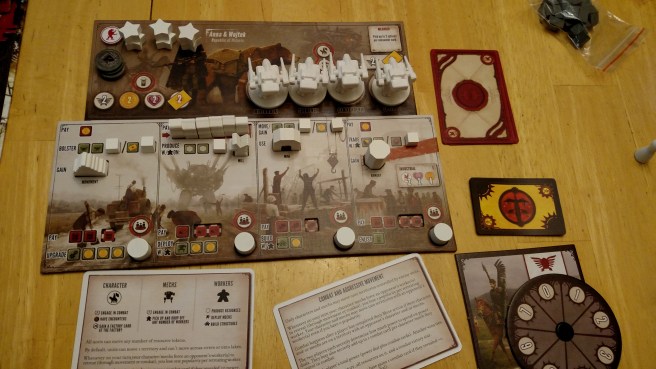
The second board each player receives is an action selection board.  Here is where you get more variety from the game.  Each board has a specific type of focus associated with it.  These focuses range from industrial to manufacturing, and the focus of your nation will drastically change how you play.  The second player board also has the actions you will take each turn, but divides the board into top action and bottom actions.  These actions are simple to read as actions with an icon in red being a cost, while icons in green are the resources they provide. This allows for language-independent play.  Top actions typically get you resources to spend while bottom actions are where you spend resources to build your nation.  The top actions are bolster (get points/cards for combat), produce (get resources depending on the tiles you are on), move (move your pieces/earn money), or trade (get two resources or get popularity).  The bottom actions are upgrade, deploy, build structures, or enlist.  These actions require a bit more description.  The action board has a number of spots filled in with squares.  When you spend the upgrade resources, you move one cube from the top (revealing a new option when you take that action) and cover up a bottom cost (making that action that much easier in the future).  Deploy is how you place mechs on the field.  Each mech you deploy unlocks new powers for your character as well as all other mechs such as moving across rivers or having bonuses to combat.  Build allows you to move a structure from your board to the main game board.  Once removed from your board, the space uncovered unlocks new options on your turn like allowing you to move across the board or harvest extra resources.  The final action, enlist, allows you to get extra materials off-turn when opponents to your right and left take bottom row actions.

With the basics, the game starts off with you having two workers on the main game board next to your base and your character mini on your home base.  Players then take actions as described above.  A player selects an action space, then takes the top action, if he/she wants to, of that spaces and then takes the bottom action, if he/she wants to, of the same space.  What makes this interesting is the next time a player selects an action, that player cannot take that same action space!

Two of the things I mentioned above are combat cards/points and popularity.  Popularity is used in scoring at the end of the game.  Popularity measures how well the common man thinks of you.  Depending on your popularity, you receive more points at the end of the game for each area you control, each thing you accomplish, and how many resources you control.  Lower popularity means you earn fewer points, so this is an extremely important number!  Combat is also a simple and fast.  When you move a mech or a character onto a space of another player, combat might happen.  If there are only workers on that space, those workers flee back to their home base and you lose one popularity.  If a mech or a character is on that space, then combat happens after the move action.  Each player selects how much combat power they want to spend on the fight, from 0 to seven, and may select one combat card to add to the fight.  Combat cards range from one to five.  Each side selects what they will spend, (power is spent regardless of whether they win or lose), and reveal to their opponent.  The loser moves back to their home base, the winner gets the tile and all the delicious resources on the tile.

There are a few other minor things as well.  Your character can have encounters which are random cards that describe fun, extra events in the game such as finding a herd of cows that you can kill, buy, or steal causing you to lose or gain resources in the game.  Your character can also move to the center tile of the game and encounter the factory, an old relic of the last war.  The factory has a deck of cards that provide you with an extra action you can take with new exciting options like double moves and bonus resources.  The final thing of note is your goal.  Every player starts the game with two goal cards.  Goal cards state an action you must have accomplished on your turn for you to unlock a bonus way to score in the game.

This game follows a very similar end game mechanic to Euphoria-each player has six stars.  When a player completes a goal such as deploying all his/her mechs or winning a combat, that player places a star on the board in that spot.  When a player places his/her last star, the game is instantly over.  At this point, every player scores points based popularity and tiles they control, stars placed, and each pair of resources as well as the extra structure bonus tile.  The player with the most money/points at the end of the game wins!
IMG_20160710_181756044.jpg
Mechanics– I liked this game’s mechanics, but I didn’t love this games mechanics.  I had fun and built an empire, but I don’t think it’s much of a combat game.  Your actions are quick and easy to do, but the concept of fighting feels slightly added on.  Overall, the game is sleek and works well, but it feels like a cog missing one tooth-the machine hums along well, but every once in awhile, you get a bit of a clunk.  However, the two pieces of the player’s boards do make for an awesome mix as you get vastly different empires attempting vastly different strategies with warlike nations having to focus on farming  while peaceful nations might end up with a manufacturing center.  That variety really makes the game fun.  Also the indents in the board make all the actions that much more fun.  I love the upgrade action so much as I can see and even feel my nation getting better!  I have my minor gripes, but it is a fun game.  4.5/5

Theme-Much like the mechanics, I liked this part of the game, but didn’t love this part of the game.  Combat sticks for me.  We’re post-world war, but the fighting feels simple.  That is good as you resolve combat quickly, but it also means that combat doesn’t have much depth.  I do feel like I’m building and reclaiming pieces of after a war.  The instructions build on the nation’s providing each with their own background, story, and life.  I do feel like each nation when I play and the differences in player boards emphasise the theme each nation is taking. 4.5/5

IMG_20160710_181807308

Instructions-This game has a ton of instructions, but they do a good job explaining the game.  The rules are not complex with the bulk being chose action, maybe do top action, and maybe do bottom action.  The thickness of the rulebook is to build story (awesome) and to clarify all the working pieces.  I like what I see here.  It does have a few things I’d like clarified like how the submerge powers work, but overall it’s a well done and well laid out rule book that you can learn on the fly, if maybe a tad too long.  4.8/5

Execution– HOLY COW!  Stonemaier games is known for their parts, and it shows in this one!  Players get nice wooden pieces, the resources are all beautiful, even in the more simple price ranges, and the mechs/characters all look beautiful and different.  The details go so far as the worker meeples all have different hats.  It’s just a little detail, but it’s a beautiful one that really shows how much the creators loved this game.  I have an unboxing video showing all the pieces of the game here https://youtu.be/3g9vUQYz-pY .  5/5

Summary-This is an interesting one for me.  I like this game, a lot actually, but I don’t think this is my new favorite.  The mechanics are sleek, the gameplay is fast yet deep, and the execution is amazing.  If have a few issues with the theme and mechanics, mostly dealing with combat.  I do feel like I’m building or maybe rebuilding an empire, but there are just a few things that feel a tiny bit off.  These things don’t derail the game by any means, but it did take me out of the zone a bit.  Also, this game’s experience might rely heavily on the player count.  I have had more fun playing with five players than I did in a head to head match. This might not be the game I ask to bring to the table, but if someone asked if I wanted to play again, I would be happy to any time!  95%

Ring Side Report-Board Game Review of Octodice

Product-Octodice

Producer– AEG

Price– $20  here

Set-up/Play/Clean-up– 20 minutes (2-4 players)

Type- Euro

Depth-Light

TL; DR-A great mix of a Euro and Yahtzee 94%

octodice

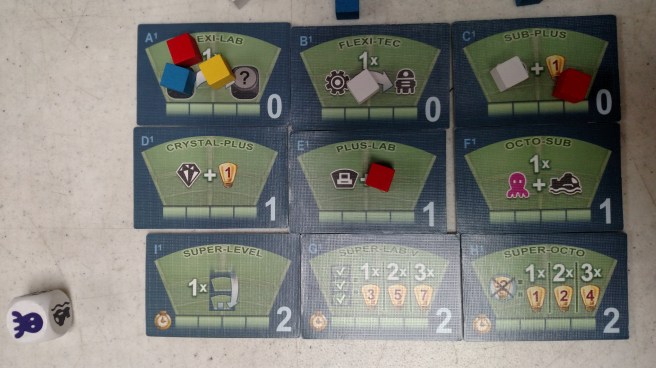
Basics-  UNDER THE SEA!  Octodice is spiritual successor of Aquanauts, a game where players battle octopods, research, and develop an undersea lab in a heavy euro game.  In Octodice, players do all the same, but using dice to dictate the actions.  At the start of a player’s turn, the player rolls six dice, chooses two to keep, then rerolls the rest, chooses two to keep, and rerolls the last two.  These dice are divided into two groups-black and white.  Black dice have a colored number on them or an octopod.  The white dice have an action or an octopod.  The active player then chooses two pairs of dice (each pair consisting of one black and one white die). The final pairs being used do not have to match the pairs made when rolling the dice. The player then uses the action on one and the color/number on the other.  The actions are: collect gems (collect points based on the number on the black die), research (get points in order by moving down a color path using the proper color and the action die on each step), develop (improve your lab and get new dice options or end game points), get robots (earn points now, two robots per each color), and get subs (put the robots in the sub and earn points after every other round).  

After a player chooses his/her two dice pairs, every other player can also choose to use two of the dice in any combination, not necessarily the same combination as the current player.  Players can do this twice per round.  Finally after choosing dice, the player looks for octopods. The octopods destroy the station and gum up the works.  If a player does not have two octopods on his/her dice by the end of that round, that player loses two points.  However, if the player has two or more octopods in the dice pool, then they score extra points!

Play then moves to the next player.  After everyone has two turns, players check to see if they knock out two or more octopods in the round and score points for each robot in the same colored sub.  After players play a total of three rounds, having a scoring phase after each two turns, the player with the most and second most gems earns more points, players with extra developed labs score points, and the player with the most points is the best aquanaut and is the winner!

IMG_20160609_182408773

Mechanics–  I hate Yahtzee.  It feels like I don’t get a choice, my decisions don’t matter, and I just have to be bored while other players roll dice.  This game has none of those problems!  Sure, randomness is a part here, but the amount of options I have at all times makes me really enjoy this game.  I’m seeing more and more games where the players have things to do off turn. Instead of spacing out on Pokemon GO, the other players get to see what I’ve done and still remain engaged with the game since they are looking for dice pairs to use.  I get my euro, but there is still enough random to keep it fun.  5/5

Theme- This game is fun, but I don’t really feel like an undersea researcher.  Most of the time, I never do the research option.  I develop my lab most often and then send out robots and subs to make points.  It feels like a slight disconnect between a game of sea scientists and what I do. 4/5

IMG_20160609_182415222

Instructions-If you understood the rules above, then all you need to play is to understand the rules for developing your lab.  Beyond that, this is a game you learn in about one minute, then play in 15.  The rules have enough to cover what they need to cover, and they don’t overstay their welcome.  5/5

Execution– I made an unboxing video of this game where you can see all the pieces at https://youtu.be/9gaHRrZs-qY.  What’s in the game box is great.  The pieces and the game footprint are small, but all well made and work for the game.  Heck, on my anniversary my wife and I played this at our table in a fancy restaurant!  The dice are nicely colored wood instead of plastic.  I *might* like rewritable tablets as I might run out of game pads for scoring, but I know the PDF is online.  Also, I would like pencils in the box!  Much like other dice games, I hate when I have to scrounge up a writing device.  But, my small gripes aside, this game is well put together.  4.75/5

Summary-I said above I hate Yahtzee, but this game is an amazing combination of Yahtzee and a euro.  AND I LOVE IT!  You get the fast pace of its American parent, the interaction of a great dice game, and the deep thinking of a euro.  Sure, you can’t expect the depth of a much longer game, but what you get is a great experience.  You can learn it quick from the rules and teach it even quicker to your friends.  The theme might be off and I want some golf pencils with AEG’s logo on them, but those are only minor complaints to how much fun I have had.  If you need a good gift for under $20 or you want a great pub game then this is the game you are looking for.  94%

Ring Side Report-Board Game Review of Piratoons


Product-Piratoons

Producer– Stronghold Games

Price– $40  here https://www.amazon.com/Stronghold-Games-6004SG-Piratoons-Board/dp/B01BL7T1KU/ref=sr_1_1?ie=UTF8&qid=1466985455&sr=8-1&keywords=Piratoons

Set-up/Play/Clean-up– 30 minutes (2-4 players)

Type- American

Depth-Light

TL; DR-A great mix of a Euro and a party game 91%

71h23oYjmiL._SL1024_

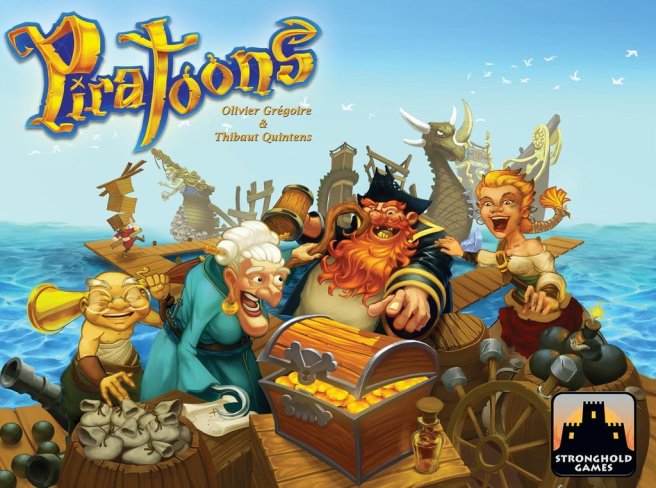
Basics-  Yer, mateys it be time to crew the ship!  In Piratoons, each player takes the role of different pirate captains trying to crew, equip, and build their ships.  The game is played in six frantic rounds.  First, three pieces of ship and five pieces of equipment and crew are placed face down on the cardboard lid of a treasure box.  Then the bottom is put on, the box is flipped, and the pieces revealed.  Players then have less than 30 seconds to place meeples as quickly as possible on the tiles.  Players can place meeples on as many tiles as they can or want and even on tiles with other players’ meeples!  After time is over, each unused meeples earns that player one coin.  Next, the player with the most meeples that is not tied with another player wins that tile.  After the race, the tiles are dumped overboard!  Ship pieces sink (are discarded) while everything else remains available.  Each player can then bid on the remaining tiles.  Players secretly choose an amount of coins to bid and reveal. Players who are tied can’t bid, but all other players pay their coins, and in order of most coins to least, select one tile.  After that, players rearrange their ship, and the next turn takes place.

    After six rounds, players score and lose points.  Players get points for the most and second most sails, ship pieces, tiles, and money, while unorganized ships, missing tiles, and open slots lose points.  Players then spend tiles in pairs and three different tiles in an area for extra points.  The player with the most points is the best pirate and winner!

IMG_20160604_133533082.jpg

Mechanics-This is a solid American game, but it’s mechanics gives it enough Euro-tendencies to keep this Euro-gamer entertained.  I really love how this game plays.  Honestly, the time you have to select pieces is almost too long, but it does give slower gamers enough time to place their pieces.  The bidding phase is an excellent addition that adds some welcomed depth to the game.  All together, this is a well executed game.  5/5

Theme- This is a great, fun party crew building game.  You don’t necessarily feel like you’re building a pirate crew, but you feel like you’re building something in a frantic fashion.  The rules do make the game fun, but it’s hard to shake the feeling that pirates don’t follow rules.  These are only minor problems, but  they do take away a bit from the game. 4/5

IMG_20160604_133502116.jpg

Instructions-What I mentioned above is all you really need to know.  But, end game scoring could use a bit more work.  I’ve had multiple people tie in the end game scoring, and some of those situations are not covered in the rules.  Overall, the rules work well, but could use a bit more clarification.  4.25/5

Execution– I don’t play too many party games, but this is the best executed one I’ve ever played.  The treasure chest that flips the tiles is the best example of the production quality.  The layer of cardboard holds the tiles amazingly well.  I’ve seen too many tile flip/party games where tiles fly everywhere during the reveal.  The color of the tiles easily helps players see what they go on the ships.  The   art looks great and funny at the same time.  And any game with nice, chunky cardboard makes me happy.  It’s a well crafted game. If you want to see all the pieces of the game, check out my unboxing here  http://youtu.be/0ZHSiAueMTA 5/5

Summary-I don’t really like party games, but this one gives me a party game with enough thinking mixed it.  The mechanics are fun.  But, the theme suffers a bit as players are pirates, but are penalized if they act like pirates.  The rules are good, but need just a but more to be great.  However, the execution is the best part.  what’s in this box is amazing.  Overall, if you’re looking for a party game, but need a hint of Euro, this is the game you’ve been looking for. 91%

Ring Side Report-Board Game Review of Evolution

Product-Evolution

Producer– North Star Games

Price– $40  here http://www.amazon.com/dp/B00NP7EWNG/ref=sr_ph?ie=UTF8&qid=1465139323&sr=1&keywords=evolution

Set-up/Play/Clean-up– 1 hour (2-6 players)

Type-Euro

Depth-Light

TL; DR-It feels like it evolves during play.  97.5%

71K+BGLct4L._SL1000_

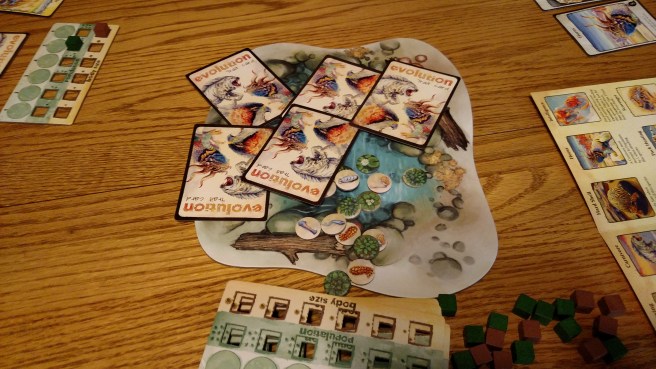
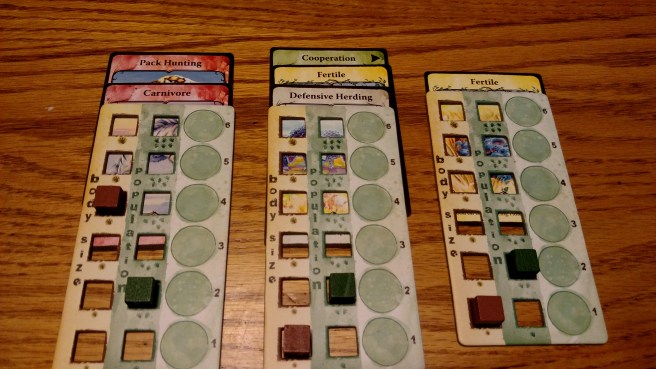
Basics-  Time for survival of the fittest!  In Evolution, players take the roles of different species trying to survive the best they can over time.  At the start of each turn, a player is dealt three cards plus one for each species they control.  If a player doesn’t control any species, that player automatically is given one species with the lowest possible statistics as a catch up mechanism.  Each card a player receives has a name, picture, a power, and a number on a leaf in the bottom corner.  The leaf number indicates how much food will be found in the watering hole, a cardboard place holder in the middle of the table, that round.  With their remaining cards, players can power up their species.  Each species has a population marker and a body size marker.  Population is the maximum food that that species can take each turn, and body size is used in defense.  The cards a player has can be played on a species to permanently provide that power, or the card can be discard to increase the body or population by one of a species species or create a new species with a body and size of one.

IMG_20160528_164403408

After each all players have played cards, then the real fun begins.  The first player reveals the cards in the watering hole, and places more food based on the leaf numbers of all the cards.  Then, starting with the first player, each player takes one food from the watering hole.  Powers may affect the amount of food takes as some powers take more for the one species or cause another species to take foods as well.  However, one power that a creature can have is carnivore.  Carnivores do not eat plants but other species!  A carnivore attacks another species, yours or another players, and gains food equal to the attacked species’ body size all the while reducing that species’ population by one.  Carnivores can’t eat creatures that are bigger than themselves, and some powers will protect creatures in play as well.  But, the main advantage of carnivores is they do not need food from the watering hole as they food comes from the bank itself.  Play continues until every species around the table has food equal to its population or there is no more food in the watering hole.  If your species didn’t get enough food, you have to reduce your population to the amount of food it did get!  All food you did collect is placed into little bags for end game scoring.  Then, the first player marker passes to the next player.

The game continues until, when dealing cards, you have to shuffle the discard pile to have enough cards to hand to all the players.  When that happens, it is the last round.  After finishing the round, you score points for each evolution trait card on a species, the species population, and all the food tokens you collected during the game.  The player with the most points wins and is the king of the jungle!

IMG_20160528_164357702

Mechanics-I love how quick and easy this game is.  It’s fast, fun, and easy to pick up.  Nothing is overly complicated, but the game isn’t a puff piece either as the diversity here makes every decision important.  When giving up a card to increase your body size, you really have to consider if that card would be better providing its trait to your species, or do you need to increase your population to gain food.  That’s just enough brain burning fun to keep you engaged, but not too much to make you not have a fun, quick game.  My only major complaint is that there is a runaway victor problem.  If a player gets too many species with the right traits, that player might run away with the number of card he or she gets ruling the game from the start and be almost unbeatable.  It’s not self correcting problem as other players will have to fix it. 4.75/5

Theme-This game feels like it evolves.  I start a carnivore, then the rest of the table evolves to fight carnivores, and a few crazy people find ways to eat as well by playing cards like “scavenger” to eat when a creature dies.  Don’t play a carnivore?  Then the tables moves to find ways to eat quicker and get the food before you get a piece.  It’s an arms race in both the biology and card playing, and I love it.  5/5

Instructions-The rules are not bad by a long shot, but I felt like I missed a few small, key details when I read and then played the game.  How carnivores eat and where some food tokens come from are a little vague, but it’s not crucial fault in having fun or understanding how to play the game.  As you saw above, the rules are not complicated.  Once you have them down, you’ll be in good hands.  Getting there isn’t hard, but possibly give the rules a second reading to make sure you have the finer points.  The rules do have a larger description of all the trait cards, and I really liked that addition as well.4.75/5

Execution-What’s in the box is awesome.  I love the cards, the art, the wood dino that is the first player token, and even the bags to contain your food/points.  I’ll even let the Lisa Frank inspired art pass as it looks cool on the the creatures.  If you want to see all the pieces of the game, check out my unboxing here https://youtu.be/QJe0e113Ljs.    5/5

Summary-The best way to summarize this game is to repeat what my brother said after his play “Can we do that again?”  This is an awesome game that plays quick, makes you think fast, and is a pure pleasure to play.  I felt like I was several creatures trying to survive while dealing with cruel fate for food.  I never felt like I couldn’t win or my choices didn’t matter.  If you love evolutionary science or hobby gaming, this is a great game that connects the two in an amazing way.  Can’t wait to play this one again, and I think I will soon as it teaches quickly as well. 97.5%

Ring Side Report-Board Game Review of T.I.M.E. Stories

Product-T.I.M.E. Stories

Producer– Asmodee

Price– $ 45 here http://www.amazon.com/Asmodee-SCTS01US-ASM-Time-Stories-Board/dp/B013TRQLJO/ref=sr_1_1?ie=UTF8&qid=1459128440&sr=8-1&keywords=T.I.M.E.+Stories

Set-up/Play/Clean-up– 3 hours (1-4 players)

Type-American

Depth-Light

TL; DR-The best DnD without a DM sandbox I could ask for.95%

31k+Hu-YxkL

Basics-Welcome to the T.I.M.E. corps!  In this game you play agents of a future agency who teleport into the bodies of  people living in various situations across space time-think Sliders and Quantum Leap.  Will you prevent the rupturing of space time?

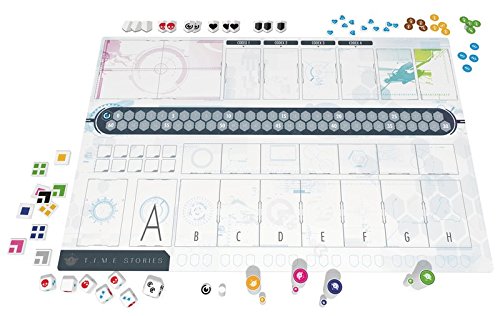
The mechanics are as easy as they come.  At the start of each adventure, you are told to find some problem, fix it, and then return.  From the space station, you teleport into the bodies of different individuals at the scene.  These bodies have their own problems.  The first adventure is a bit of a Lovecraftian inspired tale, so you start in an insane asylum and your host bodies all have some strange ticks that prevent things from working completely well.  From there, you have a map of four Tarot-sized cards that you use to indicate where your group is currently exploring and a spread of cards that indicate the room or location you’re currently looking in.  Each card is either the introductory text of the room or a space that you can interact with.  You can look at the back of each card, but some cards have conflicts you have to resolve in order to progress.  Each body you enter has two to three different stats.  These stats indicate how well you handle different tests.  These tests can range from social, to investigative, to straight up combat.  All tests are handled the same way.  You decide if you want to handle the test, choose the appropriate stat to use, and roll the number of dice for the stat on some wooden dice.  These dice have either blue explosions or red skulls.  Each test has a number of shields, and blue explosions remove shields.  Red skulls cause the test to attack you back.  You add the number of red skulls and the number of shields that have red skulls on them, and if the number is higher than your defense stat, you lose one life.  There are also some tests that have different shields like time or life and those will either take more life or subtract time from your total.

Time is the main currency of the game.  When you move between locations, roll the dice for a test, or move between panels at a location, you spend time.  Moving between panels is just one click of time and can be done at the same time as another character at your location is rolling dice.  Moving between locations results in your rolling a different die that takes between one and three time clicks to move around the map.  When your time is up, you teleport back to the space stations.

Here is the most interesting part.  As you adventure around, you receive items and tokens.  The tokens are all color and symbol combinations that you place on the board.  As you move around, these tokens unlock new locations. Some locations have one or more pictures of colored tokens on them, and you can’t access those locations until you get the tokens from other places on the map.  The other thing a character can get is items.  Items come from their own numbered deck, and these items range from maps to chainsaws.  Some give you tokens or weapons to fight with.  The most important thing some have is a mark indicating that you get to keep them if you run out of time.  When you run out of time, you reset the board, replace all items in the deck except for any items marked with the TIME symbol.  Then you most likely get yelled at by your TIME boss, and sent back in.  But, now you can skip certain locations because you remember that information from your previous times through.  In game terms you got a new map indicating the secret tunnel (for example), and you can just head there, bypassing the whole mess and a few other locations.

Your goal is to find the problem, solve it, and head home.  Using the above mechanics, your wits, and what you discover as you move around the map, can you save time itself?


Mechanics– A summary from above-You have three stats, to do a test, roll the number of dice for the stat.  You spend time when you roll or move.  Moving to a new place takes time.  Spend all your time, and you go back to the spaceship.  Done!  That is the rules for the game.  With that you can get most of the game, and that level of simplicity is phenomenal!  I love the way the mechanics don’t interrupt the game’s flow or overcomplicate things.  This feels like a super simple RPG, and honestly, that’s not far from the truth in terms of how the game plays. 5/5

51rPRLbDVuL

Theme– This game is the best American-style game I’ve played in a long time, including some of the RPGs I play all the time.  Everything in this one feels right.  The art is amazing, the cards all feel great, and the writing for the story is awesome.  It’s got red herrings throughout that you want to check out, and little details that are awesome to understand.  The only sad part is I can only play this once… 5/5

Instructions-Writing the instructions for this game are difficult.  If you write too much, then you have to explain what some things that will happen are.  If you write too little, you leave the players scrambling to understand what you meant.  This game went a bit too little for my taste.  The rules are by no means bad, but they are a bit too open as I played I and my group had to make a few calls about what things were and to just roll with the punches.  That would be absolutely unforgivable in a game where every rule call could mean winning or losing, but since this game is a complete co-op game, it’s much more tolerable.  If you don’t mind just saying “Ya, that seems right” a few times, then you won’t have a problem.  If not, you will spend a bit of time on BoardGameGeek searching forums on how to execute the rules. 4.25/5

Execution-Execution is interesting.  The game board and tokens feel sterile, and they should since your body is aboard the space station and you’re just being beamed into a person at the scene of the problem.  The art of the cards is amazing, and it does help draw you into the scene.  What I don’t like is some of the components, more specifically, the insert to keep things organized.  It’s cheap loose plastic that was broken on my unboxing copy.  This is a $60 game that after one playthrough I can’t play again (without buying an expansion), so for my money I expect a bit more.  Also, you can’t really fit all the components well into the holes provided, so most days after opening up the box, you have a mess!  That might be  a pain, but overall the game’s parts are all done well.  For the price, it’s not bad, but it could use a bit more.  If you want to see all the pieces in action, here is my unboxing video https://youtu.be/jQsb6WBz31k 4.75/5

Summary-This is a phenomenal game that basically self destructs.  It has zero replay, and that is the main drawback.  You can’t unlearn the mystery in the mystery novel, and once you know what the right choices are, then this game is basically over.  That’s not bad, as point and click adventure games are amazing, but you have to know that going in.  For what it is, it is amazing.  Its an RPG game where you don’t have a DM/GM.  I get to play with my friends with no prep and everyone is on the same side of the game.  It’s completely cooperative.  It is expensive at $60, but not overly so.  Furthermore, since the base game is designed to serve at the springboard for future games, it’s almost like buying the console to play video games.  The story of the first adventure is fun, and any game that has sneaky Lovecraft has good Lovecraft (ie this game didn’t need to scream CTHULHU! to get sales).  If want a fun co-op game where you get to play through a random adventure each time, provided you bought the expansion, then this is an amazing game that will draw you in and keep you hooked. 95%

Ring Side Report- RPG Review of Pathfinder Society Scenario #7–14—Faithless and Forgotten, Part 1: Let Bygones Be

Product-Pathfinder Society Scenario #7–14—Faithless and Forgotten, Part 1: Let Bygones Be

System-Pathfinder

Producer– Paizo

Price– $4.00 here

TL; DR-Instantly one of my favorites! 97%

PZOPSS0714E

Basics-Cheliax is back!  This Pathfinder scenario is the start of renewed relations with Cheliax as the Pathfinders move from the shadows and are asked to investigate a few choice locations in the country.  However, along the way you find that not is all it seems as you have to deal with an oppressive dictator, unfriendly towns people, and horrors from days gone by that have subsisted on the most foul of meats.  Will you survive the horrors of town and the horror long forgotten?

Mechanics or Crunch-This adventure hits all their right marks for a PFS adventure-exploration, social challenges, problem solving(non-fighting),and problem solving(fighting!).  Every character gets a chance to be awesome in this one as you can simple fight everything everywhere as a way to win, but if you think your way through the problems, you can find some awesome solutions that are rewarded.  The fights that are here are all balanced and felt fun with enough threats to keep the players interested but not enough challenge to destroy the level 1 party.  The social still has the Pathfinder problem of “fail by 1, no help” that all Pathfinder adventures will always have, but overall it’s a blast to play that is well balanced for any party. 5/5

Theme or Fluff-This adventure has the feel of a Cheliax adventure, but does have a slight problem with the end.  Overall the part of the scenario that takes place in town feels like a town adventure where you must help the townspeople survive in their dictatorship.  The rural exploration is fun, as you get to interact with some often unused monsters.  The end boss is a bit strange.  It makes sense for the DM who gets to read the behind the scenes bit of the adventure, but most adventurers might not see that and will be a bit confused.  Overall it’s fun as the left hand turn parts don’t distract from the great story. 4.75/5

Execution– I like how Paizo prepares their modules, but I’ve also become a little estranged from theme as well.  I like that they now place stat blocks at the back of the adventure, so I don’t have to have almost 10 books open to run the game.  However, I’d like a little more consistency with that.  The main NPCs get stat blocks in the text, while the rest of the monsters are at the end of the adventure.  That’s a pain to flip through, so I would prefer to just have all the encounters together in a clump at the end or put them together throughout.  That’s my only real complaint about these adventures though.  I love how Paizo puts together their stories, so this one is no different. 4.75/5

Summary-Everybody loves to hate on Cheliax, but it’s always fun to play there.  Throwing the halfling bard to the Order of the Rack wolves is always a great way to start some roleplaying as well as draw the player’s interest deeper into the game.  I love what I’m seeing here, and I think I most players will as well.  This isn’t a perfect adventure as the ending is a bit strange, and I’d like some minor format changes.  But taken together, this is one of my favorite adventures from this year. 97%