
Check out our latest Board Game Review!
Unboxing, How to play and Review of Game of Ham
Check out our latest Board Game Review!
Product– Carbon 2185
System-DnD 5e
Producer– Dragon Turtle Games
Price– $ 25.10 here https://www.drivethrurpg.com/product/283725/Carbon-2185–A-Cyberpunk-RPG-Core-Rulebook?term=carbon+2185?affiliate_id=658618
TL; DR– Dungeons and Shadowrun, kind of 90%
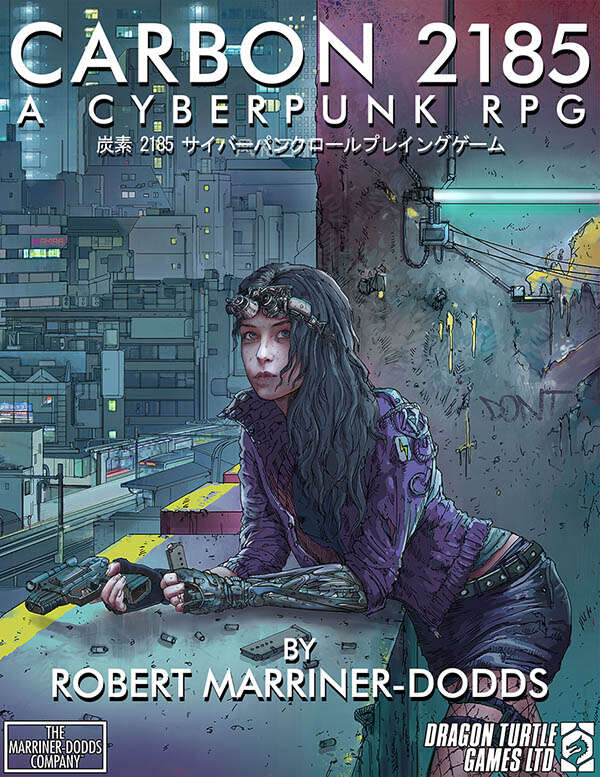
Basics– Want some cyberpunk with your DnD 5e mechanics? Carbon 2185 uses the DnD mechanics you love but moves them to a nonmagic, cyperpunk future. Let’s break it down
Mechanics-If you can play DnD 5e, you honestly know everything you need to. It’s d20 + ability modifier + proficiency modifier if they are proficient. This is the elegance of the DnD 5e system, and it’s fully on display here as skills, attacks, and saves all come across into this game.
Character generation-Again, DnD 5e is on display, but there are some drastic changes. You choose a not-race called an origin, then you choose a background. This is honestly the biggest change from DnD 5e. Here you choose an occupation then roll 2d6, adding half your Intelligence modifier to see if you last five years in your chosen occupation. Roll below your threshold and you are injured and lose your job! Survive long enough, and you get paid as well as gain a skill. You can take as many five year time periods as you want, gaining skills and money along the way. All characters get a retirement gift when they leave but if you go long enough you get a retirement bonus. This also changes the game in a weird way. This is an old mans game. If you need four times five years to get a retirement bonus, then your 18 year old going into work ends up 38 coming out. Heck, if you pull another five years in for the sweet, sweet money, you end up middle aged! Age alters the stats a bit, but it’s something to consider.
Classes-Carbon 2185 is DnD 5e, so there are base core ideas that will be here. The Daimyo is the barbarian and so on, but Carbon 2185 has subtle changes to the system that will keep it fresh. Your Daimyo also has bard abilities that make it a bardbarian. Most of the classes are represented, but they end up with a Carbon 2185 twist that does make them fun.
Cleric/Doc-You can’t really have a high hit point game without a healer, so this system has the Doc. The doc doesn’t get spells, but gets a lot of other toys that make them kind of a fighter or other splash classes. Healing abilities refresh after short rests to keep your characters fighting.
Wizard/Hacker-Everyone wants a spellcaster in their DnD, and cyberpunk is no exception. The hacker is the class that has nanobots that do things. In this system everyone basically has Matrix-like hookups that allow them to go online, so you can use that to manipulate them either with pain or distractions. This character also is the one who can manipulate computers, but there is also the hacking skill.
Now the breakdown!
Mechanics or Crunch– I like the crunch here, but I feel that other cyberpunk games have ruined me. Shadowrun has deckers who are hackers, but in this game you can’t really hack a computer and make it do all the things you want to do. Hackers have limited uses of their “spells” so it feels a bit off. Why can’t my hacker hack more than three computers a day at first level? I know the “why” is mechanics based, but it doesn’t quite fit. It’s fun, and it’s fast, but some things don’t fit as well as I want them to. Also, this game is VERY random. Character backgrounds have a very wide variety as some lucky players can get MASSIVE amounts of money and skills while an unlucky one won’t get money or skills from their background. Base abilities are the same with no point buy in the basic system . There is the basic array, but I still want my point buy. Furthermore, no feats!? You get character advancements, so feats may come one day. But, I want them! Let’s hope they come out in another book. Overall, Carbon 2185 works mechanics, but there are some issues that may affect your fun in the crunch. 4/5
Theme or Fluff-Carbon 2185 is its own setting. It’s not exactly just cookie cutter cyberpunk, but is it’s own world that builds fairly organically from today. It’s depressing as all hell, but it feels real. I enjoy playing in this setting while I would NEVER want to live there! 5/5
Execution– PDF? Yep! Hyperlinked? YEP! I like the book in general, but I feel that more is needed to further define things like computer security level and how some skills work. More are the major things I need here. Like more pictures of enemies in the back of the book. More explanation of things that are talked about, but not shown. I like what’s here, but give me more to help better understand the world. 4.5/5Summary-I like this book, but other things may have influenced me. Cyberpunk is a fun world to play in, and the DnD 5e system works lightning fast. But, some of those pieces don’t work well, like the hacker’s “not spells” and hacking computers. That hurts things a bit in terms of flow. The world is fine, but I want more stuff to show myself and the players to help me see the world and better understand the flow and crunch of it. I foresee a number of expansions to this and that would really help the players make the characters their own. It’s a solid RPG with a few issues that hurt it. If you want some Cyberpunk and some simple gaming, this will be your new favorite. 90%

Product– EB-01 The Night Land
System-DnD 5e
Producer– DMs Guild
Price– $4.99 here https://www.dmsguild.com/product/296403/EB01-The-Night-Land?affiliate_id=658618
TL; DR– Standard start to something great. 93%

Basics– Eberron? In MY 5e? OH YES! Let’s hope in and look at the new TWENTY adventure long story for Eberron The Oracle of War Storyline called The Night Land. You start by rolling into the town of Salvation on the Mournland border, and like all poor hungry souls, it’s time to find a job! What’s the job board got today?
Mechanics or Crunch– This adventure is pretty balanced for crunch. It is the same formula you’ve grown to love or maybe be annoyed with in this first adventure by Shawn. Three small quests with some time between to rest up. The party does some crazy stuff, rests, repeat. The players learn how to be their characters, get a bit of a challenge, and then 4.5/5
Theme or Fluff– Standard well done 1st level adventure! Shawn does 1st level adventure well. Small packages to not kill the party day one. It has a bit of Eberron feel, but like most things, it will require the DM to amp up the world feel. You do hang with some goblins, changelings, and some horrors of the mournlands, so you get a good intro of the horrible things that want to eat you! You can get a bit bored as your party might recognize a formula when they start. But its level one! You’re off to run errands and kill low level monsters, not take on the Lord of Blades day one! 4.5/5
Execution– PDF? Yep! Hyperlinked? No, but it doesn’t really matter (I’d still like it though). This product has THREE PDFs. One is the adventure in glorious color with lots of pictures that you run through the home printer. The second is a slimmed down black and white no frills product that you run through the home printer. Third is a newspaper to throw the players! That’s some awesome world world building! In addition, the adventure organizers have FULL PAGE sheets the players get after the adventure. The things they check off let them know some serious crap is up. Heck, I as a GM who isn’t fully aware of the campaign knows some crap is up, so I’m buying in too. I also like the authors’ use of the DMs Guild to full effect by putting lots of pictures in. These are pictures I’ve seen before, but it’s a nice touch to the other pictures that they throw in. I like the art deco style of everything. It honestly makes me feel more like we are between wars and I know something bad is coming…. 4.9/5
Summary-I like Eberron, and The Wife LOVES Eberron. This adventure brought her back to 5e and weekly gaming at the store. That’s the sales pitch that I can give. Now, is it perfect? No. It’s 1st level fare. Small tapas portions of adventures as your cleric might be able to roll out two cure wounds and a real bad round of two crits can completely wreck a party. Is that a problem? No. This is fun. I’ll equate this to my favorite above average hibachi restaurant. I know exactly what the chef is going to do there, but guess what? I’m going to show up and be happy I went! 93%

Product– Shadowrun 6th Ed.
System-Shadowrun 6th Ed.
Producer– Catalyst Game Lab
Price– $19.99 here https://www.drivethrurpg.com/product/286850/Shadowrun-Sixth-World-Core-Rulebook?manufacturers_id=2216?affiliate_id=658618
TL; DR– New but similar. 93%
Basics– Shadowrun is 30 years old! In honor of this, here is the 6th edition. What changed? What’s new? What’s old? Let’s dive in together!
Basics- Shadowrun 6th ed. uses the solid base of 5th edition. Almost all rolls are: take an attribute (the stats of your character that range mostly between 1 to 6), add your skill ranks, and roll that many dice. You then count the number of 1s and the 5s and 6s. 5 and 6 are successes and used to determine if you succeed, while if you have over half 1s, that’s a glitch and something bad happens. Pretty simple.
What’s new with the basics-the BIGGEST change between editions is edge. Edge is the magic cheaty story currency. You buy pizza? Get a point of edge. You roleplay well? Edge. You’re the only player paying attention and you catch the plot hook? EDGE! What changed is now before every roll we check who has an advantage in a situation. That side gains edge now. You see in the dark and the opponent doesn’t? Edge for you! What’s also changed is edge isn’t just rerolls now. It’s much more an a la carte menu where you choose abilities, to change dice faces, and other crazy options. Edge even powers new abilities.
Combat-combat got more of a face lift with two sizable, but manageable changes. 1st, armor…is gone. In 5th ed, I would roll to hit you. You would roll to dodge. If I got more successes (5s and 6s on the dice) than you then the difference would be added to the weapon damage. You would then roll a soak roll. Soak is reducing damage, and it was found by adding your body attribute to your armor value. You would roll that many d6s praying for 5s and 6s so you would not die! In 6th ed, armor doesn’t provide damage reduction but instead provides a score to compare to guns to gain edge. It means you roll much fewer dice and weapon damage is also down to compensate. The second biggest change is actions in combat. Before, in 5th, you would roll initiative and all characters would act from high to low. After actions, you would subtract 10 from all scores, and characters with scores above 0 would act again. This would result in multiple passes for fast characters moving at super human speeds. Now all characters roll initiative as before, but depending on the number of d6s you roll you may gain additional actions. Every character gets 1 minor action (things like run ) and 1 major action (thinks like attack and cast spells). You can spend several minor actions to make a second major action. This means you get fewer passes at the top of the round, but you also have a more stable initiative action order and action amounts.
Magic- magic changes, but it still follows the basics above. Before you would choose how hard a spell would hit, now you just roll and if you get more hits, you increase magic effectiveness after the roll doing more damage or being more hidden based on your result. Magic’s overall power did go down, but it also gained some significant ease of use, especially in regard to healing!
Technology-All the basics you loved before are here except streamlined. You no longer need to MARC (put a tag on in game) computers or computer programs to take them over. It’s also streamlined, with all matrix (think futuristic internet) actions being reduced to two basic skill pools. It’s a lot quicker, and also means that you can do so during a fight rather than having to do all the hard work before a fight. Also, all the naughty things you do online make the tracking score on your dirty deeds go up MUCH faster. This means that a whole section of the game tracking how long until the matrix overwatch simply called GOD comes to smack you down now matters a whole lot more!
Mechanics or Crunch– Sixth edition is different, and that’s not bad! Overall, the mechanics are still the same. I liked 5th ed’s base mechanics, so 6th ed starts strong. The changes that have been made are all made in the name of speed. You don’t reroll init (speed), it’s easier to do hacking (speed), magic is a smaller number of steps (speed), and a whole host of other things. These I really like. All the choices here seem to have been really well thought out. The things you won’t like are the loss of full crunch. Numbers are smaller and there are fewer fiddly bits. You can run a whole game of “Lasers and Love” where you do all the things in a Shadowrun game with just 1d6, but there isn’t a whole lot of crunch to that system. You most definitely don’t hurl a dumpster of d6s at a problem any more. That feels a bit wrong. And there is the armor thing…. It’s small. The logic has been explained to me by both the creator of the system. It’s mathematically sound. And it’s wrong. It bugs me to high heaven that I can’t strap on a tank and take no damage from a pistol. I gain a point of edge (of the maximum 2 I can earn each turn) for the tank I’ve strapped to my face but still take a crap ton of damage if I can’t roll a dodge worth a crap! 4.5/5
Theme or Fluff– Shadowrun always has good fluff, and this book is no exception. That’s it. I’m in Michigan, and despite all the horrors of the 6th World, this is the one future where Michigan has an economy! 5/5
Execution– PDF? Yep! Hyperlinked? YES! This book is done pretty well. My main issues are some of the tables and the writing with them. A key example of this is the table for racial maximums. As you build a character, you are given extra points that you can put into special attributes like magic, edge, or some racial attributes like orcs are strong etc. You have to manually find that. It’s not hard when you jump onto the writer’s logic, but why? Don’t make me five second logic puzzle out where my extra points can do. Just put that in the chart! There are a few times where those small puzzles come out. Now this is a MASSIVE BOOK, so editing issues will pop up, but those things hurt teaching new players this game. I live and breathe RPG, so that took me five seconds. A few of my friends though? It took multiple passes to make them understand if your score can go above six, then you can put the extra point there. But, for the majority of the book, this is how you want to make a RPG book. 4.5/5
Summary-The sixth sixth world is here, and I like it! This might not be a complete love affair as some minor things like tables and armor values murky my joy, but the changes together make a game that runs a WHOLE lot faster than before. The one thing Catalyst can do extremely well is tell a crazy story about orcs with shotguns in downtown Detroit, so the story and fluff of this game is amazing. The layout is good, with some minor issues that once you get past will work easily. Is this a perfect system? No, that can’t exist. The changes that happened all happened to make the game run on a non geological time scale. Will this make all fans happy? No. It’s got some differences that older fans just won’t grok. Does it make me happy? Honestly yes. I look forward to playing in the sixth world as my decker hacks Elf eyeballs in the middle of combat in Jersey fully as a member of a team even if my armor doesn’t matter much! 93%

How about a review of a board game? Been a bit, but we’re back!
Product– Adventurer’s Backpack
System-Castles and Crusades
Producer– Troll Lord Games
Price– 19.99 here https://www.drivethrurpg.com/product/234183/Castles–Crusades-The-Adventurers-Backpack?affiliate_id=658618
TL; DR– OPTIONS! 86%
Basics-It’s time for a solid player option book for CnC! This book features TONS of new classes, spells, items, niche rules, and even a complete new magic system. There is even a whole chapter dedicated to backpacks of tools each adventurer would need to do their job. How does it stack up?
Mechanics or Crunch– Ah old school… you provide us with gonzo options and allow the DM to do whatever they want. The problem is, this is pretty rules-light for how some of the crunch works. A perfect example is the warrior priest. That class has Cure Wounds which allows them to heal other characters. Awesome! I love it. But the rules don’t describe: do you roll once per day, or do you roll all hit points and then give them out as you want, or do you spend dice as you go? I could hunt online and find the answer. I don’t want to do that. I just decided and went with it. This is old school, so once the group decides, we roll with it. That’s the bad; the good is this book gives you new character classes, character options like spell casting rangers, paladins,and bards, lots of equipment options, spells, and all sorts of tools adventurers might need to fight evil. It’s not perfect, but the flaws are all part of OSR rules’ light touch. The good is amazing and makes this worth the price. 3.75/5
Theme or Fluff– I would not call this a fluff book, but I do think what is here is done well. It mostly gives you ideas how the new things fit into the fantasy worlds of Castles and Crusades. It’s world-agnostic in a decent way, so you could plug these into any fantasy world and have a fitting character. I would like more, as I want to build out the world and campaign setting, but the book gives you enough that you can find the equivalent in your world and plug and play right away. 4.25/5
Execution– PDF? Yep! Hyperlinked? YES! This book is well done. It’s an old school game, but it’s modern design makes me happy. It’s not perfect – I would like the font to be a bit larger, but this thing has all the things I think a modern book should have. 4.9/5
Summary-My summary of this book comes down to one very specific question-do you want more character options for CnC? If yes, then get the book. It’s not perfect; I think things need another round of writing to fully explain what the writers wanted me to do in some spots, but if you can look past some small issues, you will enjoy this. The fluff is decent. I want more, but it’s not bad. Just not the whole world laid bare. Physically, the book is done well. Links, layout, and text all work well. I’m glad this is in my collection, and I know my players are always happy to have this as a place to get spells, classes, and toys to help them put down evil. 86%


See our thoughts on Mage Company’s Premium Card Sleeves!
Like and subscribe for upcoming unboxing and upcoming contests!
Follow Throat Punch Games across the internet:
Twitter: @ThroatPunchG
Instagram: https://instagram.com/throatpunchgames/
Facebook: https://www.facebook.com/pages/Throatpunchgames
Website: http://www.throatpunchgames.com
Buy the sleeves here!
Mini American https://www.amazon.com/MCG-Premium-Card-Sleeves-American/dp/B0795B13CR/ref=sr_1_9?keywords=mage+company+premium+card+sleeves&qid=1573439763&sr=8-9&_encoding=UTF8&tag=fym02-20&linkCode=ur2&linkId=b3cb0fb06f59f860dd2cdd880b003ac9&camp=1789&creative=9325
Standard Card Sleeves https://www.amazon.com/Mage-Company-063-Standard-Colour-Blue/dp/B07CZ68FZ8/ref=sr_1_6?keywords=mage+company+premium+card+sleeves&qid=1573439763&sr=8-6&_encoding=UTF8&tag=fym02-20&linkCode=ur2&linkId=4ed79d96b35fc8dfbb46d8a032926c30&camp=1789&creative=9325
Standard Game Card Sleeves https://www.amazon.com/Mage-Company-062-Standard-Colour-Black/dp/B07CZ67Z84/ref=sr_1_7?keywords=mage+company+premium+card+sleeves&qid=1573439763&sr=8-7&_encoding=UTF8&tag=fym02-20&linkCode=ur2&linkId=c1dab63b22e53c879d42ed6913e8d8ec&camp=1789&creative=9325
Big Sleeve href=”https://www.amazon.com/Premium-Card-Sleeves-Mage-Company_MCG054/dp/B07958DZ94/ref=sr_1_16?keywords=mage+company+premium+card+sleeves&qid=1573439763&sr=8-16&_encoding=UTF8&tag=fym02-20&linkCode=ur2&linkId=f8521cc8046d3abef554231ea2b88b3c&camp=1789&creative=9325
Big Square-https://www.amazon.com/Premium-Card-Sleeves-Mage-Company_MCG061/dp/B07958HHJB/ref=sr_1_21?keywords=mage+company+premium+card+sleeves&qid=1573439763&sr=8-21&_encoding=UTF8&tag=fym02-20&linkCode=ur2&linkId=ef6139d2c26844ae92a12f9b90b70d0b&camp=1789&creative=9325
Standard Euro-https://www.amazon.com/MCG-Premium-Card-Sleeves-Standard/dp/B07957GTGW/ref=sr_1_22?keywords=mage+company+premium+card+sleeves&qid=1573439763&sr=8-22&_encoding=UTF8&tag=fym02-20&linkCode=ur2&linkId=a55e879a28d38b389bcf3ed6b96ed664&camp=1789&creative=9325
Brighten Your Day by Mixaund | https://mixaund.bandcamp.com
Music promoted by https://www.free-stock-music.com

Product– Esper Genesis 5E Sci-fi – Core Manual
System-Dungeons and Dragons 5e
Producer– Alligator Alley Entertainment
Price– $ 24.95 here https://www.drivethrurpg.com/product/240798/Esper-Genesis-5E-Scifi—Core-Manual?cPath=26435?affiliate_id=658618
TL; DR-5E IN SPACE! 92%
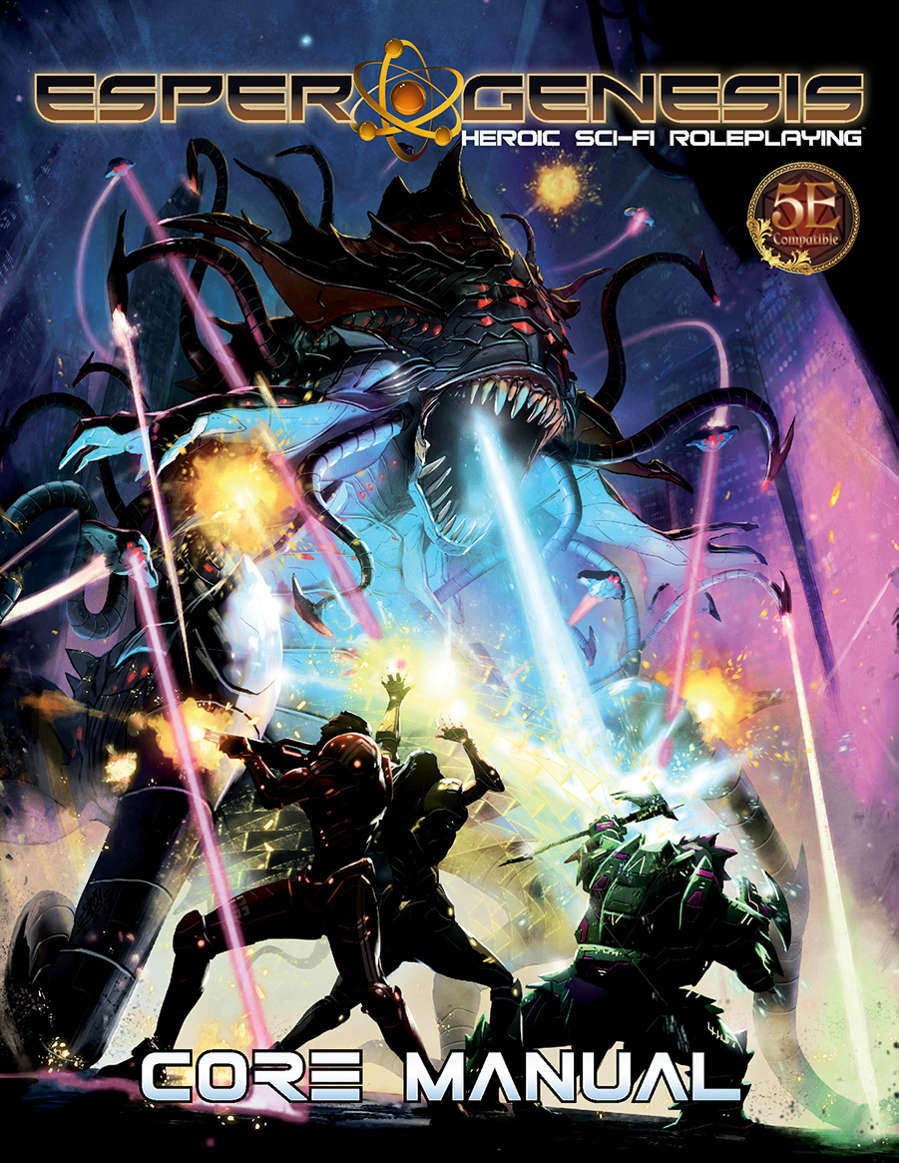
Basics-Want some DnD 5e but also want some spaceships and don’t want the less serious nature of Starjammer? Then Esper Genesis is the game for you. Hard space opera on the level of a Mass Effect with the crunch of the Forgotten Realms. Let’s go into the pieces first and then my thoughts on it.
Base Mechanic-Can you play DnD 5e? Then you know this system. That’s it. That’s not a bad or a good, it’s just the basic mechanics you know and you may love.
Classes-Like any system that bases itself on another base game there will be some reskins and some out of the box thinking taking the game in new directions. You have a not-fighter and a not-rogue, and the DnD 5e system needs those to work, but you also have whole new classes and a different magic system relying on new abilities, due to a new material found in moons across the galaxy. These new classes feel like combinations of clerics and wizards, and truly it’s not bad. It breaks fun new ground on the mechanics of the system.
Spaceship Dogfights-DnD is NOT a crunch heavy system that requires a battle map to play, so the spaceship part of the game can’t use that either. Each player gets a role on the ship and can do different actions in a round from repairs to shields to killing people with lasers. However, this is all done quickly via theater of the mind.
Those are the basics. Let’s look at my thoughts.
Mechanics or Crunch-Honestly, this is the shining highlight of the book. You have the cloned classes that you know were going to be there from the not-fighter to the not-rogue, but the changes in mechanics really help the players see a new universe of potential to the system. I like what I see here. Now, this is a reskin and cut and paste of some DnD things from spells that have to be healing word and cure wounds, but it is different enough so you get new things for you to explore. Heck, you can’t even say this is just a combo of Starfinder and DnD5e, as the stuff feels fresh enough that it has its own feel distinct from either of those properties. This isn’t just a hack job of reworked DnD 5e material, this is its own thing that stands strongly on its own two feet. 5/5
Theme or Fluff– I like what I see here, but like any gourmet meal, I left wanting more. There is a whole universe here to explore, but I felt like not enough time was spent on the world itself. It’s some amazing stuff, even if it does take some strong references from the Mass Effect series with elements like humans fighting then joining a galactic UN, a mystery element that gives powers. Now, this doesn’t make this game and its world derivative. The basic plot of “magic/science things give magic/science powers to people and now we deal with it” is a staple of the scifi and fantasy field, but what I don’t like is the limited amount of information on display. I wasn’t so much as left wanting more as I was left not getting enough. I wasn’t full waiting for my next book, but was more often than not given enough story to start strong. The world is fun, but not flushed out enough. I’m down to play and read more. What is here does draw you in, but I feel I need another 30 or so pages to really know the world or universe, from bad guys to who the main races are. That said, what is here is well done. I enjoy every piece of it, but just need more of it. 4.25/5
Execution– PDF? Yep! Hyperlinked? Yep! Ok, all the things I want standard in a book! The book is laid out well and typeset well, but the big issue I have is too many pages of double column text. Even the best world book or rule manual is simply a guide book or math textbook, and those NEED to be broken up to keep the reader involved. So I want more pictures to show me cool stuff of your world. Also, this is a third party product, so it has a limited budget. Many cool things are discussed like the monster manual in the back of the book, but I need pictures to see what you’re showing me. I want to see what you got. Also, as a new world that is whole-cloth your own, you NEED a short adventure to tell me your pacing and story structure. I read this as standard action adventure scifi, but you might have meant this to be hard R space horror. Overall, it’s well done, but it’s missing a few pieces to make it excellent. 4.5/5
Summary– From my review, you might think I don’t like this, but this is an amazing rpg. It’s got scifi using the nuts and bolts of the DnD 5e system while not just becoming spelljammer. It’s full of new flavor that is all its own and not just a copy paste from Star Wars. It’s got solid layout in a format I BEG the major RPG producers to do. All these things mean it is a solid game! My issues are minor, such as wanting more story in the base book, even though the authors clearly indicate other books that have come out since this game was published to build out the world like trailers for coming attractions. The execution of the book is good, but needs more pictures. I just want more in the book, but for a whole RPG from a small press RPG company, this is an amazing product. However, the inevitable comparison comes forward-Is this just Starfinder with 5e? And the answer, I think, is no. This is more light scifi with no space wizardry and none of the more fantastical elements that make Starfinder science fantasy while this is science fiction. The systems stay very separate from one another, as Starfinder embraces the hard crunch of Pathfinder while Esper Genesis has its own mechanics from 5e and modified as needed to give this the speed that 5e is famous for. With this book and the base DnD 5e book, you could make your own Starfinder game, but honestly, I’d use this book by itself to play an awesome game among the stars. If you are looking for your fast, fun, 5e scifi, look no further than this game! 92%

Product– Pathfinder Core Rulebook
System-Pathfinder
Producer–Paizo
Price– $60 here https://paizo.com/products/btq01y0k?Pathfinder-Core-Rulebook
TL; DR-A solid mix of new good things, but some issues remain. 92%
Basics-It’s here! Pathfinder 2nd ed is out in the wild! Let’s dig into this thing! The basics from my previous review here: Let’s look at the big changes.
Base Mechanic-The d20 system never really changes. It’s still numbers + d20 vs other numbers. Pathfinder 2nd Ed has the player add their ability modifier, their level, AND a modifier to the roll, depending on their level of proficiency. The biggest change from the previous one is that the proficiency levels are now +2, +4, +6, or +8 instead of adding one to 4. Honestly, this feels like a change coming from 4th Edition DnD. I know the heresy of that statement, but I like that mechanic.
Action Economy– Players still have the three actions per turn of the playtest with some spells or actions requiring additional actions to do.
Skills– If you are not trained it’s just a d20 + ability modifier. If you are not trained, after about 4th level, it might not be useful to even roll.
Options– This edition is labeled featfinder by its critics, but the designers use the word feat instead of options. I’m ok with featfinder as I LOVE class options.
ITEM LEVELS!!!-Items HAVE LEVELS! I love this as you know exactly what an item should cost, what kind of character should have this, and it means that some things such as alchemical items are going to be useful later as higher level options are available.
Character Advancement- Characters now level at 1000 exp. Monsters of your level give certain amounts of experience, and there are formulas for changing the experience points if you are fighting a creature of a higher or lower amount.
Those are the basics. Let’s look at my thoughts.
Mechanics or Crunch-I really love this system. Long ago, I toyed with the idea of making a 3.5/4e hybrid, and this is almost what I wanted. I get the clean mechanics of the d20, but I add my level so leveling up made things matter. I get the deep CRUNCH of 3.5/Pathfinder, but the ease of a 5e. I get cantrips that I can use all the time and not have a wizard firing crappy crossbows while still feeling like a wizard. But it’s not perfect. Skills are kind of a big deal for me. I think the system kind of forgets about skills if you are untrained. I think a fighter could pick up some basics of magic from traveling with a wizard and I liked how previously untrained actions still added your level, just with a penalty. Now you don’t add your level to untrained actions and that basically means you have silos where no untrained character can go. It’s a design choice that isn’t bad, but not one I love. Also, I really don’t like the new EXP system. Just keep creatures with different exp instead of having some crazy formula to figure out the exp! It feels like a level of simplification that some players demanded but the rest of us hate. But overall, I really do like the simplicity of the system and the variety of options in this book. 4.75/5
Theme or Fluff-Everyone has their own idea of what “fantasy” should be. Pathfinder has a niche of an almost industrial magic world where some elements of science are beginning to poke their timid heads out of the real magic with semi-magic, semi-chemistry potions and simple guns. This new game nails that vibe. Also, this edition fixes a major problem others had before: alchemy. I love the idea of alchemy, but it’s always hard to add to a system Lots of RPGs add this in later due to fan demands. But that system feels bolted on and not a core of the world, with alchemy basically being a new magic caster class but with a reskin. In Pathfinder 2e, with item levels, an alchemist makes alchemy items and the items are NOT spells. They are their own special thing. I LOVE THIS! Pathfinder 2nd ed nails the Pathfinder theme even better than the original! 5/5
Execution– PDF? Check! Hyperlinked? NOPE! Come on Paizo! This book is over 600 Pages! Even random websites trading illegal PDFs have their stuff hyperlinked and for this size of document, it’s a major problem. Also, I think 3.5 has the best layout for d20 systems in regard to class advancement and feats. However, in the new system the classes get a table of advancement for each level, but you have to read deep into each specific advancement to know what is really happening. It’s less at a glance and results in slower leveling and progression. I LOVE table with the character level, short descriptions of mandatory class options, and saving throw bonuses, and even spells if needed. Now we get too many words that are not helping, and two tables that are seperate for magic and character options. That is two too many! Nice concise tables would help this feel less wordy and less tiring to read. Next, feats for each class need a feat table with short, one sentence descriptions of each class option. This is going to take up space, but the current layout of listing several options and just making players read the possible rule in its entirety is too long and wordy. Even if you keep the full feat description, adding these tables would make skimming for your next class option a breeze, but instead you end up reading lots of class options you do not care about. Reading about options you don’t care about is tiring! The rest of the book is fine, but those class sections could use some serious changes to make the material easier to read! Pathfinder 2nd ed charts its own territory, but it needs to learn from its roots for its readability. 4/5
Summary-My review of this system is not glowing, but I do love it. The mechanics of 2nd edition Pathfinder are a mix of 3.5, Pathfinder, and 4th edition and 5th edition DnD. Since I love all those games, I had no issues with all the best being blended together to make the best of everything. I didn’t get EVERYTHING I wanted, but I got enough. I love the world, and the new mechanics of the new edition really emphasize the world. The low point was the execution of the book. It feels way too wordy and made reading all the different classes a slog. The book isn’t bad by any stretch, but I feel that taking some clues on how other editions of RPGs work and displayed their information would really help here. Now this might seem negative but overall I love this system. It’s easy to play, characters are made quickly, and I feel it’s going to be a fun system for a long time. Can’t wait to see what story I can tell with this system! 92%
 Throat Punch Games