Basics- What was that?! Dreamlink Labs found …something. And someone else wants it. Where are the scientists? Are they alive?
Mechanics or Crunch: This is a pretty simple one for crunch. It’s only a few fights. There is some craziness in the second fight, but you can tell this was designed to fit in two hours. The fights are fun, but short. 4.5/5
Theme or Fluff– This is a short one, but a good one. It’s space horror. We have some Aliens mixed with Lovecraft, and some Predator thrown in. I love all those, so it’s a solid fun experience. 5/5
Execution: I like this one a lot, but I have a few minor issues. It’s got great layout, fun extra bits to add tension, and pictures of most of the parts. I don’t like that the pictures are in the middle of the book, not in the end, but I can deal with that. It’s short, but there’s enough to get at least two hours of stuff done! 4.75/5
Summary: I love cosmic horror and good space-station horror. This is that. It’s that, but short. But, its still those things. I would like it a bit longer, but I am ok with what’s here. I can’t see where they go with the new god and the remains of a planet it broke out of. 95%
TL; DR– Either add more or remove to help with this one. 93%
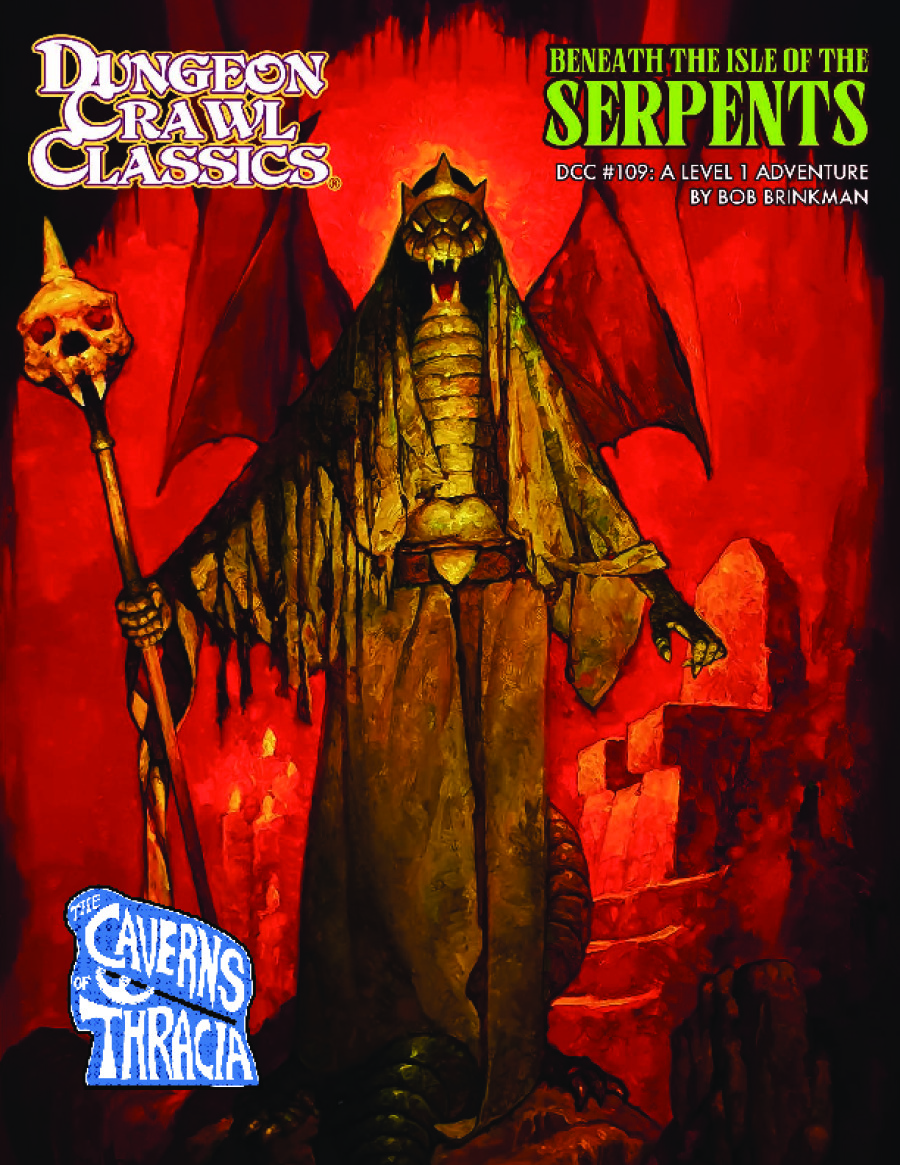
Basics- Where are they!? Cultists are attacking your lands. Find where they are, make friends along the way, and route them out from their caves!
Mechanics or Crunch: Standard fun for DCC in this one. Lots of low-level enemies to fight and kill. There is a bit of socializing, a bit of exploration, and lots of combat. All as balanced as random can be! 5/5
Theme or Fluff– I love the pieces, but I either want more or less of them. This adventure has a hex crawl. This goes without saying-THERE IS NOT ENOUGH HEX CRAWLS IN THE WORLD! But the hexes are kind of empty. There are random encounters, but I’d like more storytelling with finding specific things along the way. Give me more staged stuff to do. You wonder and find things, but you don’t get much of a story till you find a village. Events and findings outside the village will help a bit. This might also save on the other problem of the adventure-time. Hex crawls with random encounters are either the most amazing thing ever, a snooze, or a slog. It’s random, so you don’t get the sweet spot of the number of encounters the creators hoped for often. I’d either add more to the hexes or just cut that and have a combat and a social outside the volcano to save time. The volcano lair is fine. Nothing beats a fight with bad guys in a dead volcano. 4.5/5
Execution: This is DCC. It’s got the best part of old school, but it’s got a few warts of old school with the layout. If you know how to read these, then it’s completely fine. If you are new, this might be a bit harder. Not bad, but less clean than your WotC-produced adventures. But I go to tons of less pretty places with amazing menus, so for a bit of atmosphere and disarray, you will be fine here. 4.5/5
Summary: This is a solid, fun adventure that randomness can completely mess up. I love a good strange hex crawl, but those hex crawls can be a pain if the dice roll weird. I’d like a bit more story in some hexes to really amp up the overall story, but what’s here is solid enough. Good fun for you and your friends as they enter Thracia! 93%
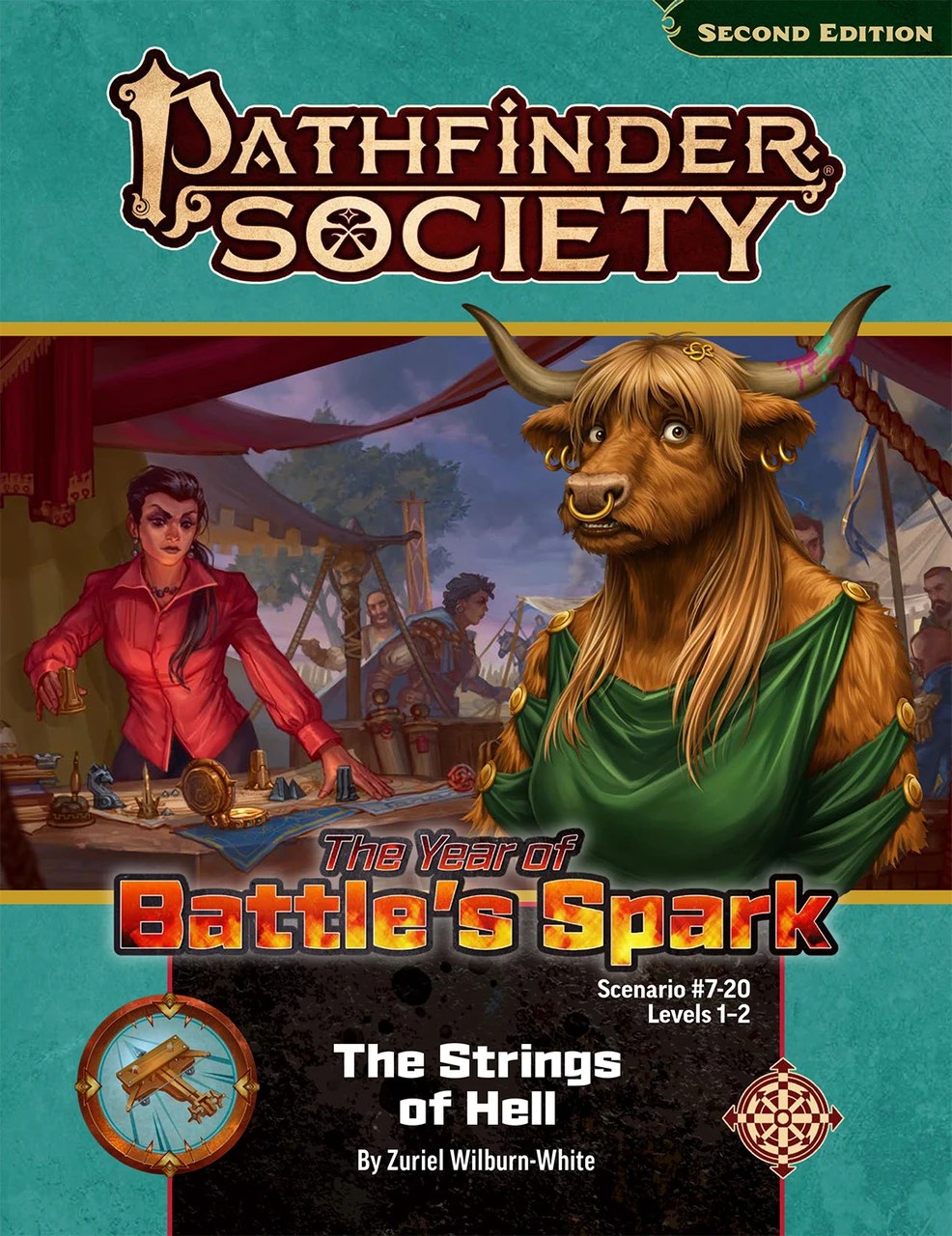
Basics- Where’s Star? An ally of the society has gone missing. Can you find him? What took them?
Mechanics or Crunch: The adventure is balanced, but there just isn’t much. The players have a fight with some intro monsters, a small puzzle, and then a final skill challenge. Those are all balanced, but it needs more. Give the players and GM more to do. 4/5
Theme or Fluff– The story here is light. The story shows something new, but even that is small. The characters meet something new, but then that’s about it. Even the reason why Star is missing really isn’t explained, just solved. That’s all due to the time constraints of the new adventures. What’s here is good, but it needs more. 4/5
Execution: What’s here is good, but it needs more. The standard Paizo polish is on display, but It needs more. This adventure used the exact same map as the last published level 1-4 adventure. That’s not great as almost ALL the level 1-4 use that, but then again, most of that map didn’t have stuff to do in it. No descriptions of anything. Couple that with a small gripe about names, and this was five bucks for less than two hours of game. 3/5
Summary-Everything here is ok. The encounters are ok. Social is ok. Puzzles are ok. It just too short. The goal is 2-3 hours. This is maybe 1 hour if you don’t mess around. I do online gaming and even with tech issues, a biobreak, folding sourdough, and wrapping up after, this was two hours. The fact that most of the map lacked descriptions is also a major issue. I can get past the map being reused again, but the fact that it’s not even covered makes this a problem. Add more to these adventures. Nothing is bad here, but it just needs more.73%
TL; DR– Good, but length hurts product and story. 83%
Basics- What’s on the moon? A new moon has been discovered, and there are ruins there. What else could be stirring on the frozen moon?
Mechanics or Crunch: This adventure has a decent mix of combat, skills, and some social. There are multiple NPCs that you get to know. They don’t do much, but they help set the scenes for future adventures. The combats are simple. There really are only two. There is one major skill challenge as well. I don’t hate this, given the design philosophy of the Starfinder society now. It’s short, but there are the key pieces I want. 5/5
Theme or Fluff– There is a lot of story in a small package. The story is light, but the adventure sets the stage for the future. You meet multiple characters. Those characters are there to help you learn the next pieces in the next adventures. That’s again, not bad, but aside from some social, two combats, and a skill challenge, the story is light. It does end on something big, so it works well enough. 4.5/5
Execution: Paizo is losing the Paizo polish to the internet. The adventure features new creatures, as in any good Star Trek adventure, as they explore a new planet. But it’s missing pieces, like pictures of the major NPCs. I can’t find pictures of somethings anywhere. Also, this adventure is 6 bucks for about 2 hours of RPG. That’s kind of a lot for missing pictures of one of the two things you fight. 4/5 Summary– This adventure is good, but the changes in Paizo’s organized play are hurting the product. The short adventures are ok, but it means there is less here. I also have fewer physical products to look at or show the players. Those changes hurt the product. I enjoy the story and adventure, but the constraints hurt the product. 83%
Basics- Who calls from below?! Chanters in the Dark is a one-shot adventure where the characters are drawn into a world of intrigue and subterranean threats. Will they be able to save everyone, or will the things from below eat them all?
Mechanics or Crunch: This adventure covers a lot of places, but fumbles a bit at the end. The bulk of the adventure is urban, as the players meet new people, possibly kill them, and then have to escape. The escape is the least fun. Basically, the characters have to run away. It’s not as exciting as a final fight, but it does make thematic sense. 4.5/5
Theme or Fluff– This is a good mix of exploration, combat, and skills, but the end is less fun. The town the players explore and the religion they may attack are both fleshed out. It’s a very meaty adventure for a book this size. The one issue is the end, as the players just run. Nothing else, but climb quickly. That diminishes the other parts. Not enough to not make it fun, but I saw some players lose some interest. 4.5/5
Execution: DCC polarizes some with its layout, and here it’s a bit less troubling but still old-school. There are multiple pages of two columns. It reads more easily than the real old-school, but if you are annoyed by the basic layout, this will not win you over. I would like more art, but what’s here is solid. 4.5/5
Summary– This is a good adventure that fumbles in the last minutes. The bulk is lots of fun , but I’d like the end to be a bit more active than a few rolls. It works as a story, but a bit more would be fun. That said, I enjoyed it and suggest everyone check this one out. 90%
TL; DR– Solid heroism, but some fumbles on execution. 92%
Basics- AVENGERS ASSEMBLE! Marvel Multiverse RPG is the latest RPG featuring Marvel comics. Will the heroes be successful, or will evil triumph?
Basic mechanics and stats:This is a 3d6 system, kind of. The basics are roll 3d6, add a modifier from their base stats, and see if it hits a different modifier. But one of the dice is the Marvel die. This die does not have a one, but a second six on the logo. If you roll that logo its a fantastic result. It can be a fantastic success or a fantastic failure, but it can also be something better than expected. After the roll and addition, if you roll the DC, you succeed. Below, and you fail.
Trouble and Edge: Good and bad situations affect the roll. Good situations or spending a character resource called karma give the character an edge. Edge allows a character to reroll the lowest die on a roll. Bad situations or spending karma give trouble. Trouble forces a character to reroll the highest result and take a worse result. Trouble and edge cancel, and a situation can have multiple edge or trouble resulting in multiple rerolls.
Combat: Combat is the same we all know and love in RPGs. Players roll initiative, and any character getting a fantastic result gets a bonus round. Each round, a character can move and do an action. Actions are grabs, attacks, or other things that take about six seconds. Attacking is the bulk of those actions, and it functions just like all other RPGs. You declare who you are attacking and how. Melee is simple, and weapons work like all other RPGs. You are aiming for a DC based on the stats the other character has. The big change is damage. Damage is based on the Marvel die and multiple multipliers. Characters add their rank and their base stat together. This is the multiplier for the Marvel die. Then, if it’s a melee attack, you add your strength again to damage. Damage reduction is also interesting. It reduces the multiplier, and if the multiplier falls to 0 or below, the attack does no damage!
Powers- It wouldn’t be superheroes if they didn’t have powers. Power is like feats and magic spells in any other system. Each one tells you exactly how to use it. Some require the use of focus. You can think of focus like magic points in other systems. You can use focus to power your powers while you have some, and resting gives you some back.
Ok superheroes, let’s get to the breakdown!
Mechanics or Crunch: This is an interesting twist on a 3d6-based system. I’ve played multiple d6 systems, and while this has heavy GURPS vibes, that’s ok. It’s inspired by, not stolen from, that system. It does enough of its own thing with the Marvel die to keep things interesting. Also, 3d6 keeps the system from being too swingy as d20 systems can be. I love me some DnD, but the d20 can crush you. 3d6 does a nice job of keeping the 9-11 average. I don’t necessarily love the add-then-multiply-by-a-different-thing approach, but it’s ok. It does make the more powerful characters MUCH more powerful than the rabble! 5/5
Theme or Fluff– Do you like Marvel comics and movies? That’s the single answer if you like this RPG. If not, then you won’t like this theme. The book has a lot of background on the universe and provides multiple heroes, villains, and universes to play in. Considering that Spider-Ham gets a shoutout, it’s deep enough for most casual fans to learn stuff. This book is solid enough for an intro to the world of Marvel Comics. 5/5
Execution: Here is where I have some issues. The book is well written and easy to read quickly. But there are no hyperlinks. It’s a big book, and there is a lot to flip through with no linking in 2026. Also, the book features multiple heroes and villains, but it lacks an adventure. The company gives away an adventure and characters to play with, but it doesn’t link to them on Drive Thru on the game’s main page. It’s on a second page that you have to search for. Help me run this system for my friends! Don’t make me search extra! 3.75/5
Summary– This is a good book with some smaller problems. I like the mechanics and the theme. Those are solid and will get you playing quickly. But the lack of modern conveniences hurts the production. Also, the lack of a simple adventure and characters to play as hurts, too. It’s not enough to keep me away, but be aware that there are those things, and they have them ready, but not linked on the page where you buy the book. That’s a forgivable issue, but something you need to be aware off. 92%
Basics- THE AGE HAS ENDED! Sunfall is a solo RPG, much like a choose-your-own-adventure. It’s set in an Aztec setting, and you awake with no memory of what has happened, but you must attempt to save humanity. Let’s look at the basics.
Basic mechanics and stats:This is a 2d6 system. You have three stats: might, agility, and will. These give you a +2 to +6 on the 2d6. Then you compare. You succeed, go to one page. Fail? Go to another. Simple and sweet.
Player resources: Players have three major resources: health(hit points), stamina, and spirit. Health is hitpoints. It works exactly like in any other RPG. Stamina and spirit are used when you do actions. Stamina for physical and spirit for mental/magic. You have none, and you either can’t act and have to take a breather round in combat, or other bad things happen.
Combat: Combat is also simple. Each round, the creature you are fighting does something. It can follow a round-by-round script or roll a die at random to select an action from a list. You can then choose to parry(harder) or evade(easier), but if you evade, you don’t get to attack back! When you attack, you choose an action and spend stamina or spirit. You then roll 2d6, add the might or will attribute, and then see if you hit. If you hit, you roll the dice for the weapon or spell, and then damage happens. If you are hit, you subtract your armor from the damage.
Talents- As you play, you will possibly earn talents. Think of these like feats. You gain abilities that let you be extra cool.
Ok, now the breakdown
Mechanics or Crunch: This is a choose-your-own-adventure book with dice. That’s the good and bad. If you have that, then this can’t be for you. The bad is that the combat is pretty simple. It’s you rolling to defend, and you roll to attack. It’s simple. You can’t do the crazy stuff you can do in Pathfinder, as the GM doesn’t exist here. But you do get to play Pathfinder without a GM. The mechanics are simple but fun. I liked the choose-your-own-adventure books when I was a kid, and I didn’t know they had those with dice until I was in my 30s (I grew up in a small town!). So, the simple mechanics only make me like this more. 5/5
Theme or Fluff– Do you like Aztecs and their mythology? I do. I crave new settings. Old school DnD is fun. Fantasy Europe for the 100th time is not bad, but if you promise me four whole books of settings where you have crazy stuff I’ve NEVER seen before, you have my complete attention. I will admit my ignorance about how awesome the Aztec world was. I’m looking forward to this book to not only entertain me with the story, but draw me into a whole history and mythology I know nothing about! 5/5
Execution: Ok, this is a choose-your-own-adventure book, so I am looking for exactly ONE thing: hyperlinking! And it had it! The book can’t have art on every page, but you won’t read this book page by page. It’s got enough to tell a story when it needs to. But I’m just glad I can choose an option, click, and BAM! I’m there! Solid work. 5/5
Summary– The simple summary is to go check out the Kickstarter. It’s free. Honestly, after that, the next question is “do you like choose-your-own-adventure books?” If not, then maybe stay away. Both the author and I completely understand that this book can’t be for everyone. I love sushi, and not everyone likes that. But if you have even a hint of love for the days when those books dominated middle school, as they did mine, or if you love or want to learn about Aztec mythology, then you need to check this out. And the final cost for all four books, digital, will be $68. That’s honestly not bad for four books. You can get them all fancy and leather-bound, but I’m a digital kid. So, I will go digital and use as many hyperlinks as I can! 100%
Basics- What’s up with the forest? In this PFS adventure, the players enter a forest that normally isn’t a problem, but no one can leave now. Why is that?
Mechanics or Crunch: This is an extremely random adventure. The major events are the same, but the pieces move around a lot. Heck, there are two different maps for the final dungeon crawl. And that’s impressive! The mechanics are as balanced as they can be, but most players will need multiple players to see all the monsters, all the traps, and all the places that are in this one. But that is not bad! I really enjoyed the crunch of this one. 5/5
Theme or Fluff– The major story beats don’t change, but the pieces move well. There are two completely different end maps and three different end bosses. All of these have their own completely novel stories to play with and through. That’s a ton of effort that most won’t see. I love the pieces the writer added to this story to keep it fresh. 5/5
Execution: It’s a PFS adventure, and it’s one of the older ones. It’s solid. Good pictures, good layout, good execution. 5/5
Summary– As an oldtaku, old anime geek, I love the steps into the Lantern Lodge. This adventure is no different. You have an evil corrupting a village, and the forest itself steps up to stop it. You got lots of new evils, lots of places, and lots of traps, as well as an overarching story that ties those all together. This scenario is a solid few hours of PFS fun. 100%
Basics- Let bygons be bygons! The lodge, once destroyed by the elves, is being rebuilt with their blessing. Your job is to clear it out. What could be left in that old lodge?
Mechanics or Crunch: This is a straight-up dungeon crawl. There are places to explore, things to find, and people to kill along the way. There are social interactions, but it’s a bit simple. Not bad, but this will fill more time than some of the simple adventures we’ve seen before. 4.75/5
Theme or Fluff– I love some dungeon. No dragons in this one! But it’s still got a lot to explore. There are THREE different maps for players to get through. That’s honestly impressive, as I’ve played similar adventures where you only get through one. It’s jam-packed! 5/5
Execution: I love everything here, but I want them to include more. Paizo does this well, but they reference things not in the adventure. Those are online. It’s easy to find, but I’d still prefer to have it all in one place. 4.75/5
Summary– I love a dungeon crawl. It’s a fun way to run through combats, find things, and see ancient history. It’s a good time, and your players will enjoy it. I’d like a bit more in-depth social interactions, but dungeon crawls don’t have much social interaction. I’d like all the stuff in the book, but it’s easy to reference. It’s a simple adventure for players to explore, report, and work through together. 97%
TL; DR– The game is interesting, but ensure you acquire all the supplementary books for full understanding! Rating: 78%
Basics- Let’s ride dragons! Drakonym is a long-awaited release from Crossed Paths Press. The core rules are relatively deep, so let’s break them down.
Base Mechanic– This game uses a d6-based mechanic. When you attempt a test, you gather dice equal to your relevant attributes, roll, and count the fives and sixes. A five counts as one success, while a six counts as two. You can have boons, where each boon allows a four to count as a success, and banes, which subtract a five for each bane. Boons and banes cancel each other out.
Shadow Dice and Hero Points- Both heroes and the GM (referred to as the Herald) can influence the rolls. Heroes accumulate hero points, which can be spent to add to a roll, reroll, or even change the narrative. The shadow die is a d12 that the Herald may ask a player to roll. This die can have various effects, such as doing nothing, ensuring a complete failure, or making success inevitable.
Combat– Combat in this game is straightforward. Heroes act first, followed by monsters, unless the heroes are surprised. Each hero has three action points per turn, with different actions costing varying amounts of action points. For example, a quick attack costs none, but subsequent quick attacks will cost more. Any unused action points accumulate. When you attack, you roll the appropriate dice based on the action and count successes as described above. Your level of success determines damage according to a tier system, where each tier has three points. Defense points can be spent to reduce damage to a lower tier or avoid an attack entirely.
Magic and Might– This system features two subsystems to facilitate player actions. Players can cast spells, each with varying mana costs, and can supercharge a spell with additional mana for extra effects. Players regain 2 mana each turn. Additionally, some classes use grit, which functions similarly to mana for physical actions. Both allow players to perform impressive feats of arcane skill or mighty deeds of strength.
Dragons- The game is called Drakonym because players get to command a dragon! You can direct your dragon to perform various actions, sharing both actions and hit points. You also have the opportunity to customize your dragon as you grow within the system.
Ok, now onto my thoughts.
Mechanics or Crunch: This system is simple but adds complexity that can be cumbersome. I enjoy d6 systems, and this game offers a fun approach to using six-sided dice for both combat and tests. However, I find that even the most common monsters have high hit points, such as 9 HP, which can drag out initial combat encounters. I appreciate the unified roll system, where all rolls—whether for skills or combat—use the same mechanic. However, having to reference different charts for damage calculations is somewhat inconvenient. Overall, it’s solid but raises some concerns regarding larger monsters. Rating: 4.25/5
Theme or Fluff– While I like the concepts presented, I think there’s a need for more depth. The world-building is limited to a few pages, and much of the context is provided in other books. If this is the only book you acquire, you may feel somewhat lost. Questions arise, like why you get a dragon and when you access some of the cool subclasses. The world story is present but covered too quickly, making the mechanics the primary focus and undermining the overall world-building. Rating: 4/5
Execution: This book performs well technically, but I feel some pieces are missing. While actions are listed, they aren’t described thoroughly enough for clarity. I lack details on how character leveling works and why I receive a dragon. It feels reminiscent of many games where the character is presented as “the chosen one” with a flashy reward from the start. I would appreciate a bit more guidance on the rationale behind the game mechanics. There are additional books that may clarify these points, but on its own, I feel a bit muddled. Rating: 3.5/5
Summary– The core book for Drakonym serves as a decent player handbook, but relying solely on it may lead to confusion. You need more context to understand how to run and play the game effectively. The supplementary books provide important information, so it’s advisable to obtain those as well. While what is included is decent, it requires further development to offer a complete game experience. Overall Rating: 78%