Book Bout- The Godborn (The Sundering Book 2)

Book– The Godborn (The Sundering Book 2)

Author-Paul S. Kemp

TL;DR–  New characters and not just a rehash of old ones! 86.7 %


Synopsis-This story focuses on Vasen, son of Kemp’s most renowned character Cale.  Vasen is the child of a chosen of a dark god and raised by clerics of a light god.  How and if Vasen can learn to walk these two paths, free his dead/sleeping father from the hells, and stop the apocalypse is to focus of this book.  Along the way Vasen will meet a strange cast of characters, see the Forgotten Realms Change around him, and most importanly, change who he once was.


Story– The story covers a lot of ground reintroducing a trilogy and all its characters as well as introducing a slew of new characters for Kemp’s next series.  It does feel like the purpose of the book is two fold: 1-set up a new book series 2-set up what happened to the Forgotten Realms.  It’s not bad, but you do feel like it has goals besides tell you a story.  However, this story does introduce new characters and it keeps them past the credits.  So, I feel that’s a win. 4.5/5


Characters– The Godborn brings back the characters from Kemp’s last three books, but also adds a few new characters.  Some of them didn’t get as much screen time, and it felt at times they were there because the fans would want them.  But, the book clocks in around 300 pages, so there isn’t space for everybody to get the spotlight the whole time.  I liked the characters as they felt well rounded.  This goes even for the characters I was supposed to hate.  However, this book does have a name problem.  Please don’t name two characters almost the same thing.  Especially if they share screen time!  4/5


Writing– This book is not for most of you out there.  Kemp loves to push the boundaries of what a DnD novel will get away with.  I was surprised to see what I read in the novel with lots of gore splattered throughout the novel.  This made me love this all the more.  This isn’t King, but it does do its job well. 4.5/5


Summary-I liked this book.  Again, don’t expect some George R.R. Martin levels of depth here, but George R.R. Martin wouldn’t write in the Forgotten Realms world.  Kemp delivers a good book that updates the Forgotten Realms and brings back some of his fan favorite characters. 86.7%

Book Bout- The Companions (The Sundering Book 1)

Book- The Companions (The Sundering Book 1)

Author-R. A. Salvatore

TL;DR-A solid Drizzit book with almost no Drizzit! 80%


Synopsis-Over the past five Drizzit books, all of his companions have died and the world has moved forward over 100 years.  Now, all of Drizzit’s friends meet up in a demiplane of his goddess.  They are given the chance to reincarnate to help Drizzit in the future.  This book follows their journeys as they become younger versions of the heroes the used to be and return to help Drizzit.


Story-The story covers a lot of ground, but it does it fairly well.  It’s really three different main stories in one.  Each story covers Catti-bre, Regis, or Bruenor growing up and introducing a decent size cast of characters and locations along the way.  A portion of the story revolves around changes to the weave and the world, setting up some future events.  It’s reasonably well done and on par with R. A. Salvatore’s previous books.  I did think it was kind of funny a significant portion of a character’s inner monolog was dedicated to laying out that any character could die at any point, but really, it’s got the Harry Potter problem;  no main character at anytime was really in any danger.  4/5


Characters- I have to admit, I’ve never been a fan of Drizzit.  This is more to do with when I came into DnD then the character himself.  When I entered the hobby, Drizzit was well established and every drow I met was fighting across type and trying to redeem themselves.  Well, this book deals with that problem by just not having Drizzit in this book (almost).  The book really just focuses on his companions and how they grow up.  The characters stay pretty consistent and well designed.  I did have some real problems with Bruenor.  You will get really tired of his crap. 4/5


Writing- This is pretty much on par with what you would expect for R. A. Salvatore.  It’s fairly well done.  I’ve never been a huge fan of Drizzit’s philosophical treatises at the start of each section but these are kept to a minimum.  The style is well done, but some sections do drone on a bit longer than necessary and some elements seem a bit contrived.  However, it is worth the ride. 4/5


Summary- I liked this novel.  It’s not an instant classic, but for a DnD novel, it’s well done.  It expands the world and led me to want to read more about Drizzit.  Since I’m now hooked, I call this a win. 12/15- 80%

Daily Punch 11-7-13 Anti-acid armor in Shadowrun

How about some more additions to Shadowrun 5e?  Who hates acid corroding their armor?


Modification          Capacity           AVAIL       COST

Noncorrosive        [Rating]              6                   Rating x 250Y


Noncorrosive:  This armor is covered in a chemical “seal” designed neutralize acidic contact.  When you at damaged by acid, you may add the noncorrosive rating of this armor to the soak roll.  If you take no damage from the attack, your armor is not considered exposed to the damage and its armor score will not decrease.  Also, when you are damaged by acid while wearing this armor, your armor will not start taking damage until a number of rounds equal to its noncorrosive rating.


Thoughts?

Daily Punch 11-5-13 Nonconductivity in Shadowrun Drones

More thoughts from the Shadowrun con.


Modification                  AVAIL                    COST

Nonconductivity        rating X 2               3,000Y X rating


Each point of rating you have, you gain dice to resist electric damage just like nonconductivity in armor except with your drones.  Drones may not have a rating of nonconductivity more than its body.

Daily Punch 11-4-13 Drone Armor Upgrade

Went to a sweet con over the weekend, and I thought up something I wanted.


Modification             AVAIL                    COST

Armor Upgrade         rating X 2               1,000Y X rating


Each point of rating you have, you may increase the armor of the drone by 1.  Drones may not have a rating of armor equal to double its body.


Thoughts?

Ring Side Report-Review of Lords of Waterdeep and Scoundrels of Skullport

I think it’s time for a three-fer on game reviews.  This week I go through Lords of Waterdeep and its expansion which is really two different expansions

First the base game.

Ring Side Report-Lords of Waterdeep

Price-$50

Set-up/Play/Clean-up-2 Hours

Publisher-Wizards of the Coast

TL;DR-An OK intro eurogame with a bit of Forgotten Realms feel. 70%

Basics-Lords of Waterdeep is a eurostyle worker placement game set in the Forgotten Realms campaign setting for Dungeons and Dragons.  Players take the roles of different lords and vie for control of the city.  Players win by having the most number of victory points at the end of the game.  Players typically win victory points by completing quests that require a number of fighters, wizards, clerics, or rogues to complete.  Each turn, players place a character on spaces that build more action spaces (buildings), give different cubes(fighters etc), give more quests, let you play intrigue/attack cards, grants the first player token, or give money.  Players may on their turn cash in cubes indicated on a quest to get the victory points for that quest.  Play continues like this until all units are played and then anyone who played intrigue cards gets to replay their tokens for more actions.  Once all the turns are done, players reveal their lords and get victory points based on who they were and what quests they completed.

Theme-The game isn’t bad, but I didn’t feel very lordly.  I liked the amount of back story that went into this game.  The back of the book give in-depth histories on all the lords that are in Waterdeep and the buildings.  But, I never felt like I was sending minions off to do my work.  I never really felt like I was vying for power.  I felt like I was a guy playing a game in my house moving cubes around.  It’s not “bad”, but it’s not great. 3/5

Mechanics-Again, nothing is “bad,” but it’s not amazing.  The mechanics felt like an easier to play version of way to many other eurogames out there.  I enjoyed myself, but there really isn’t anything new.  In fact, this game might be somewhat limited when compared to the other games out there.  In other games, you get to try to make more tokens to make more actions.  In this game, you automatically get one on turn five.  It feels a bit simplistic.  Also, some of the mechanics kind of conflict with the theme.  In Lords of Waterdeep, when you spend your fighters, wizards, clerics, and rogues, they go away forever when you complete a quest, and you then must get new ones to complete new quests.  Why?  Do all my characters go on suicide missions when I send them out?  In DnD, why would I never work with a quest giver again, but not kill they guy if he screwed me over?  It’s small things that kind of separate me from the theme.  3.5/5

Art/Construction– Here I have some real issues.  The art is good.  Good, old Forgotten Realms art.  There are nice touches like having the in-game money be Waterdeep coinage.  But the box is pretty flimsy.  My copy is beat to hell.  And, I don’t think I’ve done anything to specifically damage it, but it does get hurt pretty fast.  Also, I hate the plastic inlay that holds the game pieces and how it works with the box.  I have more than once had to pick up every piece of this game from my car.  When I spend as much time cleaning up the game from my car as I do playing it, something has gone horribly wrong. 2.5/5

Instructions– Honestly, these instructions are awesome.  Wizards of the Coast knows how to write manuals, and I felt like this one taught me how to play quickly with no real trouble. 5/5

Final Thoughts– This isn’t a bad game.  I’ve had my fun, but for two hours of my time, I typically vote for other games.  It’s easy to play, but any veteran eurostyle gamer out there; they will be a bit board.  If you want an ok intro game, this is it. If you want something with a lot of meat on its bones, you will end up looking elsewhere.  70%

Now there are two expansions that come in one box.  Let’s do them together

Game– Lords of Waterdeep-Scoundrels of Skullport

Producer– Wizards of the Coast

Price-$40

Set-up/play/take-down-2 1/2 hours (with base game)

TL;DR– This makes an ok game into a good game. 80%

Basics– The first expansion to Lords of Waterdeep is a two part expansion.  One part is Undermountain, the largest dungeon in the Forgotten Realms. The second is Skullport, a town within Undermountain and under Waterdeep.  Both expansions come with new buildings, lords, intrigue cards, quests, and a separate board with new actions.  The Skullport expansion also comes with a corruption board.  Corruption is a new mechanic that only is part of the Skullport expansion.  On the Skullport board, buildings, and intrigue cards, players have the options of getting much higher rewards, but at the coast of losing points at the end of the game.  The more corruption that is used, the more each corruption point costs later.

Mechanics-Now we’ve gotten somewhere.  The Undermountain board and game is ok.  Again, nothing really stands out.  It’s got three new actions spots and some new cards.  Ok for an expansion, but not enough for the price of the set.  However, the Skullport side of the box really makes this stand out!  The corruption mechanic is pure awesome.  Now you have to make some intelligent choices on what you think you can get away with.  In addition, both expansions now allow you to really build engines to make your game truly move.  Instead of only choosing the highest point quests for your faction, you might choice lower point ones that give you constant rewards.  The game isn’t perfect.  The religions quests tend to get rid of corruption, so it’s easier to win that route if that’s one of your lords extra victory point conditions is religion.  Also, some of the newer lords are not as useful as the standard set.  The beholder stands out as its power is corruption points are worth +4 victory points in addition to their normal value.  So you don’t really get extra points like all the other players, but you can still get hurt by corruption. 4.5/5

Theme– This game is better than the normal, but it’s not a completely new game.  It does have the same theme breaking problems of the original (disappearing minions etc) that I mentioned before.  Skullport really helps with adding corruption by making me dread getting those little blue skulls, ramping up the tension along the way.  4/5

Instruction– Just like before, Wizards knows how to teach people to pay a game.  Well done 5/5

Art-Didn’t really fix much here.  It’s still a problem and now it almost gets a bit worse.  You put cubes/corruption on spaces.  The cubes get moved, stuff gets shuffled, and it gets to be a problem.  Also, I hate the inlay design! 2.5/5

Final Thoughts-I honestly won’t play this game without the expansion.  The expansion really makes this game a real euro game.  You get engine building and choice; both of which were sorely lacking before.  Lords of Waterdeep wasn’t bad, but now it’s good.  Mind you, good not great.  I’ve played better but nothing at the intro eurogame level. 80%

Ring Side Report- CritCon 2013 Review

Last week Saturday was CritCon.  Let’s give this thing the rundown!

CritCon is a new con started by the Critical Glitch podcast(http://criticalglitch.com/ ).  Critical Glitch is a Shadowrun Podcast, and honestly, it’s a pretty good one.  The podcast loves Shadowrun.  But, the guys on the podcast do say when things are not up to snuff, so it’s a quality analysis of what Catalyst is up to.  CritCon started out as a pure Shadowrun convention, but over time new game groups moved in and at the con was a fair bit of Pathfinder and even a two full tables of World of Darkness.

Location:  CritCon was at the Northwest Masonic Temple in Columbus Ohio.  The location was great.  I had a four hour drive from Jackson, MI, but the con’s room was big enough for the crowd without being overlarge.  Based on this year, the con is sure to grow, and it might need a bigger location next year.

Time: CritCon was a one day thing.  It started~9AM and went till 7PM on November 2nd.  We had to be out the door at seven.  I wish we had more time, because I had a lot of fun and didn’t get to do all thing things I wanted.  The slots were well planned out as we got a good game slot then had a lunch break and finished with a second game slot.  Sadly this was the same day as “Extra Life” but the con ended early.  I’d play/run 25 hours of SR if given the chance.  Kind of a missed opportunity.

Atmosphere:  This thing was incredibly laid back.  At any given time, four or five MVP’s from the Catalyst demo team were sitting around and talking.  I always enjoy meeting with my betters, and it was good to learn from the best and to just shoot the breeze.  In addition, there was a bunch of different pick-up games going on.  It’s always good to see random gaming going on at a con.  To me, unscheduled gaming means new friendships.

Games: Since Critical Glitch is a Shadowrun Podcast and the two hosts are very important members of the Catalyst demo team, Shadowrun was the main commodity.  However, it was great to see some Pathfinder and World of Darkness going on during the con.  There was even a games library with two demo copies of Shadowrun: Crossfire.  I wished I had a chance to play, but there just wasn’t time!

Admission: FREE*  *=five+ non-perishable food items for the Mid-Ohio Food Bank.  With each can you gave away, you got tickets that you could use for bonus dice for your dice pool.  AND the creators of the Podcast and the con HANDMADE dice bags!  I wastched one guy walk in with a full box of Top Ramen, get a crap ton of free dice for the game and a free dicebag.  This is the best con deal I’ve seen in a while.

Final Thoughts: I had a blast.  I ran my first con game of Shadowrun, and as per usual, the runners did some completely crazy stuff that was nowhere near the standard, planed format.  I also got to meet some major players in the Shadowrun world.  Catalyst put some money into this, and when I see major companies putting money into a small con, it makes me want to give them more money (like I don’t already….).  I met some great players and saw some new ways to play Shadowrun.  I wish the con was longer.  I wanted to play some more games and get a chance to try Crossfire, but oh well.  As the con hit 50 people, I’m looking forward to the con, just not the four hours in the car, next year.

Blurbs from the Booth- On randomness: how random is random?

Today’s post will be a bit math heavy, but I promise to make it fun along the way!


Let’s say you and I decide to make an awesome new game.  We’ve decided to make “Fall of the 11th Age”, because 13 is too many ages for you.  A major part of the game is number 11.  We’re going to base the main dice mechanic on its so important.  You’ve had an awesome idea to make a cool new die called a d11 that will go from number 2 to 12, and you excitedly start making the game.  I say that we don’t have the kickstarter money to custom make d11s, so I start working on my version that uses 2 regular six-sided dice (2d6).  Since we both cover basically the same numbers (2 to 12), out systems look close enough to one another. So, we merge my and your ideas and start to really make some headway in the play testing.  But, some strange things begin to happen.  When we use my 2d6 system, things are pretty predictable.  The fighter almost always hits the goblins.   But, when we use the d11, the fighter misses the goblins ~50% of the time, and the wizard pulls of some hits that we didn’t think were possible.  What’s going on?

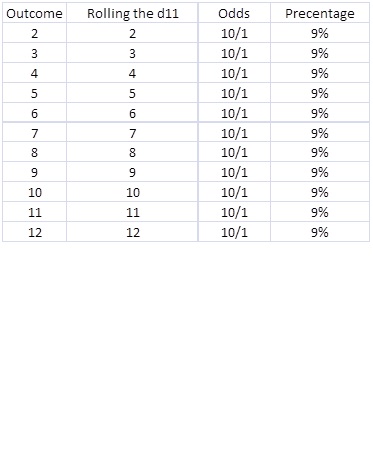
The answer lies in the math behind the game or, more specifically, the statistics of the dice.  Below I have two graphs.  The first is a graph showing how random each result is on the d11.  Statisticians love them some dice problems, so lots of work has gone into the dice.  On a fair die, every side has equal probability of occurring.  For our die d11, that means every side has a ~9% chance of being rolled.  This makes the behind-the-scenes math of “Fall of the 11th Age” pretty easy to figure out.  Here’s a quick example:  to hit the goblin, a fighter needs to roll a seven or better.  So the fighter can roll a 7, 8, 9, 10, 11, or 12.  That’s 6 numbers.  To find that probability of that occurring you multiply 6 by the probability of each event (6 x 1/11).  So the end result is 6/11 or ~55% chance of success on any roll.  I’ve put in a handy chart to show what I mean.


Untitled

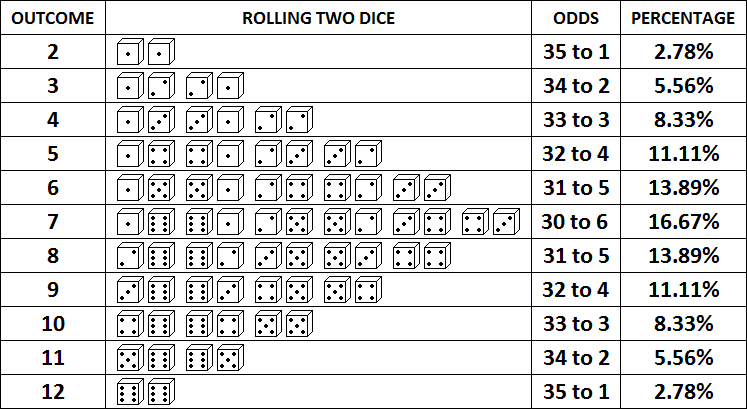
But things are not that simple when it comes to the 2d6 system.  Above, I mentioned how statisticians love them the dice, well a major part of that is how fair dice are and independent.  When you roll a d6, every die face has an equal probability of occurring.  When you roll two, each side has an equal probability of occurring AND what occurs on one die face does not affect the result of another.  There are a few assumptions that go with this and I don’t want to get crazy with physics of rolling dice together, so we’re going to keep this simple.  PLEASE!  It gets weird from here if we go deeper!  So dice are random and separate.  So when we want a result, to figure out the probability of that result we have to count the number of ways to make that result.  I’ve included a table to help with this.  A really important thing to note on this chart is how multiple dice roles make the same number.  For a simple example, look at the 3.  A 1 on the first die and a 2 on the second makes a 3 while a 2 on the first die and a 1 on the second also makes a three.  This is part of the independent results thing above.   So if we use the same “Fall of the 11th Age” math we used above with the d11 to hit the goblin, we need at least a 7 on 2d6.  There are multiple ways to make a seven.  For this, the best way to find the likely hood of this event is to ADD the percentage likelihood of each individual event.  So for a 7 to occur we add 16.67+13.89+11.11+8.33+5.56+2.78 which equals 58.34%.  This may not be a massive change from the d11 system, but it’s also not the whole story.


V4N2WgahS8BojSANeNB38Of0uw7oJbUNAhHAjPGIrP_SQkuC7oc8Vz-9zdARvX0HVEISqSOIljmOetW_1B-dL47H3dl3AuzAzmENXe8T4ccnqXgIoJs

from http://www.wikihow.com/Sample/Dice-Probabilities


Besides just finding the likelihood of hitting the goblin, there is a few more statistics “things” at play.  These are the mean, median, mode, and standard deviation.  Let’s look at the first three.  A mean is the average that we all know and love.  For “Fall of the 11th Age,” we just add up the dice results of 2 to 12 and divide by the total number of events (11) which is 7.  The median is the middle value; think of the median as a balance on a teeter-totter on a play ground.  If we moved the middle of the wooden beam around a bit, where would both sides balance one another.  Again this is 7.  2 3 4 5 6-7-8 9 10 11 12  There are five numbers to 7’s left and five numbers to 7’s right.  Where things really get interesting is with the mode.  The mode is the most likely to occur event in our group of events, or another way to think about it is, the event with the most number of ways it can happen.  For “Fall of the 11th Age,” in the 2d6 approach 7 can occur the most often since six different dice rolls can make a seven.  But, in the d11 approach, there is NO MODE!  Every number can occur equally.  (Again, we can get all math argue-y with if there is no mode you take an average bla bla bla, but this is my article and I want to make a point, so NO MODE!).

Standard Deviation is a bit more complicated, and I won’t go into it all.  For a great summary, go to http://www.mathsisfun.com/data/standard-deviation.html.  But, a real simple definition of standard deviation is a measurement of how much things very.  You use standard deviation to find out how random your stuff really is.  Let’s look at the 2d6.  The average result is 7, but over 60% of the time, you will role between a 5 to a 9.  When you roll a d11, the results get a little more varied.  Using standard deviation, 60% of the time you will roll between 4 and 11.  (If you check my math, I’ve simplified down the actual results.  It makes life a bit easier).  What this really means is you are more likely to be closer to the average in 2d6 then with d11.

Why does this matter?  Well it matters for how random you want your random to be.  For 2d6 vs d11, the difference between 55% and 58% doesn’t matter much, but what if we only needed a 6 instead of a 7?  Using what we went through above, the d11 likelihood is now a 64% while the 2d6 likelihood is now a 71%.  The difference is getting pretty substantial at this point.  Also, how random you want extreme events to be?  For the 2d6 system, 12 or crit will only be 2.78% which is pretty low.  But, for the d11 system, it’s 9%.  The d11 dice don’t really care what side comes up (dice, they are a cruel mistress….).  And since the math works the same in reverse, critical fumbles work exactly the same way (2.78% cs. 9%).  If we graphed the d11 results we would see a flat curve of probabilities.  When multiple ways to achieve the same value occur, interesting new things occur in the data and your game.

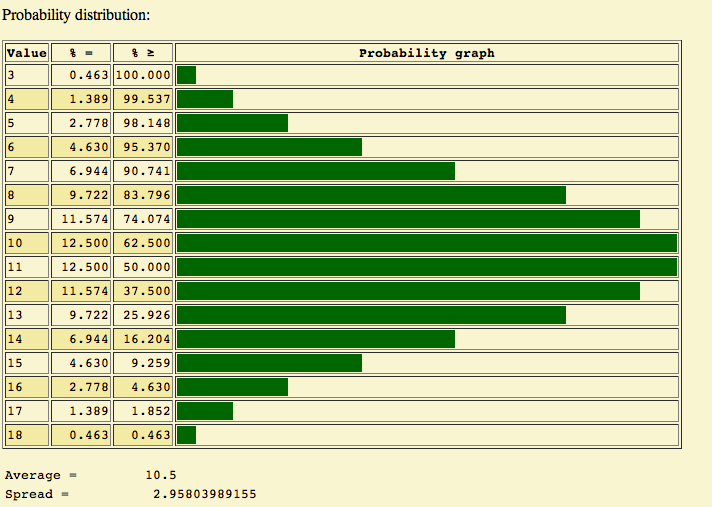
The example above is a pretty simple.  Let’s look at something a bit more extreme.  Let’s use Dungeons and Dragons d20 vs. Hero System’s 3d6.  (Yes, I know 3-18 is a smaller range then 1-20, but I want to use some real world example for the gamers).  A d20 is a single die, every side is equally likely, so every side has a 5% likelihood.  For Hero System, I’ve put another chart below to show all the results and likelihoods to make life easier.  For this one the “%=” column give the probability of a dice roll, and “%>” is the likelihood of this and all higher number dice rolls.  Let’s say you have to roll a 9 to hit a monster.  For a d20, you have a 60% chance to get that event.  But, for the Hero System, its 74%.  Again, this major difference has to deal with the mode and likelihood difference between each number in the two dice pools.  A d20 doesn’t really have a mode (See rant on mode averaging above), while a 3d6 pool has a mode at 10 or 11 and each number has a different probability of being rolled.  What if we need to crit to hit?  In DnD with a d20, its only a 5% chance, but in Hero System’s 3d6 dice pool, I’m looking at a 10-fold lower difference with a meager 0.463%.  When you look at the standard deviation, you are most likely to get between 8 to 13 on 3d6, while on a d20, for the same probability, you will most likely get between a 5 and 15.


Screen shot 2010-12-31 at 20.59.17


from seanswgcorner.blogspot.com

            What the crux of this argument boils down to is likelihood differences in getting different dice values.  How much random do you want in your games?  When I do something in the real world, is my life a full of extremes or is it pretty average?  How often do things get crazy vs. stay normal.  How often do the normal expected results occur when I do something?  On a d20, if a10 hits and a 14 hits, since each are equally likely, does a 14 really represent more skill or just another hit since both are equally likely?  For 3d6, I feel there is a palpable difference in likelihood and it affects the stories I tell.

What do you think?  Now, no system is “wrong”, but what does the math “say” to you?  What do you feel when you play these different games?  Do you feel a difference when a modes and different outcome likelihoods enter the game vs. when it’s just one die?  One of my favorite systems Arcanis uses 2d10 plus an attribute die for its d20 + attribute rolls.  I love that system because you get all the fun of a d20 game, but you also get the predictability of a smaller standard deviation.  While I enjoy the randomness, I feel that helps help keep the game from being overly swingy or random.  What do you want in a game?  How random do you want your random?