Strike Break
School abjuration ; Level bard 1, bloodrager 1, druid 1,magus 1, sorcerer/wizard 1 Subdomain defense 1
Thoughts?
I was thinking shield save you form a strike, but what about a spell that saves you from a crit?
Strike Break
1st-level abjuration
Casting Time: 1 reaction
Range: 30 feet
Components: V, S
Duration: instantaneous
An field of magic force stops a strike from decimating a target, but merely causes the target to be pummeled. When you cast this spell, a target in range is no longer subject to a critical hit, but is struck as normal with an attack or spell. This will only affect one strike even if the target is struck with multiple critical hits in a round.
Thoughts?
We had a rogue who jumped a candle, so how about a rogue who killed a giant?
Most rogues are sneaky fellows who walk the dark paths and hide in the shadows. You are not the person. You favor strength over speed . You follow a member of an old court of knights. Your mentor Jack the Giant Slayer used deception, large axes, and magic items to fell any foe fool enough cross your path.
The original Jack the Giant Slayer fell a beanstalk with an ax. You’ve trained to follow in his foot steps. Starting at 3rd level, you can make sneak attack with non-finesse weapons. In addition, you can now wield non-light weapons off-hand. Two-handed weapons must still be wielded two-handed.
Jack climbed a beanstalk, and you know how to do the same. You climb at the same rate you walk on the ground, unless you posses a faster climbing spread already.
In addition, you gain advantage on all Strength(athletics) checks.
Jack lied to giants to the point they killed themselves, and starting at 9th level, you gain advantage on a Charisma(Deception) checks.
Jack beat the devil at his own game, and he was awarded a magic sword, a cap of knowledge, a cloak of invisibility, and the shoes of swiftness. When you become 13th level, you are award a gift of your choosing from the round table. You must choose between a +1 weapon, a cloak of displacement, headband of intellect, or boots of speed. When chosen, this choice can never be undone
When you reach 17th level, you may not be the Jack of old, but you are the Jack of now! As a bonus action you can make a Charisma(Deception) check against another creature. If that creature fails, you gain advantage on your next attack roll against the creature.
In addition, when you reach level 17, your sneak attack damage against creatures larger than yourself increase to 1d8’s. If your sneak attack dice are already 1d8’s or larger, increase your sneak attack dice to the next larger dice size.
Let’s keep up with the against the giants push with another spell-Gravity Crush
Gravity Crush
3rd-level evocation
Casting Time: 1 action
Range: 150 feet
Components: V, S, M (a ball of lead)
Duration: Instantaneous
You cause the ground to instantly quintuple the gravity of a point in range. Each creature in a 20-foot-radius of the point must make a Strength saving throw. A target takes 5d6 magic bludgeoning damage on a failed save and is knocked prone, or half as much damage and avoid being knocked prone on a successful one. Creatures that are large or larger make this save with disadvantage.
At Higher Levels: When you cast this spell using a spell slot of 4th level or higher, the damage increases by 1d6 for each slot level above 3rd.
Let’s keep building on the theme of big enemies taking bigger damage!
Power Throw
1st-level evocation
Casting Time: 1 action
Range: 30 feet
Components: V, S, M (powdered rock)
Duration: Instantaneous
You cause a large force to throw two targets into one another. Choose two targets within range to make separate Strength saving throws. On a failure, the target is throw up to the range of the spell. If the target is throw into another target that also failed a saving throw, the recipient and and the target take magical bludgeoning damage as shown below based on their respective sizes. As an example, if a large creature is thrown into a medium creature, both creatures take 2d6+2d8 magic bludgeoning damage. The thrown creatures ends prone. If no two targets fail their saving throws, then any who did may be moved up to the spell’s range and take damage as below as they are thrown to the ground.
At Higher Levels: When you cast this spell using a spell slot of 2rd level or higher, increase the number of targets of the spell by 1 for each slot level above 2nd.
| Size | Damage |
| tiny | 2d2 |
| small | 2d4 |
| medium | 2d6 |
| large | 2d8 |
| huge | 2d10 |
| gargantuan | 2d12 |
You enjoy a challenge to the point you actively hunt those that could crush you in on hand. You stalk the darkness finding your pray and putting them down. Be it for the thrill of the hunt or to protect your people, you truly stalk the most dangerous game
At 3rd level, you gain the ability to hurt those that are larger than you. For each size category that a creature is larger than you, increase the damage dealt to the target by 1d6. You may only deal this extra damage once per turn.
At 7th level, it is extremely hard to find you when you don’t want to be found. You gain expertise as a rogue in Dexterity(stealth).
At 11th level, when you make more than one attack against a target in a round and the first attack hits, the second attack deals an extra 2d10 damage to the target.
At 15th level, when a target larger than you makes an attack or uses an ability against you, you gain a +1 bonus to your AC and saves against that attack or ability for each difference in size between you and the target. As an example a small creature would have a +2 bonus to AC and saves against a large creature.
Here is my giant killer Paladin’s Sacred Oath for DnD 5e. Let’s follow a lesser known medieval hero who dominated a giant just to carry his gear!
The Path of Astolfo is an oath taken by some of the knights long ago who followed a leader known as Charlemagne. Their leader and his knights are lost to the ages, but few find his name and fewer take up his mantel. A defender of the weak and an especial protector of those locked under magical manipulation, Astolfo was rescued by magic and understands that magic in all its forms might not necessarily be evil. Known for his dominated giant foot servant and his golden lance, Astolfo was a traveler who went to the moons and back to save his friend then become a defender of an entire city. Those who follow his path wander the countryside attempting to help all those they find, even using magic to coerce those who might be irredeemable to become righteous.
You gain oath spells at the paladin levels listed.
| Level | Spells |
| 3rd | Shield of faith, sanctuary |
| 5th | lesser restoration, suggestion |
| 9th | remove curse, dispel magic |
| 13th | dominate beast, guardian of faith |
| 17th | dominate person, greater restoration |
When you take this oath at 3rd level, you gain the following two Channel Divinity options.
Horn of Charm: As an action, you blow a magic horn causing its song to bend the will of even the most hardened creatures. At 3rd level this action acts as if you cast charm person using your spell save DC as the DC for this effect. At 7th level, the effect of the horn can be as if you cast dominate beast. At 10the level the effect of the horn can be as if you cast dominate person. Finally at level 15, the effect of the horn can be as if you cast dominate monster.
Golden Lance. As an action, you present your weapon and speak a prayer asking for the force of your forebearers. For one minute or until you are knocked unconscious, your weapon glows with a golden radiance. When a creature is struck with your weapon as part of an attack, the target must make a Strength saving throw (DC equal to your spell save DC). On a failure, the target is knocked prone.
Starting at 7th level, you gain a nightmare mount. Its AC is equal to your AC and has hit points equal to a half your hit points. As an action you can have it make one attack, but can use your move action to command the creature to move as normal. It loses the Ethereal Stride ability, but does not make hoof prints to be tracked.
At 18th level, the nightmare gains a flight speed equal to its land speed.
Beginning at 15th level, you gain advantage on all saving throws against spells.
At 20th level, as an action, you can follow your master and become a true defender of the people. For the next minute, increase your AC and saves by 3. In addition, all allies within 30 feet also gain these benefits. These benefits last for the duration, you voluntarily end it, or until you are knocked unconscious.
Once you use this feature, you can’t use it again until you finish a long rest.
Product-Scythe
Producer– Stonemaier Games
Price– Preorder here http://stonemaiergames.com/buy-scythe/
Set-up/Play/Clean-up– 115 minutes (1-5 players)
Type- Euro
Depth-Medium
TL; DR-Great parts, but player count dependent. 95%

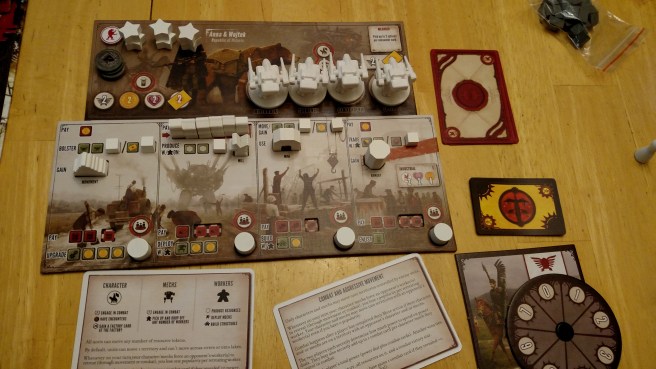
Basics- COMRADE! Scythe is a board game of nation rebuilding and development following an alternative World War I. Players take the roles of different nations attempting to become the most successful nation after the fall. Each player is given two player boards to start the game. One board is your nation, describing your nation’s special power and unlockable powers you get when you build mechs-giant walking war machines that provide you with extra powers when you build them.
The second board each player receives is an action selection board. Here is where you get more variety from the game. Each board has a specific type of focus associated with it. These focuses range from industrial to manufacturing, and the focus of your nation will drastically change how you play. The second player board also has the actions you will take each turn, but divides the board into top action and bottom actions. These actions are simple to read as actions with an icon in red being a cost, while icons in green are the resources they provide. This allows for language-independent play. Top actions typically get you resources to spend while bottom actions are where you spend resources to build your nation. The top actions are bolster (get points/cards for combat), produce (get resources depending on the tiles you are on), move (move your pieces/earn money), or trade (get two resources or get popularity). The bottom actions are upgrade, deploy, build structures, or enlist. These actions require a bit more description. The action board has a number of spots filled in with squares. When you spend the upgrade resources, you move one cube from the top (revealing a new option when you take that action) and cover up a bottom cost (making that action that much easier in the future). Deploy is how you place mechs on the field. Each mech you deploy unlocks new powers for your character as well as all other mechs such as moving across rivers or having bonuses to combat. Build allows you to move a structure from your board to the main game board. Once removed from your board, the space uncovered unlocks new options on your turn like allowing you to move across the board or harvest extra resources. The final action, enlist, allows you to get extra materials off-turn when opponents to your right and left take bottom row actions.
With the basics, the game starts off with you having two workers on the main game board next to your base and your character mini on your home base. Players then take actions as described above. A player selects an action space, then takes the top action, if he/she wants to, of that spaces and then takes the bottom action, if he/she wants to, of the same space. What makes this interesting is the next time a player selects an action, that player cannot take that same action space!
Two of the things I mentioned above are combat cards/points and popularity. Popularity is used in scoring at the end of the game. Popularity measures how well the common man thinks of you. Depending on your popularity, you receive more points at the end of the game for each area you control, each thing you accomplish, and how many resources you control. Lower popularity means you earn fewer points, so this is an extremely important number! Combat is also a simple and fast. When you move a mech or a character onto a space of another player, combat might happen. If there are only workers on that space, those workers flee back to their home base and you lose one popularity. If a mech or a character is on that space, then combat happens after the move action. Each player selects how much combat power they want to spend on the fight, from 0 to seven, and may select one combat card to add to the fight. Combat cards range from one to five. Each side selects what they will spend, (power is spent regardless of whether they win or lose), and reveal to their opponent. The loser moves back to their home base, the winner gets the tile and all the delicious resources on the tile.
There are a few other minor things as well. Your character can have encounters which are random cards that describe fun, extra events in the game such as finding a herd of cows that you can kill, buy, or steal causing you to lose or gain resources in the game. Your character can also move to the center tile of the game and encounter the factory, an old relic of the last war. The factory has a deck of cards that provide you with an extra action you can take with new exciting options like double moves and bonus resources. The final thing of note is your goal. Every player starts the game with two goal cards. Goal cards state an action you must have accomplished on your turn for you to unlock a bonus way to score in the game.
This game follows a very similar end game mechanic to Euphoria-each player has six stars. When a player completes a goal such as deploying all his/her mechs or winning a combat, that player places a star on the board in that spot. When a player places his/her last star, the game is instantly over. At this point, every player scores points based popularity and tiles they control, stars placed, and each pair of resources as well as the extra structure bonus tile. The player with the most money/points at the end of the game wins!

Mechanics– I liked this game’s mechanics, but I didn’t love this games mechanics. I had fun and built an empire, but I don’t think it’s much of a combat game. Your actions are quick and easy to do, but the concept of fighting feels slightly added on. Overall, the game is sleek and works well, but it feels like a cog missing one tooth-the machine hums along well, but every once in awhile, you get a bit of a clunk. However, the two pieces of the player’s boards do make for an awesome mix as you get vastly different empires attempting vastly different strategies with warlike nations having to focus on farming while peaceful nations might end up with a manufacturing center. That variety really makes the game fun. Also the indents in the board make all the actions that much more fun. I love the upgrade action so much as I can see and even feel my nation getting better! I have my minor gripes, but it is a fun game. 4.5/5
Theme-Much like the mechanics, I liked this part of the game, but didn’t love this part of the game. Combat sticks for me. We’re post-world war, but the fighting feels simple. That is good as you resolve combat quickly, but it also means that combat doesn’t have much depth. I do feel like I’m building and reclaiming pieces of after a war. The instructions build on the nation’s providing each with their own background, story, and life. I do feel like each nation when I play and the differences in player boards emphasise the theme each nation is taking. 4.5/5

Instructions-This game has a ton of instructions, but they do a good job explaining the game. The rules are not complex with the bulk being chose action, maybe do top action, and maybe do bottom action. The thickness of the rulebook is to build story (awesome) and to clarify all the working pieces. I like what I see here. It does have a few things I’d like clarified like how the submerge powers work, but overall it’s a well done and well laid out rule book that you can learn on the fly, if maybe a tad too long. 4.8/5
Execution– HOLY COW! Stonemaier games is known for their parts, and it shows in this one! Players get nice wooden pieces, the resources are all beautiful, even in the more simple price ranges, and the mechs/characters all look beautiful and different. The details go so far as the worker meeples all have different hats. It’s just a little detail, but it’s a beautiful one that really shows how much the creators loved this game. I have an unboxing video showing all the pieces of the game here https://youtu.be/3g9vUQYz-pY . 5/5
Summary-This is an interesting one for me. I like this game, a lot actually, but I don’t think this is my new favorite. The mechanics are sleek, the gameplay is fast yet deep, and the execution is amazing. If have a few issues with the theme and mechanics, mostly dealing with combat. I do feel like I’m building or maybe rebuilding an empire, but there are just a few things that feel a tiny bit off. These things don’t derail the game by any means, but it did take me out of the zone a bit. Also, this game’s experience might rely heavily on the player count. I have had more fun playing with five players than I did in a head to head match. This might not be the game I ask to bring to the table, but if someone asked if I wanted to play again, I would be happy to any time! 95%
One more idea that I have been kicking around for a bit.
Faith Healer
The power of life courses through your veins, and you share this gift with those you can. Gain the following:
Thoughts?
Let’s get some more DnD 5e to the table shall we? It’s time for a spell..
Fast Healing
2nd-level evocation
Casting Time: 1 action
Range: Touch
Components: V,S
Duration: Concentration, up to 1 minute
You conjure the healing power of the universe and cause the target of the spell to regain hit points equal to your spellcasting ability modifier at the start of its turn. You or the target may move after you cast this spell, but must remain within 50 feet of each other or the spell ends on that target. This spell has no effect on the dead, undead, or constructs.
At Higher Levels: When you cast this spell using a spell slot of 3rd level or higher, you may target another creature for each slot level above 2nd.
Thoughts?