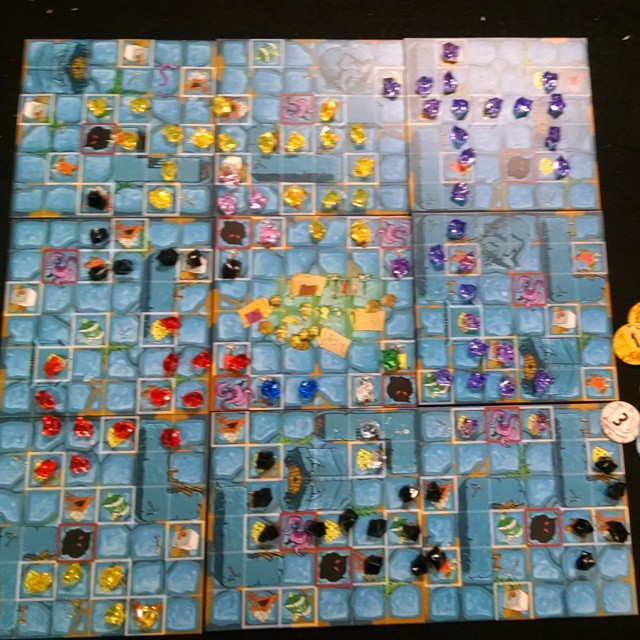
Ring Side Report-Board Game Review of Wasabi! now Sushi!

Product– Wasabi!

Producer– Z-Man Games!

Price– ~$50 here

Set-up/Play/Clean-up– 45 minutes (2 to 4 players)

TL; DR– PLAY AT A SUSHI-YA!  98%


Basics-Irasshaimase!  In Wasabi, you play a sushi chef trying to make as many orders happen as you can.  Each player starts with a recipe book, point tokens turned over to the number of ingridiants side, and a bowl for wasabi.  To start, players go around the table selecting three pieces of sushi that are handed to the next player, so you don’t get to pick your starting sushi.  After this, each player then chooses three different types of sushi to make ranging from easy two sushi piece combinations to the extremely hard five piece sushi.  Once every player has their three sushi pieces and their three recipes, the real game starts.  On your turn you can do two things: place a sushi piece or discard as many recipes as you want and draw new ones.  When you place sushi piece, you check to see if it creates any of the recipes you want to create.  If you do, you get to turn over a point token possibly gaining extra wasabi cubes (points and tie breakers), gain a power card, and draw a new recipe.  If you don’t finish a recipe, then you just draw up to your three sushi pieces.  Power cards allow you to change tiles on the board, place on top of other tiles, remove other pieces, and even place two tiles.  You can only gain one power card per turn, and you can only use one power per turn.  Discarding and drawing new recipes is pretty simple; discard what you don’t want, and draw up to three recipes.  The game continues until someone finishes all their for point recipes tokens, or until no more legal moves can be made.  The best chef is the person with the most points and wasabi cubes.


Mechanics-This is a fun one that can be pretty frustrating if played poorly.  There are some strategies that will work like doing your five point recipe first, then moving to your four, and so on while keeping a few easy two piece recipes in your plans to keep getting power cards.  That kind of makes the game less fun as there are less smart ways to play than different way to play.  However, if you want a simple game that is a much smarter version of tic tac toe, this is a good one to have on hand.  4.5/5


Theme- The game starts you out with soy sauce bowls and recipe books that look like menus from a Japanese dinner.  That right there fills that game with some awesome theme.  The board looks like a matt, and the tiles all look great.  I have never played this game and not left hungry for sushi.  You will feel like you spent 45 minutes in a sushi restaurant staring at the menu. 5/5


Instructions– The instructions are done fairly well.  There are a few minor English issues, but overall they communicate the rules well and explain the game quickly. 5/5


Execution– I love chunky cardboard!  This game has a ton of heavy cardboard pieces with all kinds of sushi ingredients on them.  The board is nice, and the art is great. You will leave this game hungry.  Also, I flat out love the menus that serve to hide a player’s pieces and the soy sauce bowls for wasabi points. 5/5


Summary-This is a fun, quick game that anyone can play. Players don’t need the in depth strategy that some games require.  It’s a simple tile laying game that you learn in a minute, and master in about five.  Some of the mechanics can lead to players losing through no fault of their own, but overall it’s a blast to play.  Moreover, all the different ingredients will leave you hungry!  The theme is so awesome that you will want to go to your favorite Sushi restaurant after playing this one. 98%

Ring Side Report-Board Game Review of Shadows of Malice

pic2037527_t


Product– Shadows of Malice

Producer– Devious Weasel

Price– ~$50 here http://www.amazon.com/Devious-Weasel-Games-IMPDWE1000-Shadows/dp/B00NAG5YCK

Set-up/Play/Clean-up-2-6 hours (2 to 8 players)

TL; DR– Say yes to being a God in the American style game. 86%

10817844_1503711186566683_1116632659_n

Basics-Fight the darkness!  In Shadows of Malice, an ancient evil is stirring, and the players take the rolls of avatars of light trying to stop it.  To do this, players must find the hidden strongholds of light among all the strongholds that have fallen to darkness before the vile Xulthûl.  Each player starts with an item, soulshards, and a special power.  Over a series of turns, the heroes move across the map revealing towns, mystics, monster lairs, and strongholds while shadow tries to find the strongholds of light.  Each turn, players roll two six sided dice, one for movement and one for fate.  If the player rolls doubles they draw a fate card.  Fate cards range from great effects like doing extra damage to horrible effects like permanently getting a negative on all dice rolls.  Fate cards last until they are spent or until a new fate card is drawn.  The players can then spend movement points to move across the map.  If player end on tokens or monster lairs on the map, they can encounter what’s there.  In towns, you can spend soulshards to get items like potions or treasure.  Mystics will heal or remove fate cards and make potions.  Monster lairs and stronghold have monsters.  When players encounter a monster, they roll to see the monsters type, the monsters power, and how many abilities the monster has.  The type affects some powers and treasures, but provides flavor for the encounter.  The power determines how much damage the creature does, how much the creature adds to its attack, and how much life the creature has.  The abilities add new flavor to each combat like preventing damage or adding to the monsters attack.  Combat is pretty simple.  Both sides roll a six sided dice and add bonuses based on treasure, monster’s power and other cards.  Before each roll, players can spend soulshards to activate abilities or to increase their dice rolls.  Whatever side has the higher combat check does one damage to the other side.  Some treasure, abilities, and powers allow monsters and character to possibly do extra damage depending on random dice rolls.  Combat continues over these rounds until one side runs away or until someone dies.  If the players win, they gain soulshards based on the powers available and have a 50/50 chance to gain clear soulshards on a one for one basis for each the monsters life points.  If players travel together (forming a band), each character beyond the first player add an extra six sided die to the player’s combat roll.  After the players turn, the shadows take a turn.  Shadows randomly remove one seal from their realm each turn.  Then, either spawn a new shadow or randomly move a shadow present on its own game board.  If a shadow moves onto the spawn point, it gains life.  However, if a shadow moves onto an open portal, the shadow moves to the player’s side.  From now on, this shadow will move one to two spaces toward the closest stronghold.  If the shadow gets to that stronghold, and the stronghold is a light stronghold, then the shadow becomes Xulthûl and fights the players.  Players can fight shadows in the normal world to prevent this, or kill Xulthûl.  Play repeats like above with players having a turn, then the shadows.  The player’s goal is to find the hidden light strongholds among the shadow ones.  For each light one found, the players gain power.  However, for each shadow one found or uncovered by the shadows in the main world, the darkness gains power and all monsters are harder to fight.  Once players find the one light stronghold per map tile, they win!


Mechanics-The mechanics are pretty simple with lots of randomness from the dice. When you know what you’re doing, you can generate monsters and end fights quickly, moving the game closer to two hours rather than the six..  The randomness can really bite you in some cases, but since you roll tons of dice, the swingyness of the dice is counteracted by probability.  This game feels a lot like Arkham Horror with moves, combat, and some events determined by dice.  That’s some good company to be in.  4.5/5


Theme- This game really excels at the theme.  The game starts with an interesting story, and adds random elements that are on point.  The game is a quest to discover things and defeat monsters.  You get the feel of combat and exploration with lots of variation.  Some changes are pretty cosmetic like the type of monster, but even those simple changes do allow you to build a story in your mind.  It’s not perfect as some elements like the monster abilities can randomly generate monsters that don’t make sense (vampire ooze with an exoskeleton!).  But, you get the chance to start on a story from the book and build on the story of being a god if you want too. 4.5/5


Instructions-I don’t like how the rules are laid out.  The rules use a numbers system with subsections numbers, kind of like a legal document.  I haven’t seen that done really well, and that kind of hurts this book.  Also, this book really needs a quick turn-order page.  The order of turn actions is all in the book, but the book is a bit unorganized and you will get lost for a while trying to determine how turns work.  However, if you read a rule a few times, you do get a decent sense of how to play.  And, this document does list all the pieces (AND give little pictures of the pieces!) and what they do instead of assuming each piece will make sense.  Those details really do help make the game that much easier to understand and play.  While I try to just read the rules when I play, Devious Weasel has several videos explaining the game.  They do a good job, but by themselves, the rules do a decent job of explaining how to play this game. 3.75/5


Execution-This game is as third party as they come.  It’s from a smaller company.  I have to admit, even as a well versed gamer, I’ve always been a bit hesitant to play games by smaller, local companies.  They sometimes don’t have the production quality or art skill of larger companies.  I’ve seen quite a few badly drawn maps with cheap quality cardboard pieces that just don’t stand up to any plays.  This game convinced me to give up the prejudice.  The pieces are nice, chunky cardboard.  The art is generic but well done.  You can tell this is a small company, but it’s not bad.  In fact, I’m pretty happy with what’s in the box.  Heck the box is even well done!  My problems are with the dice.  I would like a few more different colors instead of different size dice.  Also, turn guide or turn order cards and extra terrain/monster generation cards would have really knocked this one out of the park.    4.5/5


Summary– If you’re looking for a fantasy version of Arkham Horror, this is the game for you.  Honestly, I had a blast playing this one.  It’s got simple mechanics that generate a near infinite series of combinations of games as players get the chance to explore a new world every game. It’s not perfect as randomness can make some games simply not fun to play due to some crushing difficulty, random monsters that don’t make sense, or just monsters making all the right moves.  However, if you can get past the standard problems of American style games, you will get to be a god and save the day!  If someone asks you to play a god in Shadows of Malice, SAY YES! 86%

Ring Side Report-Board Game Review of Roll Through The Ages

Product– Roll Through The Ages

Producer– Eagle/Gryphon Games

Price– ~$40 here http://www.amazon.com/Roll-Through-Ages-Bronze-Age/dp/B001POAECY/ref=sr_1_1?ie=UTF8&qid=1416486454&sr=8-1&keywords=roll+through+the+ages

Set-up/Play/Clean-up-30 minutes (2 to 4 players)

TL; DR– A great Euro-style dice game. 85%


Basics- Roll to see how civilization grows in this Yahtzee like game.  Players take the roles of different civilizations during the Bronze Age.  Each turn a player rolls a number of dice equal to their cities (starting at three). These dice have different faces ranging from workers, food, goods, coins, and disasters. A player can reroll the first roll twice just like Yahtzee, but all disaster faces must be kept.  After a player finishes rolling, the player collects food, workers, and goods depending on the dice results.  The most confusing aspect of the game is you earn goods.  Each player has a peg board and a score sheet.  This peg board has spots for food and goods.  There are six different tracks for goods, but you gain goods by moving each peg one space starting at the bottom for every one good you have.  If you gain more than six goods in a turn, then the bottom good gains another rank and so on up.  As an example, if you gain seven goods, you would gain one rank of each good, then gain one extra rank in the bottom two goods.   After collection, players then feed their cities and have disasters happen.  Don’t have enough food for your cities?  Then you gain disaster points at the bottom of your score sheet.  Some disasters give negative points at the end, cost the player goods, or even attack other players like the literal plague (rolling three disasters results in a plague that gives every other player three negative points.  Players can then spend workers to earn more cities or monuments for points by spending workers to cross of boxes.  When you cross off all the boxes in a city or all the boxes of a monument, you have built that monument or city and now get the points or dice in future turns.  The first player to build a monument gets a higher score of points, while the players who builds after get fewer points.  Players can also buy one development a turn.  These developments do several things like preventing plagues, allow you to save more resources, or get you extra points for monuments or cities.  To buy a development, a player spends coins from dice or goods.  Each good rank has a number associated with it indicating how much it’s worth for developments.  You have to fully spend all your goods of one type if you use them-you do NOT get the difference!  Once a player is done, he/she passes the dice, and the next player takes their turn.  The game continues until someone has five developments or all the monuments have been built between all the players.  Then, the game continues until all players have taken an equal number of turns.  Player with the highest score wins.


Mechanics-This game is quick, but has a surprising amount of depth.  You roll the dice three times, choosing which dice to keep, and then you make choices with the resources you find.  It’s all pretty easy.  However, what you get and your own plan really make you think on your feet.  It’s fast, but smart and elegant.  5/5


Theme-I love Euro-style games, but these games really lack the theme and story of their American cousins.  There is a store here as you build different world wonders and have the make choices for your society.  Will you abuse your people to build great heights or will you stay small and manageable?  If you look for a story, it’s here, but the instructions won’t help you as you get a one sentence introduction to the games story.  You can tell that story isn’t the focus of this game.  The components are nice and do feel a bit old, in a good way, so it’s not a complete loss.  2/5


Instructions-The instruction to this game are well done.  It’s a simple game that runs quick, so the instructions are a tri-fold pamphlet.  The hardest part of the rules is understanding how goods work.  If you can get past that and the examples provided, you’re golden.  These rules do a good job of getting you playing all by yourself without having to turn to Board Game Geek and the internet for help. 5/5


Execution-Here is where this game shines way above most games.  This game doesn’t just have some dice; it has custom carved wooden dice.  It doesn’t just have markers for your items; it has cool wooden boards with different colored pegs for each item.  I was kind of disappointed the game didn’t come with golf pencils to mark up your score sheet, but nobodies perfect. 4.9/5


Summary– This is one of the games I bring with me to cons and game days whenever I travel.  It’s light as it fits into a small box, it’s heavy as its got some great Eurogame elements in a dice game, and it’s quick as it takes less than half an hour to play.  You learn how to play in less than five minutes, and you start making smart choices in 10.  If this game had some pencils and a bit more theme to it, this game would be at the top of my dice game list.  However, given what’s here, this game is a blast and something you shouldn’t pass up. 85%

Ring Side Report-Board Game Review of Lost Legends

Product– Lost Legends

Producer– Queen Games

Price– ~$50 here http://www.amazon.com/Queen-Games-QUG61063-Legends-Board/dp/B00EFKA14G/ref=sr_1_1?ie=UTF8&qid=1416372470&sr=8-1&keywords=lost+legends

Set-up/Play/Clean-up-2 hours (3 to 5 players)

TL; DR– Lot’s of little errors really hurt this game. 70%


Basics- Want to be the hero? In Lost Legends, players take the roles of different heroes as they try to kill the most impressive monsters.  The game is roughly divided into two phases: equipping your character and killing monsters.  When you equip you character, you take a hand of cards and select one card.  You can use that card in one of three ways: equipment, money, or skills.  You can discard the card to gain money to buy other equipment.  You can turn the card upside down and place it under you player mat with the bottom part showing to gain some skill to equip and attack with new items. And finally, you can pay the card’s cost in money, and place it on one of the four areas next to your player mat.  The equipment range from swords and wands to spells or armor.  You then pass the remaining cards to the next player as you receive a new hand of cards from a different player.  Play continues this way until you have two cards.  You select one of the remaining cards and discard the other to the center discard pile.  After the equipment phase, players then take turns fighting monsters.  Monsters are damage by your equipment. Some cards do damage, then do damage based on the number of skill icons you have, and can do extra damage by exhausting the card.  Exhausted cards cannot be used again until the equipment phase.  If you kill your monster, you take the card and turn it upside down and place it under your player mat with the bottom icon showing.  You gain points based on the monster icons you have killed with extra points ranging from getting four different monsters to three monsters of the same kind.  Also players compete to see who’s killed more of a particular type of monster.  The first player to get the extra points for a specific goal gets extra points with the last player getting the least.  In addition, you also gain experience which allows you to get extra money, health, or mana.  If you don’t finish the monster, it damages you, and the next player fights his/her monster.  Monsters can kill of players, so planning how you fight the monster is important.  If you start your turn and don’t have a monster, you can take the current face up monster next to the monster deck or take a randomly drawn monster from the monster deck.  When there are no monsters, the round ends after everyone has one more turn.  The game goes through two more cycles of equipment and monster fighting.  The player at the end of the game with the most points wins.


Mechanics-The mechanics of this game are pretty simple.  You draft for a few cards, and then you fight the monster in front of you.  No monster?  Draw a new one. When the monsters are all gone, you repeat till three rounds pass.  That’s not bad, but the random nature of the monsters really hurt this game.  You have the drafting mechanics for the items, but the monsters just end up either killing you or being a cake walk, and that has everything to do with the random draw.  It makes the draft work against the second part of the games randomness. 4/5


Theme-This game has some great art, but beyond that, there isn’t really a theme.  All the items are cool, and they give the world a feel.  However, the rule book has less than a paragraph of story.  I had fun, but I didn’t feel like I was really in a different world fighting monsters. 3/5


Instructions-These rules are confusing!  The rules have out and out misprints leading to some problems, but beyond that the examples have extra information that major rules don’t, the flow is hard if not impossible to follow, and cards don’t really make sense when you look at them critically.  If you have the rules, board game geek’s forums, and some understanding friends, you can get through this game and have fun.  But, don’t expect your first play through to be an easy one by any means if you only have these rules to go by! 2.5/5


Execution– I didn’t hate what comes in the box.  The parts and markers are reasonably well done, if a little small.  What will CONSTANTLY annoy you is having to pick up your player mat to play more skills and monster cards.  It’s extremely hard to do without any nails.  I would have really liked a chunkier cardboard player mat, so I could pick it up!  4.5/5


Summary– I had fun playing this game, but don’t think it I’ll get this one to the table soon.  It’s a drafting game where half the game is random.  It’s a game where you might be equally able to play without the rules as with them.  It’s a game that I reasonably enjoyed, but couldn’t play some of my cards as I don’t have long finger nails.  If you want to play Seven Wonders but want a DnD theme on it, this isn’t a bad game.  If you want a drafting game outright, you may be better with Seven Wonders or Among the Stars. 70%

Ring Side Report-Board Game Review of City Hall

It’s election day.  How about a board game of political maneuvering?


Product– City Hall

Producer– Tasty Minstrel games

Price– ~$60 here http://www.amazon.com/Tasty-Minstrel-Games-TTT1010-City/dp/1938146840/ref=sr_1_3?ie=UTF8&qid=1415154750&sr=8-3&keywords=city+hall

Set-up/Play/Clean-up-2~2.5 hours (2 to 4 players)

TL; DR– Influence might be you favorite addition to gaming too! 93%


Basics- Want to be mayor?  In City Hall, each player is striving to win enough public support to become mayor of New York.  To do that, players try to our maneuver or out influence each other through action selection and territory control.  Each round, players take turns placing a meeple on one of seven offices in the town: tax assessor, surveyor, campaign manager, lobbyist, zoning board, deputy mayor, and health commissioner.  The tax assessor position provides money based on the locations owned on the board and current population score.  The surveyor allows a player to buy new positions on the board.  The campaign manager increases your approval rating.  The lobbyist gets the player more lobbying cards (more on that later).  The zoning board allows a player to build on places that the players owns on the board.  The deputy mayor changes the order of players.  And, the health commissioner grants players population based on the number of stars the player has on the board with the player with the most getting 4 population while all other players get slightly less population.  What makes this action selection game stand out are the influence cards.  When you choose an office, you bid a number of influence cards.  Every other player in turn order can increase that bid, bid the same, or not bid at all.  When it gets back to you, you get to either pay the highest bid to the bank or take influence cards from the highest bidding player and they take your action with that office instead.  The game is also a territory control game.  When you use the zoning board to build on a location you own, you choose one of four different buildings from your hand that range from factory, park, tower, and housing.  Factories are worth $7 when you are the tax assessor, but only one star.  Housing is worth a maximum of five stars, but has no tax value.  Towers are a combination of the two with one tower being a max of three stars and $3 for tax.  In addition, you can build parks which are worth no taxes and no stars.  All buildings are worth nothing by themselves, but gain and lose stars depending on what buildings are adjacent. (Location, Location, Location!)  Towers, housing, and parks always increase stars, but factories decrease the values of nearby housing.  Thus, you have to carefully plan and capitalize on situations so you can have the most stars.  Stars help you when you take the health commissioner action.  Each player counts their total stars on all building with the player who got the commissioner action either adding three to their score or doubling their score.  The player with the most stars then moves up the population tracker by four, the next by two, and the third place player getting 1.  Each time a player selects the zoning board in addition to the action of gaining building cards and building on a location, a token moves up the approval rating, and when either that token or a player’s token gets to five approval, the game is over.  Players multiply their population total by their approval rating for their points.  Additional points are given out for most parks, most influence, and other factors at the end of the game, and the player with the most points wins the election and is now mayor.


Mechanics-This is a fun one.  I’ve seen the combination of action selection and territory control before, but the addition of the influence cards really knocks this game out of the park.  The different actions are simple and quick so the game moves at a good clip.  Also, the game has a built in end.  You only get so many moves to build, and letting your opponents have any of those moves could be devastating.  When you steal an action with influence is such an important part of this game, and in my opinion, influence is the most fun part of this game.  Honestly, this might be my favorite game from Tasty Minstrel Games for the influence mechanic alone.   5/5


Theme-This game feels like political maneuvering, but it doesn’t feel like an election.  Influence and stealing turns feels like politicians fighting over what gets to make what happen.  It’s an amazing game in that respect.  However, I didn’t feel like I was running for an election instead of just maneuvering to get people to move to my places across town.  It felt more like I was running a chain of hotels and businesses than a true mayoral race. 4/5


Instructions-These instructions are done pretty well. The rules by themselves teach how to play well.  I was left with a few questions such as are your cards secret?  These were minor questions however.  Also, I would have liked a few more pictures in the rules, but overall the rules were clear and easy to read. 4.5/5


Execution– I like the way the game is produced.  I would have like bigger cards, but the card size keeps the total game size down.  The board is easy to read, and each player gets a player board to help them understand what each position does.  That really helps speed play up.  However, I have a major problem with this game.  There are not nearly enough stars!  The game comes with a single sheet of punch out stars.   That is about half of what you need for a good sized game.  I know I am not the only one who has had that problem.  4.5/5


Summary– This game might have one of my favorite new mechanics.  I’ve seen action selection before.  I’ve seen area control/management before.  What I haven’t seen is action bidding/stealing before.  That’s a small change that really adds a ton to this game.  This game isn’t perfect as some small problems in the execution, instructions, and theme hurt this game a bit.  But, what is here is a quick, excellent board game with lots of political maneuvering that I want to get to the table as soon as I can again. 93%

Blurbs from the Booth-How I review Games

I love gaming, and spend way too much time and money doing it, but not all games are created equal. Some of my more popular blog posts have been my game reviews.  Let’s go through what I look for in a game, and what I want in each area.


Board Games

When I examine a board game, I look at four areas: mechanics, theme, instructions, and execution.


Mechanics-Board games are applying logic and people skills to better handling a situation compared to your competitors.  The way that logic works is the mechanics- mechanics covers how a game works.  Be it a deck building game, area control, dice rolls, randomocracy, or something mixed between everything, this can really make or break a game.  I like when I see several dimensions of mechanics at play.  Games like Tiny Epic Kingdoms or Trains take two  or more simple mechanics and mix them into something better like flour and eggs making a cake.  Some games do this amazingly well like Rococo.  Some games fail at doing something as basic as rummy….LOOKING RIGHT AT YOU TENTICAL BENTO!  If a game feels like it runs smoothly, then that game will most likely get a five.  If the game runs like a car on its last legs about to die on a bumpy road, that game will most likely be a one or less.


Theme-Theme is the story of a game.  Chess is a war between two kingdoms.  Rococo is different dressmakers vying for the most prestige at a ball.  Besides beating your friends at a game, this is the thing that will keep you playing.  If you lose the Lord of the Rings card game, you’ve not only lost, but the world will be plunged into darkness!  But, theme is hard to make happen.  It might just be a simple intro story like in Lost Legends, or it might be an ever pervasive thing that winds through the whole game like Arkham Horror.  Weaving a story into the theme is the height of game design for me.  Games that have tons of story like Eldritch Horror are great games that deserve a five for theme, while some games like euchre don’t even score a one as there is no story to the game.  As the amount of story you want is a game varies from person to person, this is consequently one of the most subject portions of my scoring.


Instructions-I’m a pretty smart guy.  I got me a PhD and everything!  (cue people pointing out all the grammar and spelling mistakes….)  But, if you can’t tell me how to play your magnum opus of a game, then that game is crap to me.  Getting your point across is important, but also how you do it is really key.  If you hit me with a wall of text in size 4 fonts on a plain white sheet of paper, then I’m going to hate you.  What you write has to be entertaining and informative while still being easy and fun to read.  Top marks go to games like Dungeon Petz where not only are the rules taught with lots of pictures, but there are lots of small jokes for the players.  Games like CO2 are horrible.  It is only a few pictures with several pages of just black text in three columns on white pages.  Also, if your rules are flat out wrong like pointing to a card that says weapon and discussing how armor works, you are going to make me very mad!  The original rules for The Lord of the Rings Dice Game had massive misprints that completely broke the game.  Needless to say the online rules were much better.  Pictures say a thousand words, as well as, breaking up the text.  Even if I can play your game after reading your rules, your rules still have to serve as a quick reference.  If I can’t find the rules I need even after a few plays, then those rules are still bad.  Layout, text size, text type, word choice, easy of readability, and pictures really define this section.


Execution-Here is my kind of catch all.  This encompasses some of the instruction that you might see on cards, the art on all the components, component quality, and even the box.  Execution is easy to mess up.  If the game is about shuffling cards, and you buy the cheapest cards you can find, then the cards will break/fold/tear and the game is crap.  Fantasy Flight games is the king of game execution.  Their games have lots of nice tokens with good quality cards.  Some games fall apart in the box like my copy of Machina Arcana which had a few warped ties and the cardboard standees for the monsters that broke or bent.  This won’t kill a game, but it will make the game more or less fun to play depending on the quality of what you get to play with.


Role Playing Games

RPG’s cover paradoxically more and less ground than a board game.  This category covers both a completely new game that is its own thing while also covering a short adventure for an established game.  I tend to cover both roughly the same, but some reviews are much longer because of what I have to cover.  Let’s look at the pieces that are out there.  I roughly divide my reviews on games into: mechanics or crunch, theme or fluff, and execution.


Mechanics or Crunch-The real solids of an RPG is its mechanics.  This is the part you will argue over with your GM.  I judge an RPG based on how well the mechanics work by themselves or work with the existing rules.  I also tend to judge the mechanics of how well the work with the story.  RPGs have to have much more focus on the story than a board game does.  Players are much more ok with just rolling dice in a Shoots in Ladders to decide how their characters move, but no role playing game person wants to play a game where all their actions are completely out of their hands without some story behind it.  Some mechanics are amazing like the simplicity of Dungeons and Dragons 5e, and those systems earn the fives I give them.  Some systems are just way to much crap like Fatal (DON’T, FOR THE LOVE OF GOD, LOOK THAT UP!).


Theme or Fluff-If something is the crunch, then the other side has to be the fluffy bits.  Theme and story are the story you play in.  You can play a simple game where you just go around and kill monsters by rolling a die and adding a number, but you won’t play that for weeks on end with your friends.  A great story is what draws players back to the table.  I judge this aspect of the story by how well the story is written and how involved I get in that story.  I love when a story draws you in and won’t let you go.  I really enjoy the theme of the second part of the Skull and Shackles adventure path.  The whole adventure path is about being a pirate, and this whole module is about having a ship, raiding other ships and being a pirate.  Weak stories just turn your players away and bore them to tears.  If you can’t keep me, the GM, in your story, then how can I be expected to keep my players in your story?


Execution-As with board games, this tends to be a catch all for a lot of little things.  Text size, art, layout, spacing, font, tables of information, and even the paper quality all factor into this score.  I really like how the Dungeons and Dragons 5e players hand book is laid out.  For a lot of RPG’s, I know I’m basically reading a text book about a place that doesn’t exist.  Here is where you keep me reading.  Giving me a boring list of places with little regard to art or spacing will drive me away in a flash.


This is how I judge the games I play.  I’d also like to make an aside.  I tend to give higher scores than most reviewers.  There are multiple reasons for that.  For one, I tend to like most of the games I play.  I don’t often read bad RPGs or play horrible board games.  I tend to see the best out there, but some games are bad, and I know it.  And another major factor is I don’t have time to tell my readers about the bad stuff out there.  I review one RPG and one board game a week.  Reading through 300+ pages of a horrible RPG is not only a poor investment of time; it robs me of time to read and do the things I like.  I have way too many stacks of good games and RPGs to read and play that I can’t waste the time to tell you about any bad ones.  Oh, I do play them, and sometimes I do talk about them.  But, for the most part, I just don’t have the time to spend 3-4 hours playing a bad game/10+ hours to read and play a bad RPG, and hour to write about it, an hour to (poorly) edit my writing about it, and an hour to post that around the internet.  If I’m talking about your product, then most likely I like what I see.  If I don’t, and you know I’ve seen your stuff, then maybe there is a problem we should discuss.


How about you?  How do you evaluate the games that come across your desk?

Ring Side Report-Board Game Review of Belfort: the Expansion Expansion

Product– Belfort: the Expansion Expansion

Producer– Tasty Minstrel games

Price– ~$20 here http://www.amazon.com/Belfort-The-Expansion-Board-Game/dp/1938146832/ref=sr_1_sc_1?ie=UTF8&qid=1414638034&sr=8-1-spell&keywords=belford+expantion

Set-up/Play/Clean-up-2.5~3 hours (2 to 5 players)

TL; DR– Some great things, some ok things 93%


Basics- Belfort was one of my favorite games (reviewed here https://throatpunchgames.com/2013/12/10/ring-side-report-board-game-review-of-belfort/).  I loved to play it, but I wanted some new options to spice up a classic.  The Expansion expansion enhances the game by adding new building expansions (hence the expansions expansion) that add on to your current building as well as providing assistants who help you throughout the game.  The building expansions provide new ways to get points at the end of the game while the assistants provide new powers like preventing other players from building in an area to avoiding paying taxes all together.  Other than these additions, the game is played exactly the same.


Mechanics– This is a (semi)mixed bag.  I love the addition of the assistants.  They provide new powers that really shake up the game.  The assistants change each turn with the players with the fewest points choosing first and working up the point scale to choose each assistant.  You might get stuck behind the eight ball on who gets what assistant if you run away with points, but the assistants help prevent the runaway point problem happening through some elegant game design.  That I really liked.  However the building additions are a bit more cumbersome.  I like the expansions in theory.  But, you have to have the base building, and most of the costs to build are a bit too cost prohibitive.  It makes a player do more calculations to decide if building an expansion is worth it, but I feel most of these costs are a bit too much to make them worthwhile.  Also, building expansions are collected when a player doesn’t use an assistant’s power.  However, if you’re playing smart you won’t have a turn where your assistant isn’t hard at work. 4/5


Theme- The addition of the small elements in this set really does hammer home some themes missing from the first one.  All the assistants do things that their fantasy races would do.  It makes a ton of sense and does draw you in a bit more.  The building expansions also all make sense like an inn getting a pool.  The costs to build some of these items are a bit off (sacrifice a token to build some buildings).  But overall, this expansion has a ton more theme than the original game. 4.5/5


Instructions– These instructions are short and to the point.  Also, each part of the expansion gets a write up to help you understand the finer points of how the building and assistants works and how to build and use them.  I love when instructions answer the difficult questions that will come up during game play.  There is some humor in this book, but it’s all in good fun as well. 5/5


Execution– This is small box, but not an empty one.  The box comes with several cards for the expansions, cards for the assistants, and wooden blocks for some of the assistant’s powers. In fact, this expansion fits into the original box.  I’m not complaining.  For the cost, you’d be hard pressed to pick up other expansions out there that are done as well!  5/5


Summary-Overall, I like this expansion.  The best thing this expansion does is enhance the theme of the original game.  The game does feel more fantasy now with the addition of the assistants.  Before, the theme was there but a bit too dry.  What I don’t like is the building additions.  I don’t think you get enough bang for your buck for building them.  Maybe if you play smarter than I did, you will see some combinations I didn’t.  I had fun, but the random nature of the buildings you can build means the starting buildings in your hand and their additions will dictate how you must play the game.  That’s not horrible, but it can be a bit of a pain.  Nothings in bad here, and if you want some added life and strategy in your Belfort, this is a great expansion. 93%

Ring Side Report-Board Game Review of Tiny Epic Kingdoms

Product– Tiny Epic Kingdoms

Producer– Gamelyn Games

Price– ~Not out yet, but ~$20

Set-up/Play/Clean-up-30 minutes (2-5 players)

TL; DR– Truly a pocket-sized, quick 4X game! 94%


Basics– Tiny Epic Kingdom is a 4X game where players try to out expand, out exploit, out evolve, and out build there opponents.  Each player starts with some resources (corn, ore, and mana), a territory card in front of him/her, and two meeples on one location within that territory.  What makes this game interesting is the way these actions are handled and the game speed.  The current lead player chooses an action: move a meeple within a territory, move to another territory in front of another player, build your tower, research magic, make more meeples, or trade resources one for one.  When the player chooses his/her action, he/she must choose to take an action that hasn’t been taken for at least five turns.  When an action is selected, a wooden shield meeple is places on the action selection card, and the card is only cleared when five actions have been taken.  After the lead character chosen action is done, each other player in order chooses to take either the same action or gather resources.  When you gather resources, you gain corn, ore, and mana from each space you occupy.  Each action is also very simple.  Moving across a territory or to a new territory simply moves a meeple, but can result in wars.  When two meeples from different factions meet, the players must go to war.  War results are decided by how many resources each player is willing to spend.  Mana provides two war recourse, ore one, and corn none.  Each player then decides how they are willing to spend by secretly placing a 12 sided die down to indicate how much they will spend.  When this is done, the player with the most spent wins, but both players must spend all the resources.  However, each player can declare peace resulting in an alliance and sharing the space.  When you build your tower, you spend ore equal to the next level of the tower you’re building and move up a victory point track.  When you make more meeples, you spend food equal to how many meeples your currently have plus one, and gain another meeple on a space with only one of your meeple.  When you research magic, you spend magic equal to the next space on the magic track, and gain a special faction specific ability.  The trading action is a catch all action that allows you to trade one recourse for one of any other.  The game end is triggered when a player either: has seven meeples out, has fully built their tower, or fully researched their magic, and the game completely ends on the turn when the last of the five action marker shields is placed on the action selection board. Points are scored by ranks on the tower, magic research, meeples in play, and extra magic point powers.  Player with the most points is the winner.


Mechanics– This is an amazing game.  There is no randomness, no fiddly bits, and no wasted turns.  Each turn and action will somehow allow you to build you your faction.  I also can’t say enough about the action selection.  I love games where every player is always active somehow as opposed to some games where when you’re off turn, you might as well not even be in the same room  If you can out maneuver your opponents you will win and feel like a winner.  When you do something is almost as important as what you do and who does it. I’ve played quite a few 4X games, and this one feels the least fiddly.  Nothing here is tacked on for some odd aspect of balance.  Everything here feels smart and balanced.  Instead of dice, combat is an exercise in outsmarting your opponents and resource management.  The hidden dice wager mechanic here is amazingly fun and amazingly tense.  There are multiple paths for victory (ALWAYS a plus!).  And all of this is packed into a game that takes 30 minutes for FIVE players to play!  Hands down awesome. 5/5


Theme- This isn’t the most thematic game out there, but you have to keep in mind this game is designed to be played in less time than you get for lunch at work.  The races mostly feel different because of their magic powers.  The undead can get more food when people die.  You can eventually build constructs out of ore.  Those little things drive home what theme is in this game.  The player interactions do tell a story, but this isn’t a game where you can expect the Lord of the Rings to just happen.  You will feel like you’re in a fantasy world, but don’t expect RPG level of immersion. 4/5


Instructions– The instructions do a decent job of explaining the rules.  The rules are short, well written, and overall great.  However, there are a lot of powers and interactions that could use a set of FAQ’s or some further information and explanation.  It’s nothing game breaking, but an extra page or two on the seven pages of rules would really help me understand exactly what the designers meant in some cases.  However, if your group has some common sense, it won’t stop this game from being fun. 4.75/5


Execution– This game comes in the same size box as Dungeon Heroes which is a small box about one inch high, by six inches long, by four inches wide.   That’s a pretty small box.  But what you get in it is anything but small.  You get a ton of wood pieces, player boards, territory cards, and action boards.  All of this is done on good quality cardstock.  I also know Gamelyn Games prides itself on its wooden meeples, and this was no exception as all the wooden tokens and meeples are well done. With all the stuff you get in here, this box feels like a Tardis. 5/5


Summary-This is a fun, quick, well done game.  It’s small enough to fit on a bar table top and easy enough to play you can learn and win in under an hour.  My only problems are the game’s theme isn’t its strongest assets and the rules are a tad ambiguous in a few places.  These are not in any way major problems.  And, I promise if you want 4X that you can play in less than a weekend (looking at you Twilight Imperium!), you will have a blast with this game.  I have never played a game of this that didn’t end with all the geeks standing around the table assessing the other players, and that’s when you know stuff gotten real!  And, for the price, you can’t beat this game. 94 %

Ring Side Report-Board Game Review of Among the Stars

Product– Among the Stars

Producer– Stronghold Games

Price– ~$50 here http://www.amazon.com/Among-The-Stars-Card-Game/dp/B00KD4LN36/ref=sr_1_1?ie=UTF8&qid=1413249689&sr=8-1&keywords=among+the+stars

Set-Up/Play/Clean-Up-One Hour (2-4 players)

TL; DR– Builds well on the drafting mechanic with a fun theme 97%


Basics– The galactic war is over, but how will peace proceed?  In Among the Stars players take the roles of different alien races building a communal space station to serve as neutral territory after an intergalactic apocalypse.  Players build their space stations over four rounds.  Each round a player receives some location tiles. Each turn, a player selects one tile and can either pay to build that location, discard it for money, or discard it to buy and build a reactor (some tiles need power that reactors provide).  Then, all players will pass the remaining tiles to either the right or the left.  The player then builds onto his or her station or collects money.  Some locations give instant points while others provide points at the end of the game.  A round continues until you only have two location tiles left.  After selecting your last tile, you discard the other, receive a new hand of tiles, and the game continues.  After three more rounds, the player with the most points wins.


Mechanics-I love drafting games.  I love planning and tile laying games.  This combines them booth beautifully.  Each choice you make maters and you never feel like you can’t do something.  Also, the alien races provide interesting powers that help you plan your moves.  This game feels like a combination of Suburbia, Carcassonne, and Seven Wonders, and that’s great company to be in. 5/5


Theme- The theme is good here, but not perfect.  The basic story is the alien races declared peace after a giant war.  The instruction book does an excellent job explaining all the nuances of the war and the races which I enjoyed.  However, the fact that this isn’t a co-op game loses some of the theme for me.  The story of cooperation is somewhat lost when the different races have to fight over who builds the better station.  I love the details and art that build this world, but the story and the mechanics fight at bit in the execution. 4.5/5


Instructions-The instructions are well written and easily describe the game.  The mechanics are not difficult to understand, and the rules explain them well.  After the rules, the book spends most of its time describing the game universe.  Since this world is well developed, it’s a nice addition to the game and the story you get to play in. 5/5


Execution-I like the tiles, I like the art, and I like the pieces.  The components are all well done.  I would have liked a bag to shuffle the tiles in, as it’s always harder to shuffle tiles compared to cards.  But, what is here is well done. 4.8/5


Summary– A friend of mine brought this game with him when he stayed at my house for a weekend.  I played once and asked my local gaming store to pick this up right away.  It’s a great game that has a lot of replay.  The randomness of the tiles and the different races all provide a different experience each time you play it.  The story might not be perfect, but it does draw you in a bit.  The mechanics are a combination of all the things I love to make something better.  You can’t go wrong with this game. 97%

Ring Side Report-Dual Board Game Review of Eminent Domain: Escalation

Product– Escalation expansion to Eminent Domain

Producer– Tasty Minstrel Games

Price– ~$25  here http://www.amazon.com/Tasty-Minstrel-Games-PSITTT5001-Eminent/dp/1938146808/ref=sr_1_1?ie=UTF8&qid=1412735641&sr=8-1&keywords=escalation+eminent+domain

Set-up/Play/Clean-up- 45 min (2-now 5 players)

TL; DR– some good, but drastic changes the game 85%

Basics– In the future, there is only war!  Escalation is the five player expansion for Eminent Domain.  The game play doesn’t change from my original write up here https://throatpunchgames.com/2014/05/05/ring-side-report-board-game-review-of-eminent-domain/.  This expansion adds another player as well as character roles, additional research cards, new planets, and roles for the larger ships in the base game.

Mechanics– I really loved the base game, and was excited to get my hands on the expansion.  However, the expansion makes some drastic changes to the base game that severely shift the mechanics of the game.  This expansion allows some research cards to be bought using fighters instead of research.  This means that war cards become the default strategy as now a hand full of red warfare cards can buy you either research or planets.  The roles for larger ships allow fighters to more easily capture planets further enforcing this.  Instead of now trying to balance research, colonization or attack, and survey, any player will now just choose to focus on surveying and warfare.  This changes the flow of the game, and not for the better.  This is chiefly evident in one power that lets a player conquer another player’s planets.  The player who does the conquering doesn’t even have to pay for the planet; the stock of points in the middle pays the person the planet was stolen from.  This shifts the play from light deck building to “get all the red cards first” game.  It makes the game much less fun.  Hands down the best part is the expansion are cards for a fifth player.  The new planets and research cards are interesting, but many of them feed into the problem of war being so dominent.   2.5/5

Theme–   If you like the change in mechanics, then you will love the theme.  I don’t, but I can see how the theme changed.  The universe is at war now, so the cards and mechanics will reflect it.  I might not personally like the change, but it’s done well.  4.5/5

Instructions-The rules are short and get the new changes out to the players pretty well.  It doesn’t have the text book problem, and it gives a great explanation to all the changes.  Well done. 5/5


Execution– This is a good expansion for its parts.  The instructions are laid out well.  The cards all have great art and stand up well to shuffling.  The tokens are well done.  I like what I see here.  Heck, even the expansion box can fit in the original box. 5/5

Summary– I’m not a fan of this one.  I love the addition of a fifth player, but the changes to what warfare cards can do are just too drastic.  While you can’t get all the research cards for a victory, you can get enough to easily stomp you opponents.  Also, you can now get research cards and planets that produce new ships each turn, so every turn you will almost be invading two planets a turn feeding this problem even more.  It changes a game with an awesome balance between colonize, trade, and warfare to a hostile game of war.  I didn’t have as much fun playing this.  However, the instructions are well written, the expansion is put together well, and the mechanics, while not my favorite part of this expansion, really do reflect the theme.  If you want Eminent Domain, but need to attack your fellow players, this is the expansion for you. 85%