Ring Side Report- RPG Review of Data Trails

Product-Data Trails

System– Shadowrun 5e

Producer– Catalyst Game Labs

Price– $25  here http://www.drivethrurpg.com/product/150001/Shadowrun-Data-Trails?affiliate_id=658618

150001-thumb140

TL; DR– Great flavor, but almost no crunch! 82%

Basics-Want to ride the matrix?  Want to be a digital cowboy?  This is the new book for you covering how the matrix of 2076 works and the new toys to play on this matrix. It also provides a brief history of AI.  The book adds new cyberdecks, add-ons to all the matrix toys out there, new qualities, and even has a section on how to play an AI character.

Theme or Fluff-Let’s start things a bit different than most of the reviews I write.  Let’s focus on the theme first.  Of all the things Catalyst does, covering the story of their world is the absolute best thing they do.  This book has tons of world building elements: all the fiddly bits of the 6th World’s wide web, covering how the matrix works, how it’s made, how to interact with it, its history, and providing me with extra story bits for any games I run.  Every aspect of the world gets a bit built on it.  For the SR vets out there, this book might be a little overkill.  However, for anyone who hopped on in Shadowrun 5th edition, this is an absolute essential to provide some much needed history and context to how people use the internet of the future. 4.75/5

Mechanics or Crunch-I started with theme, but theme shows how much this book is missing from its crunch.  The book adds an impressive amount of story but doesn’t really have the mechanics to back it up.  For your average decker, what’s here is good.  You get new toys and add-ons to all the old toys to keep you fairly happy.  However, even there you don’t get near as much as the other gear books.  Technomancers get even less.  For the rest of the 6th world, it’s not entirely worth it aside from a good reference on how the basics of the matrix work.  But the best example of how mechanics don’t back up fluff is in how different matrix hosts work and defend themselves.  A good chunk of one chapter is spent on how different companies defend their hosts.  But, no real mechanics are given either identifying what type of ICE is used or how they attack.  Furthermore, I’m glad I got a good briefing on how AI altered the matrix, but including a section on how to play them is pretty much useless for the majority of GM and players.  If they included that as its own small book, I’d buy it in an instant.  As a section in a core book, it’s just not a  great use of space. 4/5

Execution– The thing Catalyst doesn’t do well is format their books.  First and foremost, a book by Catalyst is only useful if you’ve completely read the book before and memorized the general locations of things in the book.  As a quick reference to thumb through, you will be lost.  The chapters are not named in a way that helps the reader, the book doesn’t have an index, and none of the new additions have a quick reference area to speed use later on.  Catalyst knows how to write fiction, but their fiction bleeds a bit too much into their mechanics.  In sections discussing how to create an AI or a host, the first part of the chapter will be the world story of it, and the second part will be the mechanics of it.  But, nowhere in the middle will it give the firm shift of when one section ends and the other begins.  All of those things are hard negatives, but what is here does read quickly and is enjoyable.  The back and forth of the characters is fun while drawing the reader in deeper.  This isn’t the best book I’ve read, but it’s a decent overall book. 3.5/5

Summary-Here is the quick question to help you decide if you need this book: do you spend most of your Shadowrun time in the matrix?  If yes, then you buy this book.  If no, maybe you’re good with what’s in the base book.  As someone who’s deeply invested in the 6th world, I loved learning about the new wireless net.  I just wasn’t overwhelmed by some significant parts of the book.  I’m glad I know how to run an AI now, but odds are good I never will, especially as someone who almost exclusively focuses on Shadowrun Missions.  I’d also like Catalyst Game Labs to overhaul their books a bit and really change some aspects of production to help the readers find what they need more quickly.  Making those changes will really make me love their books. With that said, as someone who loves Shadowrun and the matrix in particular, I’m glad I got this book, even if I can’t use chunks of it. 82%

Ring Side Report- RPG Review of the Advanced Class Guide

Product– Advanced Class Guide

System– Pathfinder

Producer– Paizo Publishing

Price– $ 40  here http://www.amazon.com/Pathfinder-RPG-Advanced-Class-Adventure/dp/160125671X/ref=sr_1_1?ie=UTF8&qid=1442939514&sr=8-1&keywords=advanced+class+guide

81B2qS6ruWL

TL; DR– This books walks the balance, mostly. 90%

Basics-Why not a wizard/sorcerer?  Why not a ranger/rogue?  The Advanced Class Guide is the book to make that happen.  This book has 10 new classes, archetypes for almost every class, feats, and new spells.  This book is a giant resource of new ideas and abilities for the Pathfinder RPG focusing on hybrids of the other classes.  Here are the new 10 classes and the classes they come from:

Arcanist (wizard/sorcerer)

Bloodrager (barbarian/sorcerer)

Brawler (fighter/monk)

Hunter (druid/ranger)

Investigator (alchemist/rogue)

Shaman(oracle/witch)

Skald(barbarian/bard)

Slayer(ranger/rogue)

Swashbuckler(fighter/gunslinger)

Warpriest(cleric/fighter)

Mechanics or Crunch-This book has a hard job here, but it does it pretty well.  Every one of the new classes feels balanced if a little more powerful than the original classes.  It’s a fine line to walk, but overall it did it well.  Sometimes a few concepts are thrown in that muddy the water, without adding as much as you would expect.  A key example is panache, grit, and luck.  All three of these subsystems are almost exactly the same with characters gaining any combination of the three are able to combine the three into one giant pool.  That’s good for theme, but bad and confusing when players have to build characters.  The other extra additions like feats to splash new half classes into the original classes are done well, and the new archetypes and spells all feel fresh and new. 4.5/5

Theme or Fluff-This isn’t a book full of stores for the world of Golarion, but it does have some fluff.  Each class has a bit of story to it that helps introduce and mold the class and its use.  However, the stories are in a bit of a vacuum.  What’s there is great, but this book is designed to be plugged into any world.  It works well in that respect, but it’s a bit sterile.  Other books from Paizo focus on the story of each class in Paizo’s world, but this book doesn’t really do that.  4/5

Execution–  It’s Paizo-they know how to make a book.  Maybe a few more pictures, but for the amount of information, it reads quick and is entertaining. Paizo-they make good books! 5/5

Summary-I liked this book, but as the system grows, it get’s a little heavy and unwieldy. This book adds an astounding amount to the system and keeps it all in balance relatively well.  This is not a book to build stories off of though as what’s here is ok, but think of the addition in this book more like Legos-no real ideas by themselves, but together and with your own imagination they become awesome creations.  As for the book itself, it’s a Paizo book, so it’s done well.  If you want more character options in your pathfinder game, this is most definitely an awesome addition to your game but something that might upset the power level a bit.  90%

Ring Side Report-Board Game Review of Wordariffic

Product-Wordariffic

Producer-Gorilla Games

Price– $ 15 but not available yet SOON!  http://gorillaboardgames.com/our-games/wordariffic-the-partyword-game/

Set-up/Play/Clean-up– 20 minutes (3-9 players)

Type-American

Depth-Light

TL; DR-Boggle and Cards Against Humanity’s baby. 98%

photo-original

Basics-Do you find Scrabble too easy?  Do you want a party game that has the challenge of a word game and the fun of Cards against humanity?  Then, try Wordariffic.  This is an amazingly simple game that combines the two beautifully.  Players start with 10 cards.  Each of these cards have a letter in the corner and a list of 10 words.  Then, one player will flip a card from the draw deck face up and roll a 10-sided die.  The flipped card’s word that the 10-sided die rolled is the word of the round.  Next, players scramble to create a word that best describes the word of the round using the different cards from their hand of cards.  When each player finishes, they yell “WORD!” to show they are done.  Last player to do that is the judge for the round and is ineligible to win.  A player can also simple opt out and just discard cards to get new cards instead of trying to win that round.  The player with the longest word is awarded one chip, and the judge will award three chips to the best created word describing the round word.  Players discard the cards they used for the round, draw back up to 10 cards, and play continues until the pile of chips rounds out.  Player with the most chips wins!

Mechanics-I’m not a word nerd, but with this game, you don’t have to be.  Words can’t be longer than 10 letters, and for most words and rounds, the winner only spelt a four letter word.  That levels the playing field in a big way.  Also, the overall mechanics are simple enough that your average fourth grader could easily play this game, making this a surprisingly educational game.  Randomness and luck will determine the day, and just like Cards Against Humanity, the judge’s opinion might sway the vote far more than the word you put down.  But, this is a party game that plays in 20 minutes, so even a game that goes badly doesn’t necessarily mean a game that won’t be fun. 4.75/5

Theme-This is a party game, so it doesn’t really aim for a theme.-/5

Instructions– The rules are a page, not even a two-sided page.  What I described above is about as much as you need to know.  It’s easy to read, quick to understand, and fast to play. 5/5

Execution-I made an unboxing video of the parts here https://youtu.be/r1DCS1LvMPA.  Overall, it’s top notch.  What you get in the box is amazing.  The cards are good quality.  The chips and dice and nice, and everything fits back in after you open the box and components.  Also, THE GAME COMES WITH A BAG FOR THE CHIPS!  I can’t stress enough how much that makes me happy to see the components have a bag to put it away quickly.  5/5

Summary-I love this game, but a good chunk of you won’t.  Not because it’s a bad game, but because it’s a word and party game.  If you love Scrabble, want a party version for a ton of players, and the silliness of Cards Against Humanity, then this is the game you need to get.  If you don’t like Scrabble, Boggle, or especially Cards Against Humanity, then you will loathe this game.  For me, this is a great game.  I’m not a word nerd ( I love books, but I’m not an English PhD), but this is short enough for me to enjoy what’s here, and not long enough to overstay its welcome.  It’s a great addition to any party game line up.  98%

Ring Side Report- RPG Review of Pathfinder Player Companion: Familiar Folio

Product– Familiar Folio

System– Pathfinder

Producer– Paizo Publishing

Price– $12.99 here http://paizo.com/products/btpy9au2?Pathfinder-Player-Companion-Familiar-Folio

TL; DR– Useful if you already like familiars.  88%

61y-JGUoTNL._SX379_BO1,204,203,200_

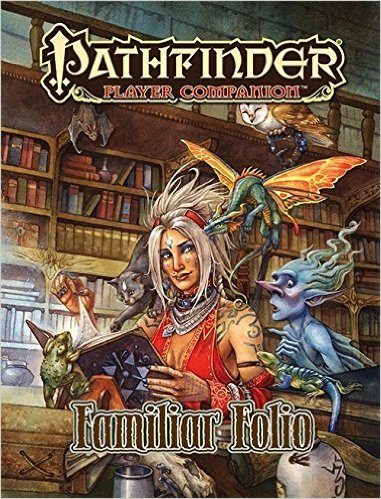
Basics-Every great wizard has a familiar, why can’t you!  Familiar Folio is a Pathfinder Player Companion book discussing familiars, how to add them to new characters, and how to improve them.  Like every other book in the companion line, it adds new feats, archetypes, items, spells, and other options for players and their familiar’s alike.

Mechanics or Crunch-This book is amazing, if you already like familiars.  This book won’t really win you over if you didn’t already have a character concept for familiars.  Every option added in this book is great, but familiars tend to work just like alchemy in Pathfinder, great if you love them, bad if you don’t.  After seeing what’s here, I can say that if I played a character who wanted a familiar, I’d absolutely want what’s here.  However, if I played someone who had the options of not having one vs having one, I don’t think this book would win me over to the familiar side, even with a mascot (familiar). 4.25/5

Theme or Fluff- This book discusses some of the story aspects of familiars, but it doesn’t really go out of its way to add them in deeper.  The book covers topics like how to roleplay with them, and it does have a bit of how different locations in Golarion would use familiars and the types in those locations. But, it’s not much beyond that.  This is primarily a crunch heavy book.  4/5

Execution-This was put out by Paizo.  For anything you can say about Paizo, the unarguable truth is they know how to make a book well.  It’s got great art, great layout, and was a pleasure to read.  5/5

Summary-The simple question to this book is, “Will you use or want a familiar?”  If you said yes, then you get this book.  If not, then don’t.  Like I said with alchemy, familiars are extremely divisive.  You love your familiar, then you will love this book.  If you couldn’t care less about your wizard friend’s odd toad in his pocket, then you don’t want this book.  What this book is is well written, a bit light on story, but overall well put together.  Just decide if you want a tag along before you begin.  88%

Ring Side Report-Board Game Review of Nefarious

Product-Nefarious

Producer-USAopoly

Price– $ 30 here 

Set-up/Play/Clean-up– 20-40 minutes (2-6 players)

Type-Euro

Depth-Light

TL; DR-Production issues hurt a decent game. 86%

61EMcEpXQBL._SL1022_

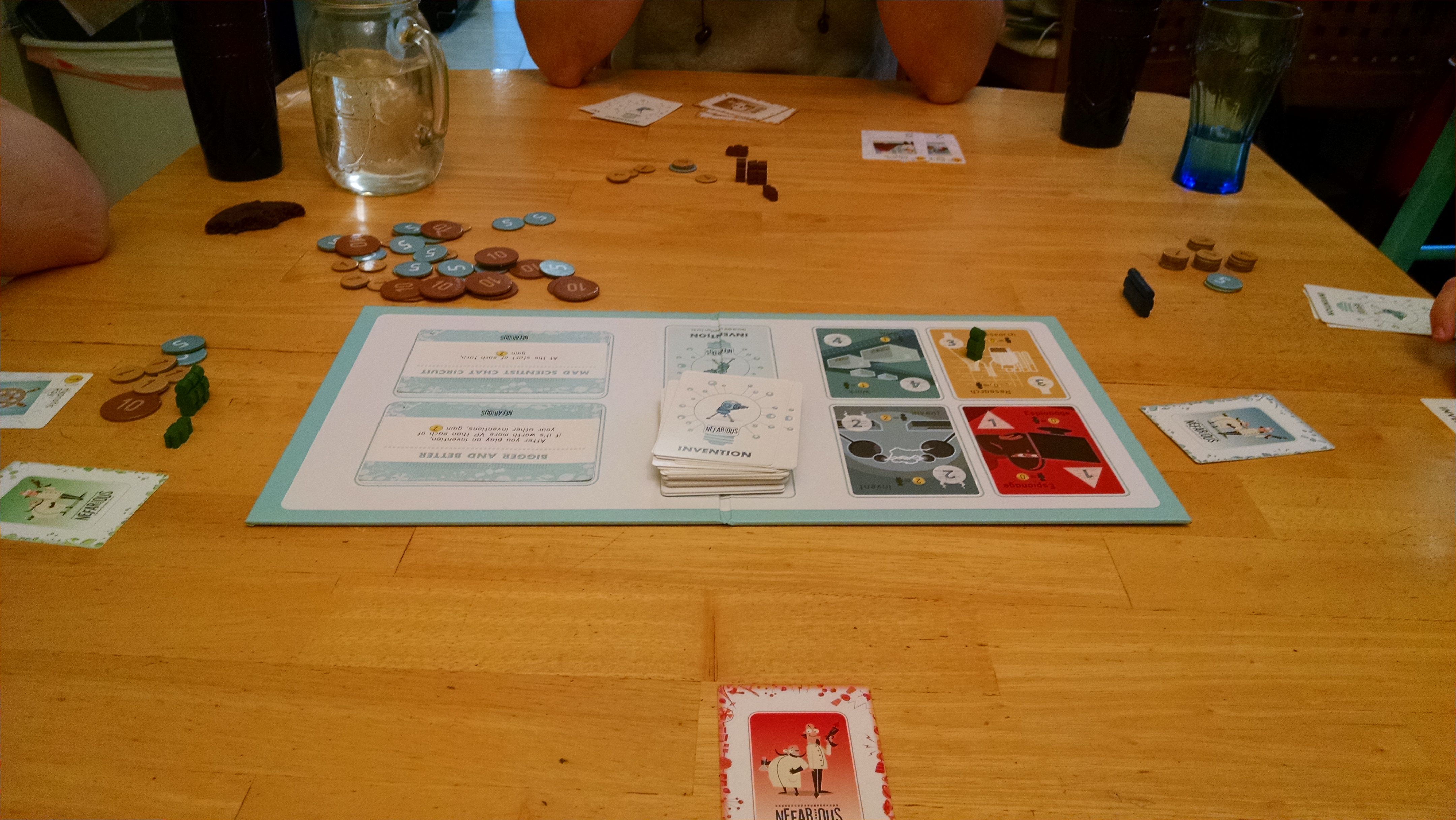
Basics-What are we going to do tonight?  TRY TO TAKE OVER THE WORLD!  In Nefarious, players each take the roles of different mad scientists trying to each take over the world.  The game starts simply enough with each player getting  some starting gold and invention cards.  Each turn, players secretly selected one of four actions, reveal them at the same time, and all actions of the same type happen simultaneously.  The actions are: espionage, invent, research, and work.  Work simply earns you more money.  Research earns you a bit less money, and you get to draw a new invention card.  Invent is the meat of the game.  When you invent, you pay money and reveal one of your invention cards.  These cards have a cost that you pay, a victory point total, and possibly some effects like gain money, cost your opponents money, or gain more invention cards.  Espionage is an investing mechanic.  When you do espionage, you select an action and place a meeple on that action on the main board.  When a player on your right or left takes that action, you gain money equal to the number of meeples you have on that action.  Once all four actions are resolved, players then select new actions, and play continues the same way.  What makes this game a little deeper than it seems are the twist cards.  Each game two twist cards are secretly drawn from a deck of cards.  These cards provide new twists on the game like giving you strange new abilities, taking away some actions, or just removing some money from some of the actions.  When a round ends, a player has at least 20 points, and that player has more points than any other player, the game is over and that player wins and conquerors the word!

maim board

Mechanics– This is not a complicated Euro, and that works for and against this game.  The simplicity of the mechanics works as a great introduction to the gaming hobby.  You will know the rules of the game in under five minutes.  The simplicity works against the mechanics as I didn’t feel as challenged as I could be if this game had multiple resources to track.  However, the multiple resources would have made this game that much harder to teach, learn and play.   Overall, it’s a good, simple Euro.  Think of this as an excellent sushi appetizer to the gaming industry-it tastes great, but you might want something a little more filling as you learn to love this acquired taste more. 4.5/5

cards

Theme– This game has some good theme, but something gets lost along the way.  The theme of inventing new items to conquer the world comes through.  And the fact that most items have some side effects also keep going with this theme as you’re battling it out with other mad scientists.  However, some of the theme get’s lost along the way.  I’m fine with most of the actions but some things don’t translate well.  The work actions seems like a misplaced opportunity in that vain.  All of my other actions are downright nefarious, but work feels like I clock in at Amazon to fill packages; even the work action looks like a shipping company.  Why not something like Extort with the action picture being a man/woman in profile with some sort of atomic raygun getting money from a generic civil leader.  It’s those little touches that cause this game to lose some of its theme.  You will still feel like a mad scientist inventing crazy machines, but maybe one who moonlights as a DHL driver.  4.25/5

Instructions– The rules a simple, sleek, and short-all great descriptors for a board game’s rules.  This game isn’t as hard as Twilight Imperium, but the rule book does explain the game in simple terms that gets the point across quickly and well.   5/5

spres

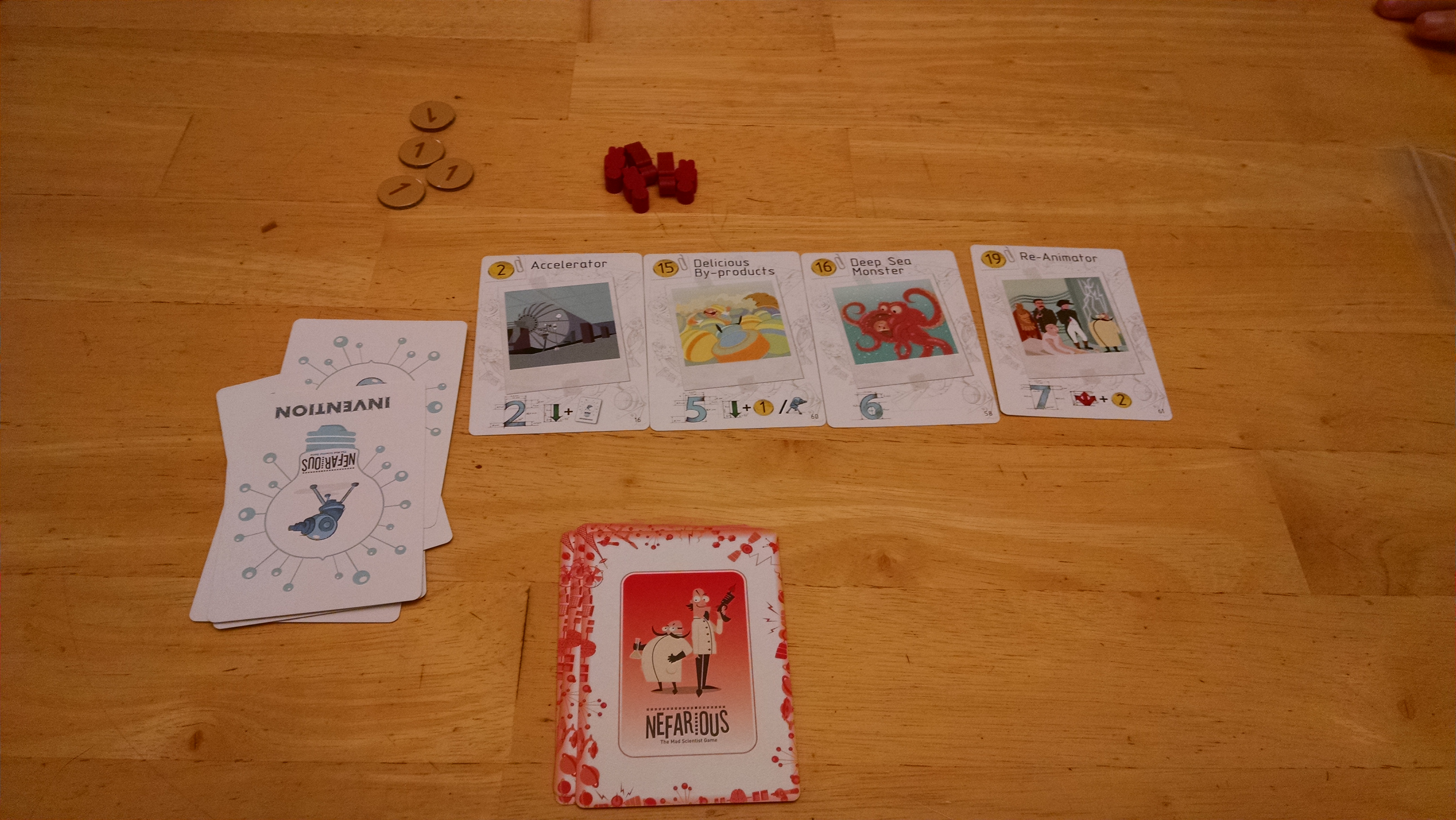
Execution– Here is where I think things need a bit of work.  Overall, everything is serviceable.  That said, there are some issues.  The cards for the game are printed on very thin cardstock.  It’s not bad, but it will tear easily.  The art in the game is awesome and has that retro-science feel to it.  The worst part of the game is the coins.  The coins are printed on sheets of several cardboard pieces pressed together, but the cardboard didn’t adhere to itself properly, so the cardboard is spongy and bows.  The coloring of the cardboard is a single sheet of sticker.  That’s not horrible, but the cutter for the cardboard didn’t cut the cardboard and stickers well, so when you punch out your money it will have all these random bits of extra sticker attacked like flaking paint.  USAopoly has acknowledged the problem, and future print runs will be better.  But, for right now my copy gets a C overall.  If you want to see the components, I’ve made an unboxing video where you can see all the components here http://youtu.be/Qdtz9YQDKHA  3.5/5

Summary-This is a good quick Euro.  It’s a great game with lots of replay.  I like the mechanics as I can teach random people how to play quickly, and they get autonomy in a short game.  Also, this game has some meat on its bones as it’s a Euro with some decent thinking power behind it.  You can’t go into this game hoping for Kanban or another four hour Euro though.  This is excellent at what it wants to be, and you have to know that going in.  I think the rules are great, but I’d like some minor, cosmetic changes to help the theme a bit.  The production quality is ok.  It will be better, but if you get a first print run, expect a few, minor problems.  But, if you’d like a good game that will have you thinking for 20 minutes with your friends, then this a great game of world domination to pick up!  86%

Ring Side Report- RPG Review of Titansgrave: The Ashes of Valkana

Product– Titansgrave: The Ashes of Valkana

System– AGE System

Producer– Green Ronin

Price– $13.99 here http://www.drivethrurpg.com/product/153950/Titansgrave-The-Ashes-of-Valkana?src=hottest_filtered

TL; DR– I only wish this had more. 88%

AGE_TG_AoV-450_1024x1024

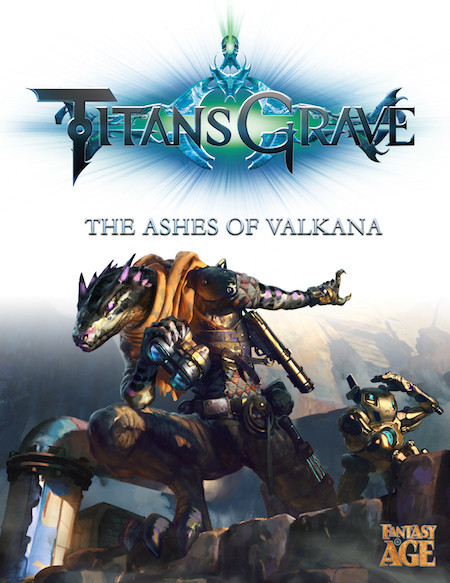
Basics-Cyberpunk, fantasy, and Wheaton-oh my! Titansgrave: The Ashes of Valkana is the much hyped book using the AGE System and a setting designed by several RPG powerhouses and Wil Wheaton himself.  On the Tabletop YouTube page, Wheaton played several adventures of this game with his celebrity friends, and now you can play this game at home with your friends.  What will happen when you disturbed the ashes of a long dead war?

Mechanics or Crunch-Titansgrave demonstrates some amazing uses for the AGE system, but doesn’t quite hit the mark I was expected.  The book has some phenomenal new additions to the system like a completely new chart to spend stunt points for one creature type in combat.  Those kind of add-ons to a system show how robust and buildable the AGE system can be.  The book doesn’t quite keep up that new energy throughout however.  The basic Fantasy Age book introduces the system quite well, but Titansgrave doesn’t do enough to expand the system for this universe.  I wanted several new additions, spells, and mechanics, however, I really only got a new race, some new items, and a few character options in the first chapter.  They all work well, but it doesn’t do enough to really drastically enhance the system.  AGE is great itself, but I want more to really make the AGE system Titansgrave own thing. 4/5

Theme or Fluff- Titansgrave tells an interesting story, but sadly one you’ve kind of “heard” before.  The Titansgrave story is the fun romp from TableTop.  Which if you saw TableTop is awesome.  But, if you saw TableTop, then you have a general idea of what’s going to happen.  I was hoping for a bit more original stuff like added adventures, side quests, and a continuing adventure in the world, but there is some things here to keep your players guessing.  Also, the story is a bit linear.  You can’t go too far off rails on this as the story is written ahead of time.  4.75/5

Execution-If you like the layout from Fantasy AGE, you will do fine here.  This book is basically a giant version of the adventure at the back of the Fantasy AGE book with some serious additions.  I’d like a bit more here as the art is good, but I need a few more maps to throw to my players and some more breaks in the text to help me better read the story.  Overall, its well done and something that you can get through with general ease.  4.5/5

Summary-Titansgrave is the first big launch of the AGE system after it got its own push post-Dragon Age.  This book isn’t my favorite RPG book of all time, but I think it does a good job of introducing the system and setting in a big way.  The book provides a completely new world to play in.  I’d like a bit more mechanics specific to the world, but what’s here is well done.  The story is good, but depending on how much your players watch Titansgrave, they may have seen some of the high points.  The book is well executed, and overall a fun read.  After reading this book, I’m hungry for more in the Titansgrave setting.  88%

Ring Side Report-Board Game Review of I Hate Zombies

Product– I Hate Zombies

Producer-Board Game Geek

Price– $ 8 but only through the kickstarter so far

Set-up/Play/Clean-up– 30 minutes (2-12players)

Type-American

Depth-Light

TL; DR-A great, simple game to get a group playing quickly. 95%

2015-08-27_1440648743

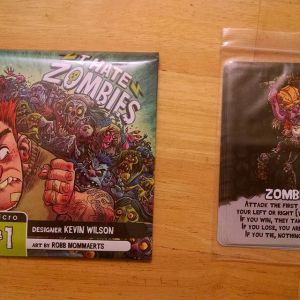
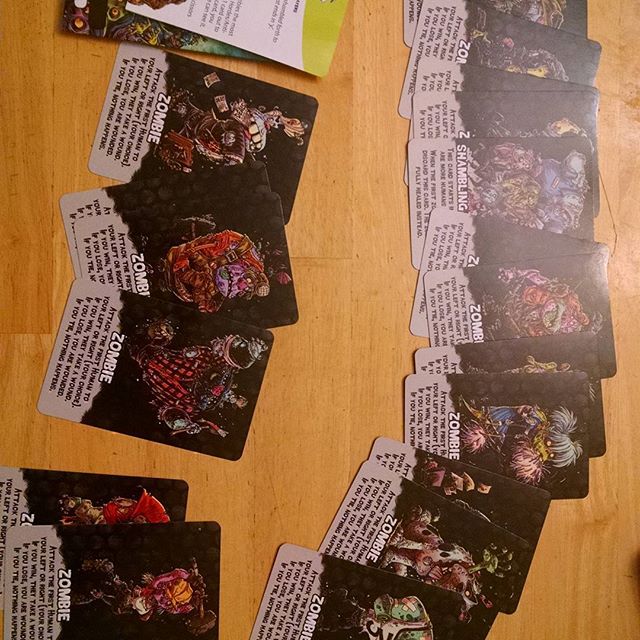
Basics-Man, I HATE ZOMBIES!  I Hate Zombies is a quick party/social game where players get to be either zombies or humans.  After everybody is dealt a card, every other player flips their card from the human side to the zombie side.  Zombies, and only zombies, then attack a human on their right or left by playing rock paper scissors.  If a human lose, they take a wound and turn their card.  If a human takes two wounds, they become a zombie!  If the human wins, then the zombie takes a wound.  Three wounds to a zombie, and that player is out of the game.  Every human has a power that ranges from healing to insta-killing one zombie!  If only humans remain, then the humans have won.  If all the players become zombies, then the zombies win!  It’s that simple.

2015-08-27_1440648789

Mechanics–   This game is crazy combination of Coup and Rock Paper scissors.  It’s fast, fun, and crazy.  However, only the zombies attack.  That’s kind of boring for the human players as they have to just endure the attacks from the zombies.  It doesn’t make me hate the game, but it is a bit boring.  However, it does move fast enough that players get a great taste of the game quickly keeping them from getting board.  4.5/5

2015-08-27_1440648836

Theme-This is a crazy American style game.  Play moves fast, so it does feel like a zombie hoard.  Overall, it’s great.  The humans all feel distinct, but the zombies all just feel like the same old thing.  That could be intentional as the zombies are now a hoard, but I’d like for the zombies to feel a bit distinct.  Furthermore, there isn’t much story here.  It evolves as you play if you play with a great group, but the game itself isn’t a story powerhouse. 4.5/5

Instructions– The rules to the game are short enough they could be written on a napkin.  It’s that simple. It’s also simple enough to be quick playing and easy to explain.  Good job!  5/5

2015-08-27_1440648914

Execution–  This game is a bunch of cards, a bunch of people, and rock paper scissors.  You have to try to screw that up!  What I did get was some awesome art, great physical card stock, and a nice pouch to hold it in that fits in a CD holder.  And the best part is this game costs somewhere around eight bucks.  You get a whole microgame that can get a whole room of people playing for about the cost of a hot and ready pizza from Little Caesars!  5/5

Summary-This is a simple fun game.  It’s not the most complex game out there, and it lacks a little in theme, but it makes up for that in simplicity, speed, and fun.  If you need to get a whole room of people playing a game to break some ice, you would be hard pressed to find a better game than I Hate Zombies! 95%

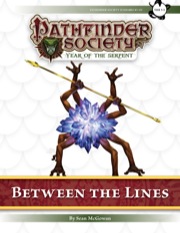
Ring Side Report- RPG Review of Pathfinder Society Scenario #7–01: Between the Lines

Product– Pathfinder Society Scenario #7–01: Between the Lines

System– Pathfinder

Producer– Paizo

Price– $3.99 here http://paizo.com/products/btpy9cu3?Pathfinder-Society-Scenario-7-01-Between-the-Lines

TL; DR– DnD-NOW WITH LSD! 92%

PZOPSS0701E_180

Basics-You’ve been summoned to help procure an item.  Fortunately, you know where it is, and even better, who has it.  They will even sell it to you!  What happens when you get what you want, and it does way more than you hoped for?  What happens when you play with an ancient box that stores the mental history of all who used it before?

Mechanics or Crunch-This is two adventures in one.  The first adventure is the standard one you know and love.  Run some errands, and then you get what you were searching for.  That’s all par for the course.  The second half is crazy, out there fun.  You enter a mental landscape.  That’s fine, but the map and the monsters are a bit off, and a bit more front loading and modifying of stat blocks would help GMs run this on the fly.  It’s not horrible, and if you read ahead (like you are supposed to!), you will be fine.  However, if you’re running this after just printing off your adventure, then you as a GM will be a  bit lost.  4.5/5

Theme or Fluff-  As I said in mechanics, this is two adventures.  Half is in the regular world, and that is something your players can easily grab onto.  This part is here more to help draw your players in.  The real meat of the adventure is the second part.  Here is where things go on and off the rails.  On rails because the players progress through a linear  dream landscape, but have to do so in a specific order.  Off rails because this adventure plays like a LSD trip-and it is amazing!  Lot’s a crazy imagery and fun ways for the GM to really ham up the crazy, psychic nature of the adventure.  I absolutely love this adventure for that.  5/5

Execution-This adventure has your usual Pathfinder Society polish.  What I don’t like is how the monsters are not customized to the adventure.  The players fight some crazy dream monsters, but the monsters are not really customized to the purpose at hand.  It’s ok, but it wouldn’t take much to really fix up the monsters here, so you’re GMs don’t have extra math to fight with.  This adventure will be a bit long if the players and the GM are slow.  Honestly, its about ¾ of two different adventures, so if your GM doesn’t manage his or her time properly, you will be done late if this is run at a convention slot.  I’m complaining that there is too much here, which is a good problem to have, but it can be a major problem if not dealt with properly.  4.25/5

Summary-Occult Adventures kicked off this season of Pathfinder Society, and it shows in here.  This isn’t completely a psychic adventure as it got strange occult influences, and I hope this keeps up through the entire season of Pathfinder Society.  This is a crazy adventure that really provides some great roleplaying opportunities as well as some great scenes for players and GMs to just go hog wild with.  I love what I see here, and I can’t wait for more.  It’s not perfect.  I’d like a bit of customization from Paizo for the monsters as a GM who has missed some important information might try to throw CR 6 creatures at a level one party if the miss the section detailing how the encounter changes.  It hurts the overall presentation a bit, but honestly, I had a blast running this adventure.  If this is any indication of what’s coming next, BRING ON THE STRANGE! 92%

Ring Side Report-Board Game Review of Diamonds

Ring Side Report-Board Game Review of Diamonds

Product– Diamonds

Producer-Stronghold games

Price– $ 25 here http://www.amazon.com/dp/B00NFSBU9Y/ref=sr_ph_1?m=A7YAR2WDYOPTK&ie=UTF8&qid=1440129851&sr=sr-1&keywords=diamonds

Set-up/Play/Clean-up– 30-45 minutes (2-6players)

Type-Euro

Depth-Light

TL; DR-Best parts of several trick tacking games. 92.5%

basics

Basics-Time to throw Eucker, Hearts, and Spades into a blender!  Diamonds is a trick taking game that combines the best of all of the above.  Players are dealt 10 cards, and the dealer will decide to trade one to three cards.  All players then choose that many cards from their hand and pass them to their neighbor.  Next, the player to the left of the dealer will place one card down.  These cards have values between one to 15 and have the four suits found on any normal deck of cards: hearts, spades, diamonds, and clubs.  Each player then has to place a card of the leaders suit, if they have any, or play any other card, if they don’t have the same suit as this trick’s lead card.  Here is where the game becomes more than just a trick taking game.  Each suit has a power associated with it.  Diamond cards place a diamond behind a small screen called your vault.  Hearts place a diamond in front of the vault in your vault.  Spades take a diamond from the front and place it behind your vault.  Clubs steal a diamond from in front of another player’s vault and places it in front of yours.  Whoever played the highest card with the lead’s suit gets to take all the played cards and set them next to his or her screen and then take that suits action.  If you couldn’t play a card with the lead’s suit, you just take the action associated with your suit.  Playing off won’t get you cards for the round’s end, but it does get you whatever power the card you played has.  Whoever won that trick then becomes the next lead player for the next trick.  After 10 tricks each round, all players separate their cards into four piles based on the suits.  Whoever has the most number of each suit gets to take that suits power again.  If you didn’t get any tricks, and thus have no cards, you get two free diamonds placed right into your vault instead.  Play then continues with a new dealer.  After each player deals one or two times, depending on the player count, each player counts their diamonds with diamonds in your vault worth two points and those in front being worth one.  The player with the most points wins!

2015-08-21_1440178740

Mechanics–  I’m from Michigan, so I knew this game from another game called Eucker.  Eucker is fun, but it lacks depth.  This game is amazingly deep for a trick taking card game.  Sometimes you do better by playing off than ever winning a single trick.  Sometimes, you need to win every trick.  That evolving strategy is amazing.  Also, the game isn’t hard to play.  I do love me some 8-hour, math fueled, Euros where I build cars, but you will learn this game in under 3 minutes, master it in 10, and have a chance of winning in 15.  Honestly, this is a well done game.  5/5

Theme-Theme is a hard concept in your average trick taking game.  What’s here is ok.  There really isn’t a story here.  But then again, I’m not really looking for one.  I’d like more, as I’ve seen some reskinned trick taking card games with more theme, but I didn’t expect too much going in.  The components are nice and do build a bit of a world, but don’t play this game if you need something like Dark Moon’s story.  3.5/5

Instructions-That paragraph above is all you need to play this game.  The rulebook is as short as it needs to be.  The game is an extremely simple to play game, so the rules don’t have to be too difficult or cover too much territory.  The extremely helpful thing included in this game is a cheat card for every player giving some quick iconography on how the different suit powers work.  Honestly, this is a slick, simple rulebook that will get you playing in about 5 minutes even if you’ve never played a trick taking game before. 5/5

2015-08-21_1440178787

Execution-This game is a small game, but not a poorly put together one.  You can see all the components here: http://youtu.be/dugtHKid-Ko . The game is about a quarter the size and weight of most of my other games, but that doesn’t hurt its delivery.  The game comes with cardboard standee vaults, a deck of cards, and plastic diamonds.  What is here is well done and beautiful.  The art is distinctive, but not distracting.  The diamonds are nice plastic pieces that you want to collect.  It’s a power-packed box.  5/5

Summary-Diamonds is the game I bring with me when I hang out with my family in Michigan.  It’s got the simplicity of Hearts, but the depth I need in a great board game.  It has great components and instructions.  My only real complaint is the theme, and the only reason I ding this game on theme is I play too many RPGs, and I want theme in everything I play.  If a games story isn’t the most important thing to you, then this is an amazing, easy to play trick taking game that’s a great game to add to any collection.  92.5%

Ring Side Report- RPG Review of Fantasy AGE Basic Rulebook

Product– Fantasy AGE Basic Rulebook

System– Adventure Game Engine

Producer– Green Ronin Publishing

Price– $16 here http://www.drivethrurpg.com/product/153066/Fantasy-AGE-Basic-Rulebook

TL; DR-A strong successor to Dragon AGE. 92%

153066-thumb140

Basics-The Dragon AGE has ended, but that doesn’t mean all the stories you wanted to tell in the AGE system have.  Fantasy AGE is the basic rule book for the previous Adventure Gaming System(AGE) system that came out with Dragon Age RPG providing all the basics any generic Fantasy RPG could need.  Let’s break this down piece by piece and see what I think of them individually.

Mechanics or Crunch

Game Basics- Fantasy AGE uses the same basic mechanics that Dragon AGE did; each player will roll 3d6 for an action, find the sum of the dice with some modifiers, and that will determine the outcome.  Contested rolls work exactly the same with the higher sum winning the roll.  This is a quick and easy way to have numeric diversity and an average in your dice rolls.

Stunts-One of the more interesting things with this system is stunts.  When you roll your dice, two of the dice are one color and the third is a different color.  If two of the dice have the same result, you get stunt points equal to the result on the differently colored die.  These stunts have point values and will allow you to add extra flare and effects beyond hit a guy, cast the spell, or bluff the guard. Each type of action has it’s own stunt point chart that you can select icons to spend your points on with the more points spent, the stronger the effects.  When I first read about this system, I was a bit put off, but then my math geek showed through.  It’s easy to think that you won’t roll doubles often, but out of three six-sided dice, you roll doubles a little less than half of the time! Again, this is a fun addition to the standard “roll dice, hit guy, next person in initiative” we’re all used to.

Character Generation-Fantasy age characters make a few important choices and have to let some dice fall. When you make a character, you get to choose your race, background, class, and then you let the dice fall where they may!  Lots of this system involves you randomly rolling for effects on your character.  This results in your average character of a race having some average abilities and likely traits, but overall, I don’t like that part of character generation.  While I’ve played older RPG editions, I prefer to let choice occur when you build your person.  This system does downplay the negative aspects of low ability rolls, but I still prefer point buy.  It’s an option, but most of the book tends to focus on rolling for your character.

Statistics:This game doesn’t have a ton of bonuses to your basic dice roll and that is great thing.  Each person has a number of statistics being: accuracy ( weapon accuracy), communication (talking to people), constitution (body toughness), dexterity (agility and coordination), fighting (heavy weapon accuracy), intelligence (what you know), perception (situation awareness), strength (physical ability), willpower (mental resolve).  You can generate these via point buy or just rolling 3d6 and hoping for the best, so your number will be between 3 and 18 white the modifier for your dice rolls roughly equal the modifiers most role players have from D&D.  You can further focus in these abilities by  getting ability focuses like Accuracy(Blades) where you add 2 to your dice results for all blades attacks.  Thus, you will really only add two numbers to the three six-sided dice rolls.  I do love any system that squashes power gaming at the start and builds in a mean and standard deviation for its die results!

Classes and Advancement-Much like the Dragon AGE RPG, there are only three core classes: mage, rogue, and warrior. These classes are much like you would expect.  Mages cast spells, rogues are nimble and skillful, and warriors are heavy people-at-arms.  Each level a character will get new options such as ability focus, talents (abilities in sequence like feat trees in DnD/Pathfinder), or class specific bonuses.  The talents provide the bulk of the customization in the game.  Every warrior has the same basic class abilities, but the warrior focusing on close combat and social interaction will be like that because of the talents he or she choose.  You don’t get that many choices, but you do get a method to differentiate yourself from the press of other individuals out there.

Magic-Magic in this system is a point based system where players have a mana pool that is spent to cast a spell.  Spells themselves come from the talents that players choose with each level of the talent providing more spells.  It’s a simple system that reminds me of Final Fantasy and the Dragon Age video games.  Not bad company to be in, but since you don’t get tons of different talents, you won’t have the abundance of spells you’re used to in different RPGs like Pathfinder.

Combat and Damage-Just like this games D20 cousins, combat flows in a turn based manner following every player rolling initiative. On your turn, you can do either two minor actions like moving or a minor and a major like attacking.  Players and monsters have a defense rating that you attack just like any other skill in this game.  If your attack roll equals the defense, you hit the enemy.  Damage is done in this game based on the type of weapon you’re wielding with armor reduces the damage that a character takes instead of providing a bonus to your chance to dodge the attack.  This doesn’t reinvent wheel, but why fix what isn’t broken?

Summary-You can see the Dragon AGE in the Fantasy AGE.  That’s not a bad thing as I liked the  Dragon AGE RPG and the Dragon Age video games for speed and elegance of the systems.  However, my major problem is that the character and players don’t have many options.  Sure, it’s fun, but I’d like a bit more crunch to my characters.  That said, it is a good, quick, and simple system that you can easily use in any fantasy setting.  4.5/5

Theme or Fluff- It’s always hard to judge generic RPGs for their fluff content.  By their nature, there can’t be a significant amount of fluff in this book since any fantasy setting should be able to be played with in this system.  But, the book does have nice art, good general fantasy additions, and all the standard fantasy pieces you will need for your toy box.  Just don’t go in here expecting Tolkien as this book can’t have that level of detail and still be general enough for everybody.  4.5/5

Execution-This book reads relatively quickly and has a decent layout. I can quickly get through the book, find what I need and make a character in under 10 minutes.  I’d like more pictures, and some extra tables to make scanning the book easier like in the talents section.  I prefer to see something similar to how Pathfinder does summaries of feats before the full descriptions.  The book even has a small bestiary with some monsters to throw at your players.  It’s not large, but for the $15 I paid for the book, I’m pretty happy to see a complete system, game mastering guide, and monsters in one book.  This book even comes with a small adventure, so you can jump into playing after you buy only this book.  Overall, good book with a few minor problems keeping it from perfect. 4.75/5

Summary-Fantasy AGE is going to be an awesome RPG if Green Ronin can bring more out for it. Titansgrave is coming out, and that will provide an awesome series of adventures and a setting for this game.  That is what this book really misses-the fluff.  The crunch is good.  It might not be my all time favorite gaming system, but it’s well-designed, thought-out, and easy to use-all the things a quality RPG needs to be viable long term.  I’d like more options, but that’s my old D&D 3.5 gamer heritage showing through.  As for the book itself, it might not be my favorite layout, but it is a great way to present a games information.  If you joined the Fantasy AGE for Titansgrave, you will not be disappointed! 92%