Blurbs from the Booth-A Tale of Four Cons

This year as part of my geek new year’s resolution, I decided to go to one con a month.  I’ve seen some, quite frankly, excellent things at some cons.  I’ve also seen some not quite so good things at some cons.  I’d like to talk about some of the great things I’ve seen and why I thought they really made my experience all the greater.

Event Sign Up-Everybody goes to a gaming con for some gaming.  Otherwise you wouldn’t spend 20 bucks for a day badge to just hang with some friends.  Hands down the best con I’ve seen for event sign up is GrandCon.  GrandCon is a new con in Grand Rapids.  The team there is the same team that works together at Origins, and it shows.  They fixed my issue with my badge and when I went to buy an event ticket, I was in and out in under five minutes.  Their con signup was web based until the Thursday of the con, then you had to do onsite signup, and that’s ok.

Now not all cons a big enough to have its own server farm, but if you’re small, consider Warhorn.  I went to CritCon.  It’s another first year con in Ohio.  These guys poured their heart and souls into this con, and it showed.  Everybody had to sign up on WarHorn.  Now WarHorn isn’t my favorite, but it works.  The con went off great.

What I don’t like as much is sheets of paper in a hall.  It’s ok for smaller cons, but as you get bigger, it’s not as useful especial as you do more complicated analysis afterwards.

Sign Up sheets-I love to run events at cons.  I want to share my hobby with others.  What I need when I do that is for the con staff to work with me.  I’ll work my heart out to provide the programming for your events, but I need clear directions from you on what you want and where do I get to work.  I loved running events at Ucon.  Ucon is just celebrated its 25th year as a con.  When I signed in as a GM, I was given my badge and a packet containing instruction and lists of all my players at each event.  It wasn’t a complete list as you could get general admission tickets, but it gave me an idea of who I could expect.  I absolutely loved that.

When a con doesn’t give me a heads up, I don’t have a clue.  Am I in the wrong spot?  Can my players just not find me? How long should I wait for players?  As a rule I try to be 15 ahead of my slot, and if I don’t see players after 30 minutes, I assume there will not be any.  Is that a good idea?  If you don’t tell me as a con organizer, I’m completely in the dark.

Event Ticketing and Recording-When I sign up for an event, I expect I have a slot in that event held for me for at least a few minutes into the event.  Watches might not be right, I might get held up in the bathroom, or my food might not get served to me to quickly at the restaurant so I’m a few minutes late.  These are excuses, but I expect at least a little leeway.  I understand if I’m 15 minutes late I forfeit my spot, but if I’m less than five minutes into the slot I expect my spot to be there.  I had a few bad experiences where I signed up on paper sign in sheets, bought event specific tickets, showed up ON TIME, but since I wasn’t there really early, I didn’t get to play.  That right there soured my PentaCon experience.

If you do have sign up paper sheets, get those to the table as soon as possible.  Just put them on the table that will have the event 10 minutes ahead.  That way when the GM gets to the table, he/she can do a head count and call names of those who signed up.  This way people who did sign up get a spot while those who just joined the game won’t take spots from stragglers.  This is one of the things I love about Winter Fantasy, a convention in Fort Wayne Indiana each winter.  Signup sheets go out to martials who manage players, ticketed players get first pick of groups, and general ticket players wait 10 minutes.  After 10 minutes, everybody gets equal seating.  I can abide by this policy, and it shows in how smoothly Winter Fantasy runs games.

Event Ticket Collection-When I ran events at Winter Fantasy and Ucon, tickets were picked up from my table in under 20 minutes.  It was smooth and efficient.  If you do this early, you don’t disturb games and the GM knows right away if he doesn’t have any players.  The con gets data and tickets, and I get a well run machine of a game going early.

Table Tents with Event Breakdown-This is hands down one of the smartest things I’ve seen at any con.  At Ucon, each table had a little folded piece of carboard that had an breakdown of all the events and event times for that table.  WHY DOESN’T EVERY BODY ELSE DO THIS?

Venders-Every con should have a thriving vender area.  Don’t care what, but if you put some good deals there, I will buy it. A sure sign a con is dying is a shrinking vender area.  Vendors pull people into a con.  I have a friend that won’t go to a con if it doesn’t have good venders.  End of story.  I go bargain hunting at cons, so con organizers, please price your vendor spots appropriately.  If you are way too expensive, you will end up with empty spots.  It’s better to go cheap to get those guys in the door and slightly increase your event ticket sales then to kill your vender area!  Venders-I love you guys, but keep in mind at a con I see your main job to get your name out there.  I already have a local guy who I buy my games from, so the argument of by local is already happening.  When I go to a con, I expect a value or exclusivity.  I also have my phone with me at all times, and I can order from Amazon with free shipping.  If your price is over 110% of Amazons price I will either buy from my local guy or Amazon.  That’s it.  When I went to GrandCon, the vender deals were insane.  I spent over $150 bucks because I was getting deals.  When I went to Ucon, I spent $30 bucks.  The proof is in the money.

Random Gaming-Every con needs to encourage random geeks to sit and play some games.  If you’re a decent size con in the midwest, check out the GenCon board game library.  I’m ok if you charge me a single general event ticket for several hours of gaming, but don’t charge me several times if I’m teaching myself and a friend a game.  Also, you should encourage people to just sit down and game.  PentaCon this year was kind of underwhelming for me, but the part of the weekend that made it fun was when I was leaving the hall and some random guy had a game out.  We started a conversation, and then started to play his game.  I played games for six hours straight.  It was a blast.  Cons, help get some random geeks together!  It’s what the whole purpose is anyway!

Friday Night Magic-Look, I don’t like Magic.  But, Magic is quite possibly the most important thing the gaming industry has going.  If you run a con that covers a Friday Night, you NEED a magic event.  Work with your Venders to get an awesome prize package together.  Sell special, Magic specific badges.  Get these guys in the door.   They might come back and buy full badges.  At the worst you get your cons name out there!


Those are a few of my thoughts on cons.  I’m only going to one more this year, but I can’t wait to see what next year brings. Hope to see you at one!
Blurbs from the Booth-What I want next in the Pathfinder Adventure Card Game

The second adventure part of the Pathfinder Adventure Card Game recently came out, and I recently played through and reviewed my experience and posted my thoughts here.  It’s fun, but I think some changes need to happen to make the game that much better.  Right now it’s a fun game my wife and I play two nights every other month.  I don’t tell my friends much about it, because it’s fun, but not the amazing experience I think it can be.  Now, I think it’s pretty good, but a few things that honestly won’t cost Paizo that much to add or change could really make this the BEST co-op card game out there now.  Let’s do a rundown of what I think needs to change.


BIG CHEAP FIX– one simple page-I want a one page, two sided piece of paper with a story, character, what’s going on, and better rule descriptions.  I’ll go into depth below.


Story, Characters and Fluff– Rise of the Runelords is a phenomenal story arc.  This game currently does an ok job of hitting the high points.  But, as someone who hasn’t played this before, I don’t have a clue of what is going on.  Right now I get, at best, two paragraphs describing what is happening on the back of a card.  That’s ok in a simple card game where I roll dice, but I want to true RPG experience.  I don’t know: what and where is Sandpoint?  Who is the villain from the first adventure part?  Why do I care about finding friends?  What festival is going on?  Adding a one page sheet (Heck post a PDF online) would really bring me that much more into the game.  Introduce some NPCs, give some background, and drag me deeper into the world.  My wife and I will read this aloud and know who we are in this card game.  It will pay off in droves if I know who I am fighting and if I know I was betrayed.  I will have “NO WAY!” moments that will hook me harder than a sea bass.  I will want to tell my friends that you won’t see it coming.  It will be awesome.


Instruction– When I reviewed the base box of the game, I didn’t really like how the rules were written.  The expansions don’t have any extra rules besides what on the cards.  Give me a sheet that explains the rules a bit more in detail.  I HATE having to rush to board game geek or Paizo.com forums midgame to figure out how to play something.  Giving me a good resource will really help with that.  If I have that sheet or PDF handy, then I know what I’m doing.


Why the simple sheet?  Well right now the biggest competitor to the Adventure Card Game is the Lord of the Rings LCG from Fantasy Flight.  The Lord of the Rings game comes out every month with one adventure and gives both player and enemy cards.  Right now I like the Lord of the Rings card game for a few reasons, but I think with a few changes the Adventure Card game can easily over take it.  First is the sheet.  The Lord of the Rings game gives a sheet with rules and story for each scenario.  That sheet honestly stops all my rules questions and drags me into the world.  The one sheet makes me that much more engaged in both theme and mechanics.  However, there are a few other things I want to bring up that the Lord of the Rings game does that I think might help a bit.  I realize that both games have different mechanics, but I think that some aspects could transfer quite well.


Different Decks-Right now, every deck is used for all the scenarios.  This isn’t bad, but it’s kind of like using a random monster generator.  Sometimes you get a hit where you roll to use an undead table and get a ghost in a haunted house.  Sometime times you roll to use an aquatic creature in a desert.  It kind of breaks the immersion in the game.  I could see smaller decks like a 1-U for undead creatures in the first scenario pack.  This would focus what monsters you encounter, but could still be mixed with other smaller decks to give some randomness.


Additional Mechanics-The general mechanics of the game work well. However, when you do this several times across an adventure pack, it does get a little stale.    So far my absolutely favorite scenario is the Foul Misgivings.  I loved the addition of the haunt and the random chance you could be attacked by the crazy ghost (I would like a bit more back story and some rule discussion, but that’s what I mentioned above).  I think that shows that there is so much more potential for this game.  Right now it’s the same action over and over, but that little bit of extra crazy made this so much more!  Please DO MORE OF THAT!


Specialized Box and one quest sets- One of the more interesting aspects of the Lord of the Rings LCG is their print on demand sets and book boxed sets.  Paizo has an amazing fiction, and I would love to play single mission or smaller boxed sets based on the books.  I will give you more money!  Want even more?  Give me a battle interactive story pack that I can play at a con!


Those are some of my ideas.  Overall, I love this game.  I see it can be so much more.  Honestly, just a few small tweaks will make this game awesome.  The larger harder ideas I have I know will take some retooling. You have my money either way.  At this game’s worst, it’s a fun way to spend time with my wife.  Give me a reason to brag about this game to all my friends!

Blurbs from the Booth-My Thoughts on The Sundering (so far)

            With the completion of the DnD Next playtest, the release of The Godborn, and the final of Murder at Baldur’s Gate, we are at least 1/3 of the way into The Sundering.  The Sundering is the multi-author plan Wizards of the Coast has to reinvigorate the Forgotten Realms.  Let’s go point by point and let’s see what I think.

DnD Next-I “like” DnD Next, but I don’t know if I “like like” DnD Next.  Since DnD and I went on kind of a break, other games have filled the void that DnD had in my life.  I’m not exclusive, but I do play Pathfinder, Arcanis, and Shadowrun.  Will DnD be able to pull itself back to the main focus of my life or will these other games stay there?   How many other people will be like me and just play the other games they found when DnD went away?

DnD Next isn’t really new DnD like 4e was, it’s almost like a strange combination of 4e, Pathfinder, and older DnD editions.  It’s not bad, but it’s not as innovative as I think it could have been.  But then again, innovation got them in the trouble they are currently in.  I was part of the rare breed who loved 4e for what it was, so I feel slightly betrayed that all the books I bought and novels I read are being changed.  I have selves of DnD 4e books that are little more than paperweights now.  I’m not leaving this relationship, but I feel like DnD and I have grown apart.   The adventures-The Sundering adventures are interesting.  I really enjoyed running Murder at Baldur’s Gate, but I know it wasn’t what my players wanted.  My players didn’t get the chance to really be heroes as every option that they could follow with the city would pretty much lead to its doom.  I hope the next events give them the chance to be heroes not just adventurers or pawns in a bigger game.  I’m having fun, but I don’t know if my players are.  I know my wife more the once said she almost doesn’t want to play since no matter what she does she helps someone evil.  WotC, please give my players a chance to win and win big here!  It doesn’t have to be an epic, destroy Shar win, but harken back to the old days of encounters where the players get to be heroes and kill some bad guys.  And while we’re on the subject of bad guys, please give me better ideas on how many bad guys to throw at my PCs at any time.  I can wing it with the best of them, but I want some consistency with other groups out there!

Also, limit player options helps a DM with the game, please.  When you give the PCs three options, they will take all three.  I know it’s awesome to give three ways the story could go, but giving my players that many options limits how much time I can dedicate to anyone.  I felt I had to speed race through my games so everybody would get a tiny bit of main focus.

All said and done, I’m intrigued.  Murder at Baldur’s gate was fun.  Not sure where it goes next, but it will be fun.  What I’m really interested in is what’s going to happen next and how WotC pulls it off.  If DnD Next launches at GenCon 2014, then I wonder when Forgotten Realms books will launch.  It’s impossible to launch them next year AND have a full year of player input into the setting.  Print times will not allow this!  Does someone have timestop out there?

The Novels-The Companions and The Godborn are on store shelves now.  I liked both of them.  Read my reviews here and here.  However, when I look at them together, I don’t like the whole.  The novels are not rebooting the Forgotten Realms, but they are rebooting the Forgotten Realms.  It feels like all the changes from the spell plague and the weave dying won’t matter.  And, that kind of pisses me off.  I loved that Forgotten Realms, and I feel like I’m being told that that was a mistake and should never have happened.  To me, WotC is almost ashamed of 4e and its changes.  As someone who loved their stuff, it almost feels that by extension WotC is ashamed of me and my devotions to those things.  I felt the changes that happened were good ones.  It shook things up and created design space for new threats.  Now, it’s back to the prespellplague status quo.  Good gods vs bad gods with pawns in between.  It’s not bad, but it’s not what I want.  Maybe I’m just one guy screaming into the wind.

In the end, I’m not amazed.  I plan to keep buying stuff, but its more out of waiting to see what happens next then really being a true believer in the Sundering.  I have a ton of Forgotten Realms good will, and right now that is what’s keeping me buying.  I wondering if that will die off or will it get refreshed with the next adventure path and novels?

Blurbs from the Booth- On randomness: how random is random?

Today’s post will be a bit math heavy, but I promise to make it fun along the way!


Let’s say you and I decide to make an awesome new game.  We’ve decided to make “Fall of the 11th Age”, because 13 is too many ages for you.  A major part of the game is number 11.  We’re going to base the main dice mechanic on its so important.  You’ve had an awesome idea to make a cool new die called a d11 that will go from number 2 to 12, and you excitedly start making the game.  I say that we don’t have the kickstarter money to custom make d11s, so I start working on my version that uses 2 regular six-sided dice (2d6).  Since we both cover basically the same numbers (2 to 12), out systems look close enough to one another. So, we merge my and your ideas and start to really make some headway in the play testing.  But, some strange things begin to happen.  When we use my 2d6 system, things are pretty predictable.  The fighter almost always hits the goblins.   But, when we use the d11, the fighter misses the goblins ~50% of the time, and the wizard pulls of some hits that we didn’t think were possible.  What’s going on?

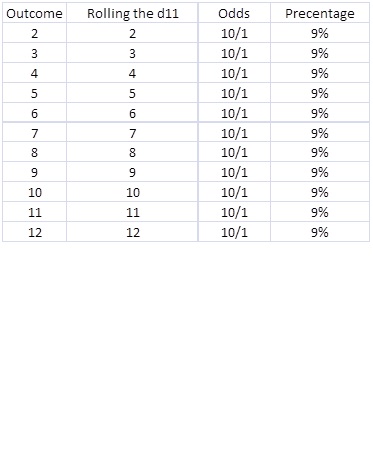
The answer lies in the math behind the game or, more specifically, the statistics of the dice.  Below I have two graphs.  The first is a graph showing how random each result is on the d11.  Statisticians love them some dice problems, so lots of work has gone into the dice.  On a fair die, every side has equal probability of occurring.  For our die d11, that means every side has a ~9% chance of being rolled.  This makes the behind-the-scenes math of “Fall of the 11th Age” pretty easy to figure out.  Here’s a quick example:  to hit the goblin, a fighter needs to roll a seven or better.  So the fighter can roll a 7, 8, 9, 10, 11, or 12.  That’s 6 numbers.  To find that probability of that occurring you multiply 6 by the probability of each event (6 x 1/11).  So the end result is 6/11 or ~55% chance of success on any roll.  I’ve put in a handy chart to show what I mean.


Untitled

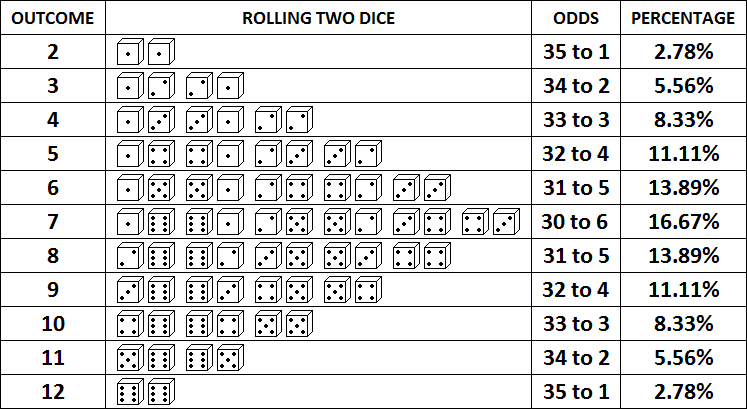
But things are not that simple when it comes to the 2d6 system.  Above, I mentioned how statisticians love them the dice, well a major part of that is how fair dice are and independent.  When you roll a d6, every die face has an equal probability of occurring.  When you roll two, each side has an equal probability of occurring AND what occurs on one die face does not affect the result of another.  There are a few assumptions that go with this and I don’t want to get crazy with physics of rolling dice together, so we’re going to keep this simple.  PLEASE!  It gets weird from here if we go deeper!  So dice are random and separate.  So when we want a result, to figure out the probability of that result we have to count the number of ways to make that result.  I’ve included a table to help with this.  A really important thing to note on this chart is how multiple dice roles make the same number.  For a simple example, look at the 3.  A 1 on the first die and a 2 on the second makes a 3 while a 2 on the first die and a 1 on the second also makes a three.  This is part of the independent results thing above.   So if we use the same “Fall of the 11th Age” math we used above with the d11 to hit the goblin, we need at least a 7 on 2d6.  There are multiple ways to make a seven.  For this, the best way to find the likely hood of this event is to ADD the percentage likelihood of each individual event.  So for a 7 to occur we add 16.67+13.89+11.11+8.33+5.56+2.78 which equals 58.34%.  This may not be a massive change from the d11 system, but it’s also not the whole story.


V4N2WgahS8BojSANeNB38Of0uw7oJbUNAhHAjPGIrP_SQkuC7oc8Vz-9zdARvX0HVEISqSOIljmOetW_1B-dL47H3dl3AuzAzmENXe8T4ccnqXgIoJs

from http://www.wikihow.com/Sample/Dice-Probabilities


Besides just finding the likelihood of hitting the goblin, there is a few more statistics “things” at play.  These are the mean, median, mode, and standard deviation.  Let’s look at the first three.  A mean is the average that we all know and love.  For “Fall of the 11th Age,” we just add up the dice results of 2 to 12 and divide by the total number of events (11) which is 7.  The median is the middle value; think of the median as a balance on a teeter-totter on a play ground.  If we moved the middle of the wooden beam around a bit, where would both sides balance one another.  Again this is 7.  2 3 4 5 6-7-8 9 10 11 12  There are five numbers to 7’s left and five numbers to 7’s right.  Where things really get interesting is with the mode.  The mode is the most likely to occur event in our group of events, or another way to think about it is, the event with the most number of ways it can happen.  For “Fall of the 11th Age,” in the 2d6 approach 7 can occur the most often since six different dice rolls can make a seven.  But, in the d11 approach, there is NO MODE!  Every number can occur equally.  (Again, we can get all math argue-y with if there is no mode you take an average bla bla bla, but this is my article and I want to make a point, so NO MODE!).

Standard Deviation is a bit more complicated, and I won’t go into it all.  For a great summary, go to http://www.mathsisfun.com/data/standard-deviation.html.  But, a real simple definition of standard deviation is a measurement of how much things very.  You use standard deviation to find out how random your stuff really is.  Let’s look at the 2d6.  The average result is 7, but over 60% of the time, you will role between a 5 to a 9.  When you roll a d11, the results get a little more varied.  Using standard deviation, 60% of the time you will roll between 4 and 11.  (If you check my math, I’ve simplified down the actual results.  It makes life a bit easier).  What this really means is you are more likely to be closer to the average in 2d6 then with d11.

Why does this matter?  Well it matters for how random you want your random to be.  For 2d6 vs d11, the difference between 55% and 58% doesn’t matter much, but what if we only needed a 6 instead of a 7?  Using what we went through above, the d11 likelihood is now a 64% while the 2d6 likelihood is now a 71%.  The difference is getting pretty substantial at this point.  Also, how random you want extreme events to be?  For the 2d6 system, 12 or crit will only be 2.78% which is pretty low.  But, for the d11 system, it’s 9%.  The d11 dice don’t really care what side comes up (dice, they are a cruel mistress….).  And since the math works the same in reverse, critical fumbles work exactly the same way (2.78% cs. 9%).  If we graphed the d11 results we would see a flat curve of probabilities.  When multiple ways to achieve the same value occur, interesting new things occur in the data and your game.

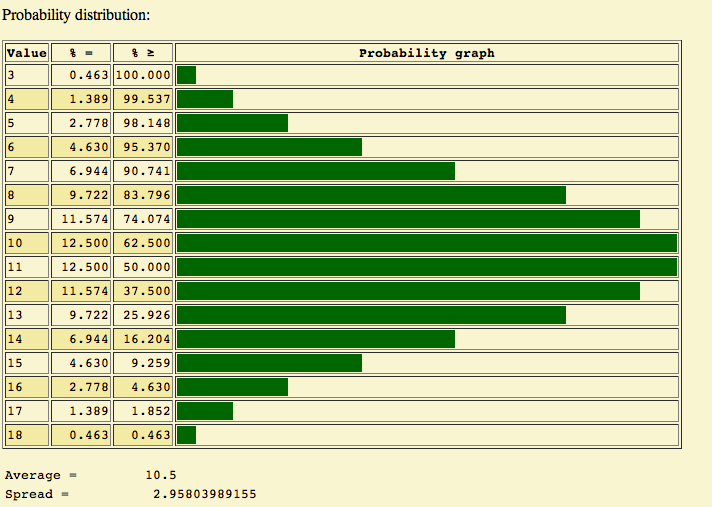
The example above is a pretty simple.  Let’s look at something a bit more extreme.  Let’s use Dungeons and Dragons d20 vs. Hero System’s 3d6.  (Yes, I know 3-18 is a smaller range then 1-20, but I want to use some real world example for the gamers).  A d20 is a single die, every side is equally likely, so every side has a 5% likelihood.  For Hero System, I’ve put another chart below to show all the results and likelihoods to make life easier.  For this one the “%=” column give the probability of a dice roll, and “%>” is the likelihood of this and all higher number dice rolls.  Let’s say you have to roll a 9 to hit a monster.  For a d20, you have a 60% chance to get that event.  But, for the Hero System, its 74%.  Again, this major difference has to deal with the mode and likelihood difference between each number in the two dice pools.  A d20 doesn’t really have a mode (See rant on mode averaging above), while a 3d6 pool has a mode at 10 or 11 and each number has a different probability of being rolled.  What if we need to crit to hit?  In DnD with a d20, its only a 5% chance, but in Hero System’s 3d6 dice pool, I’m looking at a 10-fold lower difference with a meager 0.463%.  When you look at the standard deviation, you are most likely to get between 8 to 13 on 3d6, while on a d20, for the same probability, you will most likely get between a 5 and 15.


Screen shot 2010-12-31 at 20.59.17


from seanswgcorner.blogspot.com

            What the crux of this argument boils down to is likelihood differences in getting different dice values.  How much random do you want in your games?  When I do something in the real world, is my life a full of extremes or is it pretty average?  How often do things get crazy vs. stay normal.  How often do the normal expected results occur when I do something?  On a d20, if a10 hits and a 14 hits, since each are equally likely, does a 14 really represent more skill or just another hit since both are equally likely?  For 3d6, I feel there is a palpable difference in likelihood and it affects the stories I tell.

What do you think?  Now, no system is “wrong”, but what does the math “say” to you?  What do you feel when you play these different games?  Do you feel a difference when a modes and different outcome likelihoods enter the game vs. when it’s just one die?  One of my favorite systems Arcanis uses 2d10 plus an attribute die for its d20 + attribute rolls.  I love that system because you get all the fun of a d20 game, but you also get the predictability of a smaller standard deviation.  While I enjoy the randomness, I feel that helps help keep the game from being overly swingy or random.  What do you want in a game?  How random do you want your random?

Why I love Living Games

It’s the first Blurbs from the Booth and today I talk about why I love Living games!


I’ve stood at the invasion of Elturguard as the companion went dark.  I’m immortalized in a statue commemorating the defeat and sealing of an elemental in Mil Takarn.  I’ve thrown waves after waves of demons against intrepid heroes as they stood valiantly in Jappa.  I’ve hacked computers owned by Renraku and stolen a wizard only to sell him to a different corporation in Seattle.  I’ve single handedly destroyed skyships as during the invasion of the floating fortress.  And you may have too.

I love living games.  Living games are long running campaigns where a series of modules are put out by a company or group in a particular game system.  The living game will place rules on what can and can’t happen in character generation and each module so the story that every character experiences is somewhat standardized.  Games like the Living Forgotten Realms, Living Arcanis, Shadowrun missions, Living Divine, Pathfinder Society, Legends of the 13th Age, and others all fill me with only happiness.  Now I know many others out there poo-poo the idea of a “regulated” game, but I don’t mind slight changes to the rules.  Where they only see “limitations” because they can’t do everything they want, I see only opportunities and awesomeness.  Here are some of the high points I see to living games:

  • Unity-Every week, I go to church.  I’m a Roman Catholic and at just past midway through, we all say the Our Father.  I get a feeling of unity with the larger group out there.  I’m not just one guy, I part of a larger whole.  I get that same feeling during a battle interactive (a large multi table game where parties can often interact with one another to help each other out).  I’m filled with a feeling that few can experience when I know several other people are all out there at the same time all fighting for a common goal.
  • Shared Experience- I talked above about all the crazy things I’ve done in game as a GM and a player.  You may have done something similar, and that is AWESOME!  We might not have ever met, or ever will meet, but we have shared something that only a few other people can.  We can sit down at a bar or a con and talk about the crazy stuff that happened when I tried to steal the gem and what happened when you did it.  No two tables are the same, but the basics will be there and now we have some comradery that would never have existed if it weren’t for our shared passion for an RPG.
  • Family/Friends-I’ve met friends at living games who I would have never, ever know existed.  These people came to my wedding, go with me to other cons, play other random games, and have become an important part of my life.  I look forward to hearing from them on a regular basis.  Living games give you an impressive opportunity to meet people you would otherwise not know existed.
  • Personal Opportunities-Everybody has to start somewhere.  Monte Cook did not start writing 1000 page source books.  Neither will you.  But a great place to learn about the industry is to do the grunt work of it.  Cons and living games get your name out there.  I’ve ran games for Wizards of the Coast and got to have sit down chats with heavy hitters in the industry, and it was amazing!  Also, since living games are constantly looking for people to write, it’s a great place to make some in roads.  Now, I’m not saying this will the minor leagues compared to major league baseball, but it’s at least like playing in high school.  It will get your feet wet and get your name out there.  Have a favorite game and want to make a name for yourself?  Check their website.  Most have a proper procedure for you to try being a writer.
  • Groups-Have a game you love, but can’t find a home group to do your crazy My Little Pony/Cthulhu version of it?  Go check out the living games.  Any company worth their salt will have an awesome website to support their living game.  These websites will help you find games or even give you Google groups to start playing in.  Then you find some friends, and eventually crazy Cthulhu Shuterfly with some equally crazy people.
  • Achievement (Real)-Paizo does this amazingly well.  The more you GM for them, the higher your rank.  I was at the table where the first five star female Pathfinder GM earned her rank.  In addition to being with an awesome group of people, I got to witness something phenomenal.  Or, think of it this way, YOU GET TO LEVEL UP IN REAL LIFE!
  • Achievement (Not as Real)- Every Living Forgotten Realms adventure ends with a reward sheet.  Every Pathfinder Society event ends with a chronicle.  You get a tangible reward for playing.  Now, I know it’s just paper, but you “earned” that.  There is a reason why so many companies are popping up selling game aids that represent in game achievement like gold and weapons.  It’s not much, but these represent some hard work by your character.  And, while not as great a say winning a football game, getting your sheet for winning the day does feel pretty good.
  • Effects on the Game World- I’ve been part of a vote to turn the Companion of in Elturguard.  I’ve changed the world of the Forgotten Realms forever.  Can you say that? Often times in each living game, the people who run the campaign ask for feedback based on what the characters did.  This affects future mods and ultimately changes the world.  I want my character to be part of the world and to make a difference.  Do you?  While I know you’re home group now destroyed Cormyr, but did you change the larger world outside your home group?  This is an awesome aspect of Living game: real, tangible effects on the game you love.
  • Company Opportunities-I honestly play more “living” games then I do home games.  I play a lot, but I prefer the play games where anybody can drop in and play and everybody gets a shot to have some fun.  These games give companies who might not otherwise get their game out there a shot to make some noise.  As a player, if I can’t find a group to play a game, then I won’t spend the $90+ to play Dungeons and Dragons (Players Handbook, Monster Manual, and Dungeon Masters Guide).  But if I know that I can easily just jump into a random group and play for free a bunch of times, I am much more likely to buy those three books and as many source books as I can get my hands on.
  • Portability-Some people are locked in an area and can only play RPGs with one group of people.  In some of these groups, sometimes you have to deal with people you otherwise would not like, since it’s your only shot at playing a game.  Living games don’t have that problem.  Don’t like how I GM your game?  You can most likely find someone either online or close by who will run the game system you love for you.  Or you could start your own group and get other who loves your game to join you!  Its win-win!
  • Spreading the Good Word- You have a system you love.  Whatever it is, you absolutely love it.  And I’m happy for you.  So you go to a con or two and run your intro game with pregens you personally created and a mod you wrote with love.  Your players all adore the game and say they will get every book then can!  And they don’t.  They look around, see no one else playing, and forget about that greatest game they ever played.  Living Games give you a bit of help with spreading your word.  Now, that group that loved your came know how to find others.  They know that others are playing.  They will (hopefully) join up with those others and now play your game.  And your game will spread.
  • Adventures- We all love RPGs.  It’s why you’re reading a blog on a RPG website.  What’s harder is having that game ready when your friends show up.  Every week they’re going to show up and you have to spend the prep time to get the game ready, and they don’t care that game prep takes away from your spin class because in this example your friends are mean.  Any Living game worth its salt will have a giant back log of adventures and whole quests for you to work through.  And they are cheap, well put together, and right there!
  • GAMES!-WHY ELSE ARE YOU PLAYING A RPG!  Here are some games that you don’t have to (usually) pay for!  Great living games give you a good taste of a game that a demo can’t.  You get to play a few sessions and maybe even gain a few levels.  Honestly, if you’re at a con and you see a new living game you’ve never heard of, give it a shot.  You’ll get your new pregen character and some fancy new adventure logs.  You have some tangible rewards and you got to play an awesome new game that you can show your friends back home with a ton of adventures for them to play and other new friends to show it too.

This is what I see when I see a living game.  Give them a try if you can.  You just might get more out of them then a simple game.  See if you feel what I feel when I step into a room with a couple hundred of my comrades at arms.

Blurbs from the Booth-Happy New Geek Year!

Well its been GenCon….If us (gamer) geeks have a holy day, there it was.  And to use that as a milestone, let’s say Happy New Geek Year!  And since its New Geek Year, lets make some resolutions for myself and my blog:

1)Blurbs from the Booth-I’m introducing a few new categories and this one will be my thoughts about the gaming industry and gaming in general. I’m aiming for three a month.

2)One Game Review a week-I want to develop my presence online as a game journalist.  Hence my WordPress blog.  Because if anything screams professional, its WordPress!  In either case, be prepared for more of my board game reviews.  Want to help me?  Give me feed back!  I will listen! I’m aiming for three a month.

3)One RPG Review a week-Lets build up the supplement. Same reason as 2. I’m aiming for three a month.

4)Couch’s Corner-I want to do some advice for GMs based on all the strange things I’ve seen.  Let’s see how this goes. I’m aiming for three a month.

5)Starting the random RPG club again.  I’m trying for google+/skype with an online table.  I want to try a bunch of different games and see how it goes.  I’m sitting on way too many RPGs that I haven’t played.  I’ve already dragged my wife into this….Let’s see where this goes.  I’m aiming for two games a month.

6)A contest on Throat Punch Games!  I want to build the readership of this blog.  Let’s have a contest.  I’ll have to figure out what it will be….

7)A PDF of Throat Punch Games ideas.  This may be a bad idea, but it sure will be fun!  We will have to see how Drive Through RPG works….from the other side….

8)A submission to the open Pathfinder Call.  Again, this will be crazy and fun.  Let’s see if I’m freelance material…..

9)Be a board game and RPG demo guy for a few different companies.  I want to spread my hobby, lets spread the word right!

Well that’s a big list.  Wish me luck.  Follow me on Facebook and on twitter   Root for me or taunt me, but in either case keep following me and see what we get done!