Daily Punch 11-26-15 Battlerager Prowess feat for DnD 5e

Reading through the Sword Coast Adventurer’s Guide, and I’m kind of surprised there are no feats in the book.  Let’s begin to fix that!


Battlerager Prowess

You are the bulwark of your people.  You take a punch, keep going, and then give better then you got.  Gain the following benefits:

  • The damage you inflict with your spiked armor for Battlerager Armor and Spiked Retribution class feature change from 1d4 and 3 piercing, respectively, to a monks unarmed attack die of a monk of equal level.
  • When you use your Reckless Abandon class feature, you gain temporary hit points equal to double your Constitution modifier.
  • Increase your Strength or Constitution score by 1 to a maximum of 20.

Thoughts?

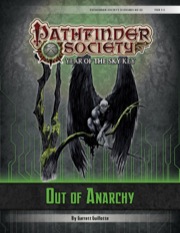
Ring Side Report- RPG Review of Pathfinder Society Scenario #6–22: Out of Anarchy

Product-Pathfinder Society Scenario #6–22: Out of Anarchy

System– Pathfinder

Producer– Paizo

Price– $ 4 here http://paizo.com/products/btpy9cu1?Pathfinder-Society-Scenario-6-22-Out-of-Anarchy

TL; DR– Too many ingredients spoil the soup! 78%

PZOPSS0622E_180

Basics-The society never leaves a man behind-they just might take five years to help him…and it might be someone’s pet project as well…. In this adventure, the Pathfinder Society sends in new recruits to find a long forgotten Pathfinder in a blockagged town in Cheliax.  There, the young Pathfinder have to navigate several different rival groups, find their target, and get him out…all while not starting the third burning of the city!  This adventure is designed for level first to fifth level characters.

Mechanics or Crunch-What’s here is good, but there is just too much here!  This adventure has some serious roleplaying opportunities (which is great) and some serious combats (there are over four!).  That is too much for a four-hour time slot!  Each part isn’t bad as the roleplaying characters get some time to shine and the combat monkeys can take center stage at different points, but in a four hour adventure slot at a con, this adventure simply is too long.  GMs will have to drop part to keep this one going fast enough to cover all the ground. 3.5/5


Theme or Fluff-So, not only is there a lot of mechanics, there is also a lot of story to cover as well.  It’s not bad, but it’s too much!  First is a missing Pathfinder.  Then,there are four factions to contend with.  Next is trying to get out and get help.  And lastly is dealing with other enemy groups in the city.  That is too much talking!  I love good roleplaying in a Pathfinder Society adventure, but with so much going on here, it’s hard to make all the pieces shine.  If you don’t ham up each group, then players don’t notice them.  If you do, then it takes too much precious time that you won’t have for the fights and talking to the different groups later.  It’s too difficult a balance to walk-especially for a 1-5 level, four-hour scenario. 4/5

Execution-Overall, this adventure has the Paizo polish.  Lot’s of pictures to help describe things, lot’s of included information to make running this easy, and a decent amount of breaks to make the text flow better.  However, the organization isn’t perfect.  This adventure is about 40 pages!  Some pages are copies of Bestiary books to help run the adventure, but I would like a few more breaks and a table or two detailing how different groups interact with the players at different locations.  Those little things would help speed up the pace of this adventure and possibly get it out close to the four-hour runtime. 4.25/5

Summary-If I had eight hours with a single table, this would be a great adventure to put them through.  They could really dig deep into the roleplaying, and the combat-crunch players would have an absolute blast as well by being able to paint the town red with their enemies.  But, this is written with the goal of four hours.  For that time limit, there is just too much here!  It’s written well enough, but will all the twists, turns, and fights, you CAN’T get this adventure done and be on time.  And any adventure I can’t run in a time slot at a con, written for a con, isn’t one I run a second time. 78%

Daily Punch 11-25-15 Armored Agility feat for DnD 5e

Let’s step up your armor game a bit!


Armored Agility

Unlike almost everyone else, you move better the heaver the armor gets.  All class and feat abilities that do not allow you to wear armor now function with  the next heaviest set (light, medium, then heavy armor) you are proficient with.  You may take this feat multiple times gaining the ability to use class and feat abilities with the  next set are armor you can wear.


Thoughts?

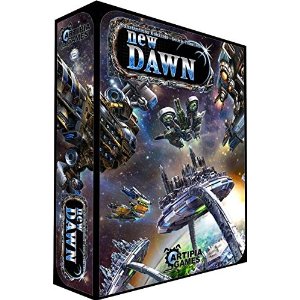
Ring Side Report-Board Game Review of New Dawn

Product-New Dawn

Producer-Stronghold Games

Price– $60 here http://www.amazon.com/Artipiagames-ARP01008-Dawn-Board-Game/dp/B00QHJCUE2/ref=sr_1_5?ie=UTF8&qid=1448827799&sr=8-5&keywords=New+Dawn

Set-up/Play/Clean-up– 90-120 minutes (2-4 players)

Type-American

Depth-Medium

TL; DR-Eclipse by way of Among the Stars. 90%
61zWzrR+b0L._SS300_

Basics-We’ve gone Among the Stars, Expanded the Alliance, sent Ambassadors, and now have a New Dawn for the galaxy.  In New Dawn, players take the roles of the same alien races from Among the Stars, but now have moved from the joint space station to exploring the galaxy for resources.  

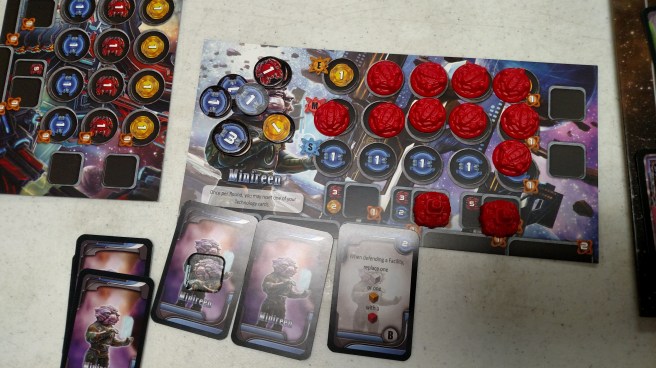
In terms of overall play, New Dawn plays a bit like Eclipse.  This game has three resources that players must spend to dominate the galaxy: economic, science, and military.  Each race/player starts with a player board with 15 bases in their color.  Each base covers up a resource of that type with the fifth base covering up a resource and a victory point.  Players choose one base to uncover and place on the central alliance start point.  Then, each turn goes as follows: 1) draw up to four tiles to explore 2) place one tile and get its placement bonus 3)buy a research card 4)Move one of your military headquarters to any space 5) take three actions in turn 6) Send aid to the alliance.  The tiles are the different sections of space to explore and are split between science, military, economic, and hostile (a mix of all three that is high risk/high reward).  Each tile has a placement bonus which ranges from getting resources, placing more tiles, or attacking a tile for free.  Research is interesting as each race has its own deck of cards that allows each player to customize how each race plays in each game and allows limited responses to other race’s/player’s actions.  Military headquarters are the main movement pieces of the game.  You start with one and use it to buy or conquer other tiles.  You never lose them, but you can buy more to give you extra power and points.  This all said, the main game itself is the actions.  Actions are as follows:  gain one resources of any type, buy a tile, seize a tile, use an ambassador, or buy a new military HQ and move all the HQs you have.  The resources are self explanatory, but the ambassadors are new.  Ambassadors are tokens that you place on any tile and then do the ambassadors action.  These actions are all written on the cards themselves, but are mostly better versions of the actions discussed above.  Of the actions you have, the two biggest and most important are the buy or seize a tile.  Buying a tile is simple.  Each tile has a cost in economic resources and a victory point cost.  You just pay the economic cost.  Seizing is more interesting and MUCH more random.  If a tile is is not controlled, you add the victory points and the cost and then roll dice according to where your Military HQ’s are.  For each military HQ’s on a tile you roll the yellow die (a d6 with numbers 2,3,4,5,5, and 6) and for each military HQ adjacent you can roll the white die (a d6 with numbers 1 through 6).  Some powers and abilities give you a green die (a d6 with numbers 0,1,1,2,2, and  3) or the RED AWESOME DIE (a d6 with numbers 3, 4, 5, 5, 6, and 6).  The attacking player must beat the defence, not tie.  If he/she wins, then that player places a base on the tile of the same type as the one from his/her player board.  Combat against a player works exactly the same way with a base on a tile giving you a yellow die in addition to all the Military HQ on or around the tile as above.  This can lead to some epic dice roll offs as player can also get rerolls and bonus dice from other powers as well.  If the defender loses, the he/she takes his/her base of the tile and covers up the right most resource on the player board and the winners get to place a base as before.  In addition, at the start of the game four random bonuses are placed around the board.  These bonuses range from extra defence, free movements of Military HQs, to rerolls and extra dice.  Each tile typically has some arrows on it.  When a tile is bought or seized, the player gets to change the direction in which it is facing, and the arrows the tile points to give a bonus to the owning player.  The last action of each turn is to send aid to the alliance.  This is buying victory point cards using the three different resources as printed on the card.  After five rounds, the points for bases, aid, uncovered resources, and purchased tech and military HQs are added up, and the player with the most has conquered the galaxy and provided the most aid to the alliance!
IMG_20151128_122814704

Mechanics-First thing first, let’s deal with the elephant in the room-Eclipse.  Eclipse is a great game, but not my favorite 4-X space game.  This game and Eclipse both have the multiple bases and resources concept, tech trees, exploration, and color-based dice combat.  And all of that is done a bit different but well by each game.  However, Eclipse goes about one turn too long.  This game is MUCH shorter, easier to recover from some early game problems, and actually provides much more player control.  AND, this game at it’s highest price is $60 while Eclipse still retails for about $100.  How New Dawn handles everything is fun, fair, and a great way to manage a galaxy.  It’s something that new gamers can handle, and older gamers will enjoy.  It’s not perfect as the randomness can honestly destroy your enjoyment of a game and combat is a bit more powerful than other strategies, but if you play American-style games, you know that pain all too well!  Don’t let those minor problems keep you from this game.  4.75/5

Theme-This game changed a few key things that I think hurt the game a bit.  The theme of the first game was alien races working against each other, but not on an overly aggressive scale as the war was fresh in their mind.  This game  is all about combat.  It will be extremely difficult to win the game without conquering a single base or engaging in combat.  It’s a massive departure from the first game.  The second is the race descriptions.  The first game Among the Stars is a pretty simple drafting and tile laying game, so the designers spent the second half of the rulebook describing the universe and the races within.  This game is a bit more complicated, so the rules need a bit more description.  But the races and world only get about a half pages description on the first page.  I really miss the world building of the first game.  The game itself is well done and you do feel like you’re conquering space and your friends’ bases.  But, I’m not sure that’s exactly what I wanted from the second game in this series. 4.25/5

IMG_20151128_122804520

Instructions-I mentioned in the theme section, the rulebook doesn’t have as much description as I would like, but overall the rules are well explained by the book.  There are a few problems that I think need a tiny bit more explanation like the arrows on location cards.  The rules tell you about the different cards placed on the board at the game start, but they don’t give you as deep a working description of that mechanic.  You will figure it out on your first play, but it’s a slight problem.  If you can apply your best logic to the game, you will do fine with the rules in the box.   4.5/5

Execution– This game doesn’t come with a ton in the box, but what’s there is done reasonably well.  To see all the pieces in the box, see my unboxing video here: https://youtu.be/EnMeLhB9Ods  The board is two sided with a simple and complex game, which is a nice added layer of gameplay and replay-ability.  The tiles all look like the same tiles from Among the Stars which is a nice call back to the first game.  I even like the new plastic tokens in the game.  What I don’t like is that the gameboard isn’t big enough.  There are spots for some tiles but not others.  I’d like one more row on all the sides to give enough places to place all the parts that game has.  Also, I’d like the box to be a little thicker cardboard.  Stronghold Games typically makes their game boxes of a lighter material which is nice when I carry five of them to a con to demo them, but the boxes don’t stand up to too much punishment.  These are minor quibbles, but there are things to consider.  Overall, it’s a beautiful game that has some good parts to it. 4.5/5

Summary-This might not be my favorite 4x game, but it’s quickly made a spot in the top few of them.  It’s got all the things I love in a game: strategy, depth, speed, and ease of learning/teaching.  I’d like a bit more story and cardboard, but that isn’t any reason to not pick this one up.  If you like Sci-FI games, 4x games, or simply want a good game to play at any gameday that won’t eat the whole day, then this is an excellent game to buy.  I can’t wait to play this again and to see the expansion that will come and further develop the ideas that came out of this game.  90%

Daily Punch 11-24-15 Full Body Swing feat for DnD 5e

Let’s keep building on the idea of con as a weapon!


Full Body Swing

Some people use their whole body when they swing.  Those with a fuller body get more of a swing!  Gain the following benefits:

  • Add your Constitution modifier to any melee weapon damage.
  • You may use your Constitution modifier in place of your Strength modifier when making a melee weapon attack roll.
  • Add 1 to your Constitution stat, to a maximum of 20.


Thoughts?

Daily Punch 11-23-15 Full Body Defense feat for DnD 5e

Funny thing, gladiators were not thin, trim guys.  They were surprisingly fat.  A guy with a gut can take a knife, spray a bit of blood to wow the crowds, and not get his abdominal wall punctured and the accompanying death sentence that goes with that.  Let’s build that into DnD 5e!

Full Body Defense

You’re big, but not exactly tall for the build.  You’re built hard enough to take the hits and not exactly care.  Gain the fallowing benefits:

  • When you are wearing no or light armor, add your constitution modifier to your armor class.
  • Add your constitution modifier again to your hit point total for each level you gained before you got this feat and for each level after.

Thoughts?

Daily Punch 10-01-15 Rogue AI positive quality for Shadowrun 5e

I recently finished reading Data Trails.  In it, the book mentions how some people tame AIs to work for them.  I think a technomancer should be able to do that.  Let’s make that happen!

Rogue AI Sprite

Cost: 10 karma

Requirement: technomancer

You play with digital fire.  You’ve found where the wild thing are on the net, and you’ve joined their wild rumpus…. and you came back unscathed.  Now, you know where the digital monsters live, and you’ve learned how to make friends with some of the most feral creatures this side of a keyboard.  When you create a sprite, you can instead tame a rogue AI.  The AI can not be registered, but can be compiled as normal with all thresholds for compiling the sprite being chosen at generation except that sprite will take twice as long to compile as you have to actively find the type of AI you want and generate a working relationship.  The type of the AI is exactly the same as the type of sprite you would have generated except the level is one higher than the type you would have registered due to the AI’s more impressive nature.  You may continue to do this process, but if you intentionally mistreat your AI sprites, eventually the AIs will not answer you digital summons.

Thoughts?

Daily Punch 9-16-15 Fell Blade magic item for DnD 5

Fell Blade

+1 , +2 , OR +3 slashing or piercing weapon, rare (+1), very rare (+2), or legendary(+3)

Only the most vile of masters can continue to use these blades.  This blade exudes a corrupting influence  upon your soul, forcing you over time to become more and more violent and sadistic.  In addition to the bonus to attack and damage the blade gives you, the blade does an extra 1d6, 2d6, or 3d6 damage, based on the item’s rarity, to any target hit by this weapon.  This extra damage also reduces the target’s total hit points by the amount equal to the extra d6 damage, and this damage cannot be healed by normal or magical means.  This damage may stack, reducing the target’s total hit points several times.  The reduced hit points can only be healed by a magic healing spell, and the caster must make a DC 15, 16, or 17 Charisma saving throw as part of the spell or the attempt fails and the spell is lost.  The reduced hit point total is healed last, and any magic healing cast on the target fails unless the caster succeeds at the Charisma saving throw.  Any character with a reduced hit point total can heal normaly, but will still have a reduced total hit points from the weapon.

Thoughts?

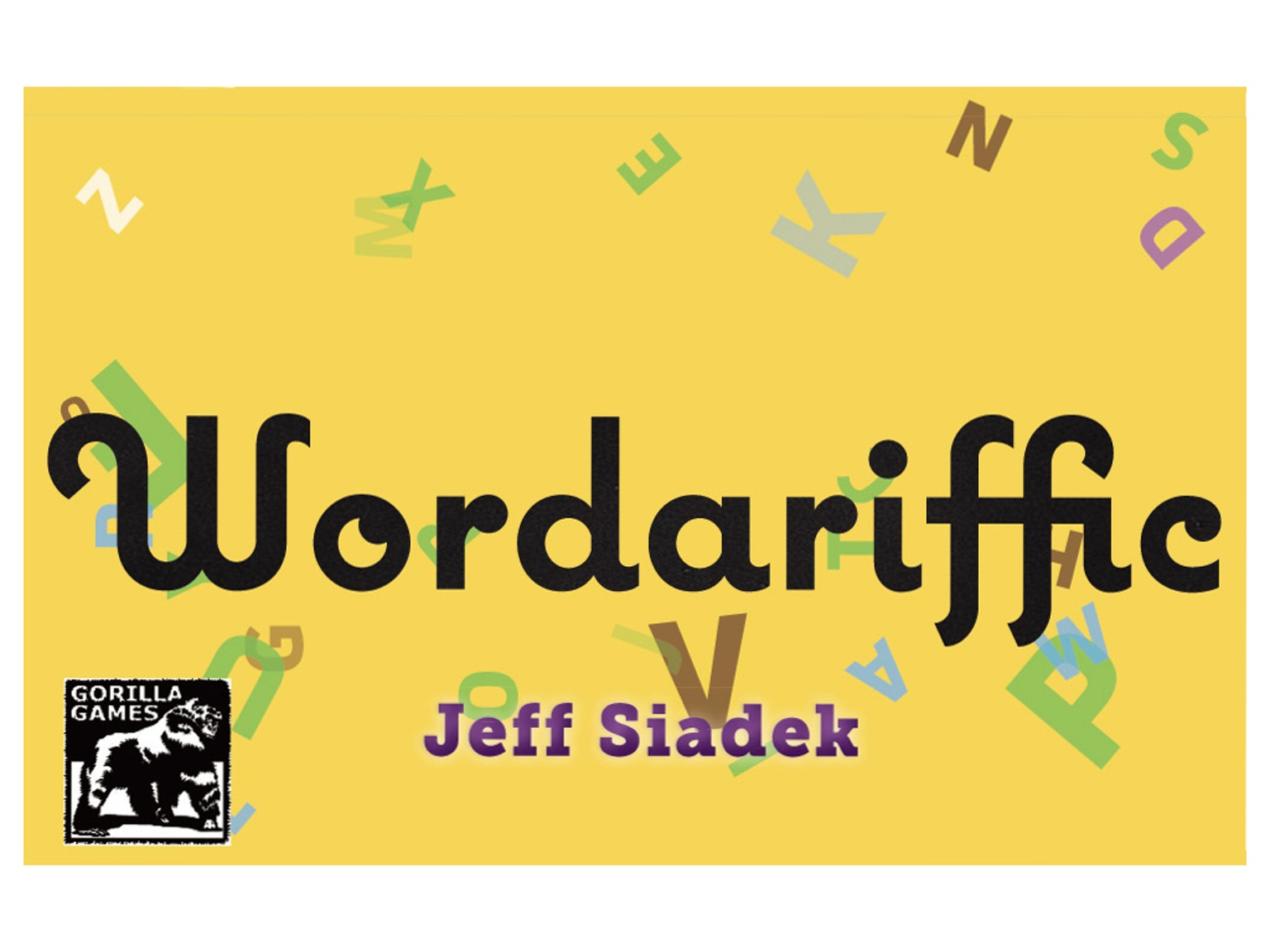
Ring Side Report-Board Game Review of Wordariffic

Product-Wordariffic

Producer-Gorilla Games

Price– $ 15 but not available yet SOON!  http://gorillaboardgames.com/our-games/wordariffic-the-partyword-game/

Set-up/Play/Clean-up– 20 minutes (3-9 players)

Type-American

Depth-Light

TL; DR-Boggle and Cards Against Humanity’s baby. 98%

photo-original

Basics-Do you find Scrabble too easy?  Do you want a party game that has the challenge of a word game and the fun of Cards against humanity?  Then, try Wordariffic.  This is an amazingly simple game that combines the two beautifully.  Players start with 10 cards.  Each of these cards have a letter in the corner and a list of 10 words.  Then, one player will flip a card from the draw deck face up and roll a 10-sided die.  The flipped card’s word that the 10-sided die rolled is the word of the round.  Next, players scramble to create a word that best describes the word of the round using the different cards from their hand of cards.  When each player finishes, they yell “WORD!” to show they are done.  Last player to do that is the judge for the round and is ineligible to win.  A player can also simple opt out and just discard cards to get new cards instead of trying to win that round.  The player with the longest word is awarded one chip, and the judge will award three chips to the best created word describing the round word.  Players discard the cards they used for the round, draw back up to 10 cards, and play continues until the pile of chips rounds out.  Player with the most chips wins!

Mechanics-I’m not a word nerd, but with this game, you don’t have to be.  Words can’t be longer than 10 letters, and for most words and rounds, the winner only spelt a four letter word.  That levels the playing field in a big way.  Also, the overall mechanics are simple enough that your average fourth grader could easily play this game, making this a surprisingly educational game.  Randomness and luck will determine the day, and just like Cards Against Humanity, the judge’s opinion might sway the vote far more than the word you put down.  But, this is a party game that plays in 20 minutes, so even a game that goes badly doesn’t necessarily mean a game that won’t be fun. 4.75/5

Theme-This is a party game, so it doesn’t really aim for a theme.-/5

Instructions– The rules are a page, not even a two-sided page.  What I described above is about as much as you need to know.  It’s easy to read, quick to understand, and fast to play. 5/5

Execution-I made an unboxing video of the parts here https://youtu.be/r1DCS1LvMPA.  Overall, it’s top notch.  What you get in the box is amazing.  The cards are good quality.  The chips and dice and nice, and everything fits back in after you open the box and components.  Also, THE GAME COMES WITH A BAG FOR THE CHIPS!  I can’t stress enough how much that makes me happy to see the components have a bag to put it away quickly.  5/5

Summary-I love this game, but a good chunk of you won’t.  Not because it’s a bad game, but because it’s a word and party game.  If you love Scrabble, want a party version for a ton of players, and the silliness of Cards Against Humanity, then this is the game you need to get.  If you don’t like Scrabble, Boggle, or especially Cards Against Humanity, then you will loathe this game.  For me, this is a great game.  I’m not a word nerd ( I love books, but I’m not an English PhD), but this is short enough for me to enjoy what’s here, and not long enough to overstay its welcome.  It’s a great addition to any party game line up.  98%

Ring Side Report- RPG Review of Shadow of the Demon Lord

Product– Shadow of the Demon Lord

System– Shadow of the Demon Lord

Producer– Schwalb Entertainment

Price– $19.99 here http://www.drivethrurpg.com/product/155572/Shadow-of-the-Demon-Lord

TL; DR– 13th Age, DnD 4e, and Warhammer in a blender! 92%

155572

Basics-The world is in chaos, and the Demon Lord hasn’t even set foot into it yet.  Shadow of the Demon Lord is the first book by Schwalb Entertainment where characters face a world on the brink.  The empire is falling, and a transdimensional evil stirs.  As it casts its attention onto the world, its shadow falls on the world causing nature to go haywire, the dead to rise, or evil to open gates from other places.  Players fight to keep the world safe.  Will you be able to stop an unstoppable evil?

Mechanics or Crunch– This is its own system, so let’s break this down piece by piece.

Basics-This game plays like a modified d20 system with bits of DnD 4e and Fantasy Flight’s Warhammer Fantasy mixed in.  Almost all actions are resolved with d20 rolls.  Characters have several stats, and the modifier for all these stats is the base stat minus 10.  Whatever the result is the modifier to the d20 roll.  For 90% of the rolls in this game that are not attacks, the characters need a 10 result to succeed at their check; This is called a challenge roll.  That’s it-it’s simple and elegant.  Aside from the basics of a roll, sometimes outside circumstances modify challenge rolls.  These are boons and banes.  In these circumstances, six-sided dice are added (boons) or subtracted (banes) from the roll.  You only ever roll boons or banes as a boon cancels out a bane and vice versa.  These are given for attacking into darkness, having favorable positions, powers, good tools on a disable check, or other in-game effects.  If you have to roll several boon or bane dice, you only ever add or subtract the highest six-sided die total among all the boons/banes.  Again, it makes math simple and elegant.  As you can tell, this is not a math heavy game.  That’s not a bad comment as the game focuses that much more on the story and quick  action resolution.

Skills-This game doesn’t have skills per se- it has professions.  Professions feel like a love letter to the OSR movement.  During character creation, players get two professions.  This is what you did before you became an adventurer, and this will determine some of the activities you can do.  Navigate by starlight alone?  That would be impossible for a cobbler, but it would be an automatic success for a sailor or a desert nomad.  Discover what a potion does?  Possibly a roll with boons for a doctor, but almost impossible (several bane dice) for a grave digger.  Again, being able to use professions as skills is simple and effective.

Combat-Combat is as simple as d20 and 13th Age.  The game doesn’t have the movement-map requirements of Pathfinder, relying more on theater of the mind.  Initiative…just isn’t a thing in this game.  Turns are divided into fast and slow parts.  Players get to take fast turns, then the monsters.  Next, players get to take slow turns then the monsters.  Fast turns are when a creature takes one action such as moving or attacking.  Slow turns are moving, attacking, and possibly other actions all on the same turn.  This game wants players to go first, then monsters. It built this mindset into the system, and it works well.  On a creature’s turn, combat works almost like any other d20 system.  Melee attacks work using the basic d20 plus a creature’s strength stat minus 10 vs. a creature’s defense stat.  Creatures can take banes to this roll to push enemies, escape an engagement, or even knock enemies prone.  Damage for each weapon is determined by the type of weapon wielded, just like most other d20 based systems.  Creatures and players do not have high hit point totals in this game, so combat can be pretty deadly pretty quickly, reinforcing the gritty nature of this game.  In addition to fast and slow turns, you also have triggered actions; these function pretty much like reactions in DnD 5e and interrupt actions in Pathfinder.  They are actions you take off-turn that are the result of other creatures’ actions such as attack of opportunity or spell effects.  Again, quick and easy is the name of the game in this system.

Distance-This is a decidedly old school game with some modern twists.  The game can use maps, but mostly theater of the mind is its goal.  Distance between characters reflects that.  Distances have descriptors like reach (at hand), short ( five yards), medium (20 yards), long (100 yards), and extreme (500 yards).  On your turn as a move, you can move double your speed stat in yards.  On a slow turn, you can do that twice.  Some creatures move fast while some move slow, and it’s just that easy.

Character generation and advancement- Character generation is a bit limiting compared to other systems like Pathfinder and Shadowrun, but on par with DnD5e or Fantasy Age.  Players choose a race and receive some preset stats.  Then, that character gets to modify their stats a little based on what their specific race provides them.  That feels limited, but it also makes all the creatures of one race in the world feel like their stats represent them, as opposed to the normal +2 all creatures of one type received in standard DnD/Pathfinder, where most human fighters have a 16+ strength compared to the majority of humanity with a 10 strength.  As part of creating your character, you also get to either choose or randomly roll a bunch of background information ranging from what you did before to your physical build.  Depending on your race, some of these backgrounds will increase various stats.  Much like Dungeon Crawl Classics, you start at level 0, and try to survive to level 1 through a short adventure.  If you do, you get to choose one of four basic classes called novice paths.  The paths are warrior, rogue, priest, and magician, and they function exactly as you’d expect, with these paths focusing on sheer damage and combat prowess, skills, divine magic, or arcane magic, respectively.  This choice will change how you level up over time.  Leveling in this game is determined on your class at some levels, your race at others, and then you are allowed choices to specialize further in an expert path at level 3 and a master path at level 7.  Expert and master paths function almost like paragon paths in DnD3.5/Pathfinder or class specialization in DnD 5e.  Depending on your style, this type of leveling will either infuriate you or be your favorite method.  Players get lots of options on what type of path to choose at each step, but once you are in your path, you don’t get as many options after that compared to, say, Pathfinder.  This game doesn’t have feats or other minor character choices, so character paths and magic spells are the majority of the choices a character makes.  However, what the novice, expert, and paragon paths offer that is not found in other games is the ability to really forge your own character.  You do get fewer options in a path, but the paths tend to allow any character at any time to really design their own character.  Want a warrior (novice path), druid (expert path), bard (master path)?  Done!  I’m not saying that character would be the most powerful or efficient character out there, but I am saying that that character might be the most fun to play.  And that kind of character design is amazing.

Magic-Magic is gained by learning traditions through path options. As a character grows in a class, he or she also gains traditions or spells and power.  A character’s power rating determines the number of spells and the level of spells a character can prepare each day.  Traditions can be thought of as almost sub-schools of magic with traditions ranging from curse to air and everything in between.  Each tradition has several different spells of different levels in it.  Magic itself follows a pattern similar to DnD 4e with spells divided into either attack or utility spells.  Attack spells have a character make an attack roll against the enemie’s defense or base stat, or the attack spell has the target make a stat challenge roll.  As an added bit of fun, some magic attacks also have an extra effect that occurs if you roll above a 20 on the attack.  These effects do extra damage, push the target further, or some other effect that shows that you are truly a master magician.  Much like the challenge roll systems and banes/boons, magic is extremely elegant and simple.  So unlike magic in a few other systems, magic is very approachable and easily mastered in a few moments.

Summary-Shadow of the Demon Lord presents a new RPG system.  It’s simple and easy to run and play.  The game is built to run efficiently and focus on the story.  One of the things trimmed out of the game is power gaming and too long between leveling.  That is done extremely well.  However as part of that clean up, the game loses many of the options present in other RPGs.  That is not a bad thing, but it’s something that you as a player and a GM must adjust your expectations for.  You will have a blast with the system, but you will run character from level 0 to level 10 in under a year instead of 20 years.  You will also have to get ready for some brutal gameplay and some limitations in character options.  If you and your group can adjust to these changes, you will have an absolute blast. 4.75/5

Theme or Fluff-This game runs like a combination of DnD, Lovecraft, Clive Barker, and Warhammer Fantasy.  Robert Schwalb is a sick, twisted man, and you will enjoy every minute of it.  The world of Shadow of the Demon Lord is already messed up before the Demon Lord casts his influence on it.  You have a world full of monsters, craziness, and feuds long before the horrors from out of time and space show up to the party.  The world is extremely well written, and built in such as way that expanding it will be easy while still giving you enough places to play and build on your own.  Well done!  HOWEVER, this is not a family-friendly game (unless you’re in the Manson family.)  The book itself has graphic depictions of violence and monsters.  Judge if this game would be appropriate for your group and yourself.  As someone with a steady diet of Lovecraft, King, and the entire Aliens vs. Predator franchises, I only wanted more.  5/5

Execution-RPGs generally come in two flavors when it comes to organization: world first or mechanics first.  This book goes mechanics first, but the mechanics are a bit disorganized.  You can get a good understanding of the game from these rules, but you will have to read things a few times.  Also, there are some slight organization problems.  Character races are introduced, then base mechanics, followed by novice paths and so on.  It breaks up the flow and makes you have to move around the book a few times in order to build a character.  It’s nothing game-ending, but it’s a minor problem.  However, the book does have a decent flow overall, a good layout, and reads well.  It doesn’t have many blocks of text that bore the reader.  This might not be the best organized book I’ve ever read, but it is at least better than average.  And, unlike some companies I could name, this book has an index!  The only thing this book doesn’t have that I feel it really should is an example adventure.  Shadow of the Demon Lord is its own system.  I love the system and world, but as a first time GM for the game, I would like to see how Schwalb would like me to run it from his book.  That omissions hurts the system a bit as I don’t have an example to base my own ideas off of.  As a kickstarter backer, I get an adventure, but I’d like that thrown into the book to really help all the new players to this system.  4/5

Summary-This is a great game that is full of absolute horror.  It’s got phenomenal, simple mechanics that allow players to focus on the story.  The story itself is an absolute disaster in the best way possible.  Every element of the world is well crafted and points to a world on the brink with the demon lord being the tipping point to drive things even further toward chaos.  My only complaints are a possible feeling of lack of character options as well as the organization of the book.  These complaints are minor as they don’t really hurt the game.  Once you know how to play, how a book is organized is only a trivial thing.  It’s a great game that I can’t wait to play more of.  It’s a love letter to all the things I treasure-simple game mechanics I enjoy and horror authors who keep me up late at night under the covers. 92%